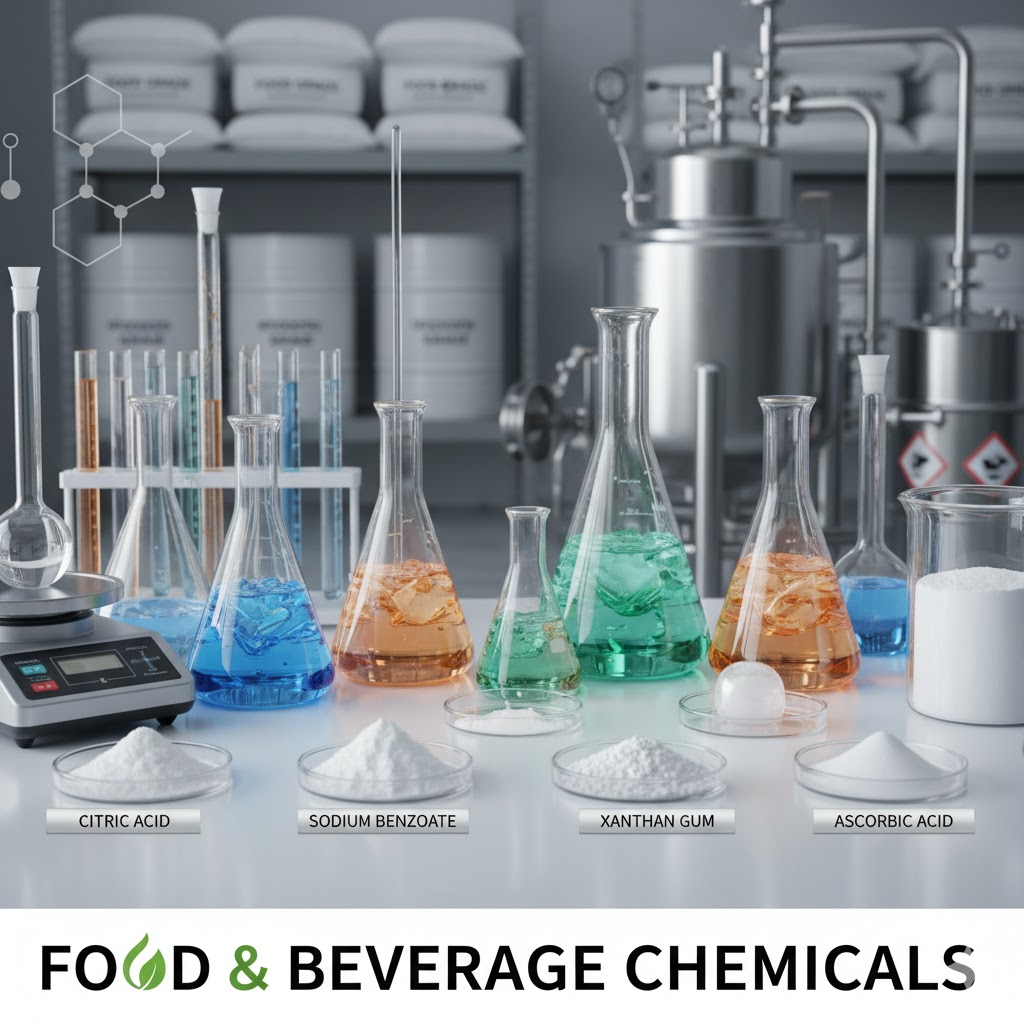
The global Food and Beverage Chemicals Market is on a strong growth trajectory, projected to increase from USD 83.5 billion in 2025 to USD 133.4 billion by 2035, expanding at a compound annual growth rate (CAGR) of 4.8%. The growth is fueled by rising demand for processed and packaged food, rapid urbanization, evolving consumer preferences, and continued innovation by both established and emerging chemical manufacturers.
Quick Market Overview
- Food and Beverage Chemicals Market Value (2025): USD 83.5 billion
- Forecast Value (2035): USD 133.4 billion
- Forecast CAGR (2025–2035): 4.8%
- Leading Segment (2025): Anticaking Agents (20.3%)
- Top Growth Regions: North America, Asia-Pacific, and Europe
- Key Players: Cargill, Incorporated; Archer Daniels Midland Company; BASF SE; DuPont de Nemours, Inc.; Kerry Group plc; Tate & Lyle PLC; Ingredion Incorporated; Givaudan SA; International Flavors & Fragrances Inc.; Corbion N.V.; Royal DSM N.V.; Firmenich SA; Symrise AG
Why the Food and Beverage Chemicals Market Is Growing
The food and beverage industry is transforming rapidly as consumers demand products that are convenient, flavorful, and safe, yet free from harmful substances. This has led to an increasing reliance on functional food and beverage chemicals that help enhance flavor, texture, and shelf life while maintaining nutritional integrity.
The growing global appetite for ready-to-eat meals, instant beverages, and packaged snacks is driving chemical innovation. Manufacturers are formulating clean-label, sustainable, and regulatory-compliant additives that meet evolving safety standards and environmental expectations.
Additionally, the rise in food safety regulations, combined with the shift toward eco-friendly chemical production, has opened doors for emerging manufacturers and technology-driven startups to collaborate with established industry leaders.
Together, these developments are positioning the food and beverage chemicals market as a vital contributor to global food security and quality assurance.
Key Market Drivers
- Rising Processed Food Demand: Increasing urbanization and busy lifestyles have boosted consumption of packaged and convenience foods.
- Technological Advancements: Modern processing techniques and digital manufacturing systems are improving the efficiency and consistency of food-grade chemicals.
- Health & Safety Awareness: Consumers are favoring clean-label products, driving demand for safer, natural-based additives.
- Sustainability Initiatives: Companies are investing in bio-based chemicals and renewable production methods to align with ESG goals.
- Regulatory Compliance: Global food safety authorities encourage the adoption of certified, traceable chemicals to ensure consumer safety.
Segmental Insights: Anticaking Agents Lead the Way
- Among the various application segments—such as anticaking agents, emulsifiers, preservatives, sweeteners, flavor enhancers, and glazing agents—the anticaking agent segment dominates, accounting for 20.3% of total market revenue in 2025.
- Anticaking agents are critical in powdered foods, spices, milk powders, and beverage mixes, ensuring smooth texture, stability, and flowability during packaging and distribution. Their use enhances shelf life and production efficiency, reducing operational costs for manufacturers.
- As global consumption of instant mixes and convenience foods continues to rise, demand for improved anticaking formulations is expected to grow. Manufacturers like Tate & Lyle, Ingredion, and BASF SE are developing next-generation, food-safe anticaking compounds designed to maintain quality without compromising health standards.
Regional Outlook: Asia-Pacific and North America Take the Lead
- The Asia-Pacific region—particularly China and India—is set to experience the highest growth, with forecast CAGRs of 6.5% and 6.0%, respectively. This growth stems from expanding urban populations, the surge in quick-service restaurants, and increasing adoption of western-style processed foods.
- Meanwhile, North America continues to dominate the global market, supported by well-established food and beverage industries in the United States, where the market is estimated to grow from USD 31.6 billion in 2025 to USD 47.2 billion by 2035 at a CAGR of 4.1%.
- In Europe, countries such as Germany (5.5% CAGR), France (5.0%), and the UK (4.6%) show steady growth driven by strong R&D investments, stringent safety standards, and the increasing demand for plant-based and fortified foods.
- Emerging markets in Latin America, Africa, and the Middle East are also expanding rapidly, fueled by growing manufacturing capabilities and local processing facilities.
Innovation and Emerging Players Transforming the Market
While established giants like Cargill, ADM, and DuPont dominate with vast production capacities and global distribution networks, new entrants and regional manufacturers are increasingly focusing on specialized and sustainable solutions.
Startups and mid-tier players are introducing bio-based preservatives, natural sweeteners, and plant-derived emulsifiers to cater to the growing clean-label trend. Strategic collaborations between ingredient innovators and food manufacturers are enabling rapid technological adoption.
For example:
- Kerry Group and Givaudan are investing in flavor systems that balance taste enhancement with nutritional benefits.
- Corbion and Royal DSM are pioneering fermentation-based ingredients that replace synthetic additives.
- Symrise AG and Firmenich SA are advancing sustainable aromatic compounds that reduce the environmental footprint of food processing.
Such partnerships highlight how both legacy corporations and new ventures are shaping the future of food chemistry through digitalization, green chemistry, and circular economy principles.
Market Challenges and Opportunities
While the market outlook is optimistic, challenges persist in the form of regulatory complexities, raw material cost volatility, and public perception of chemical additives. However, these challenges are creating opportunities for transparency, traceability, and innovation.
Companies adopting AI-driven quality control, biodegradable chemical solutions, and renewable feedstocks are well-positioned to thrive in this evolving landscape.
Key Takeaways
- The global Food and Beverage Chemicals Market is expected to grow at a CAGR of 4.8%, reaching USD 133.4 billion by 2035.
- Anticaking agents dominate the market with a 20.3% share in 2025.
- Asia-Pacific leads in growth, while North America maintains market dominance.
- Leading players include Cargill, ADM, BASF, DuPont, Kerry Group, and Tate & Lyle, alongside emerging innovators driving sustainability.
- The market’s future hinges on clean-label innovation, sustainable chemistry, and global regulatory compliance.
This Report Now at Just $5000 | Limited-Time Discount Offer! https://www.futuremarketinsights.com/reports/sample/rep-gb-2738
Checkout Now to Access Industry Insights: https://www.futuremarketinsights.com/checkout/2738
About Future Market Insights (FMI)
Future Market Insights, Inc. (ESOMAR certified, recipient of the Stevie Award, and a member of the Greater New York Chamber of Commerce) offers profound insights into the driving factors that are boosting demand in the market. FMI stands as the leading global provider of market intelligence, advisory services, consulting, and events for the Packaging, Food and Beverage, Consumer Technology, Healthcare, Industrial, and Chemicals markets. With a vast team of over 400 analysts worldwide, FMI provides global, regional, and local expertise on diverse domains and industry trends across more than 110 countries.
Contact Us:
Future Market Insights Inc.
Christiana Corporate, 200 Continental Drive,
Suite 401, Newark, Delaware – 19713, USA
T: +1-347-918-3531
For Sales Enquiries: sales@futuremarketinsights.com
Website: https://www.futuremarketinsights.com
LinkedIn| Twitter| Blogs | YouTube