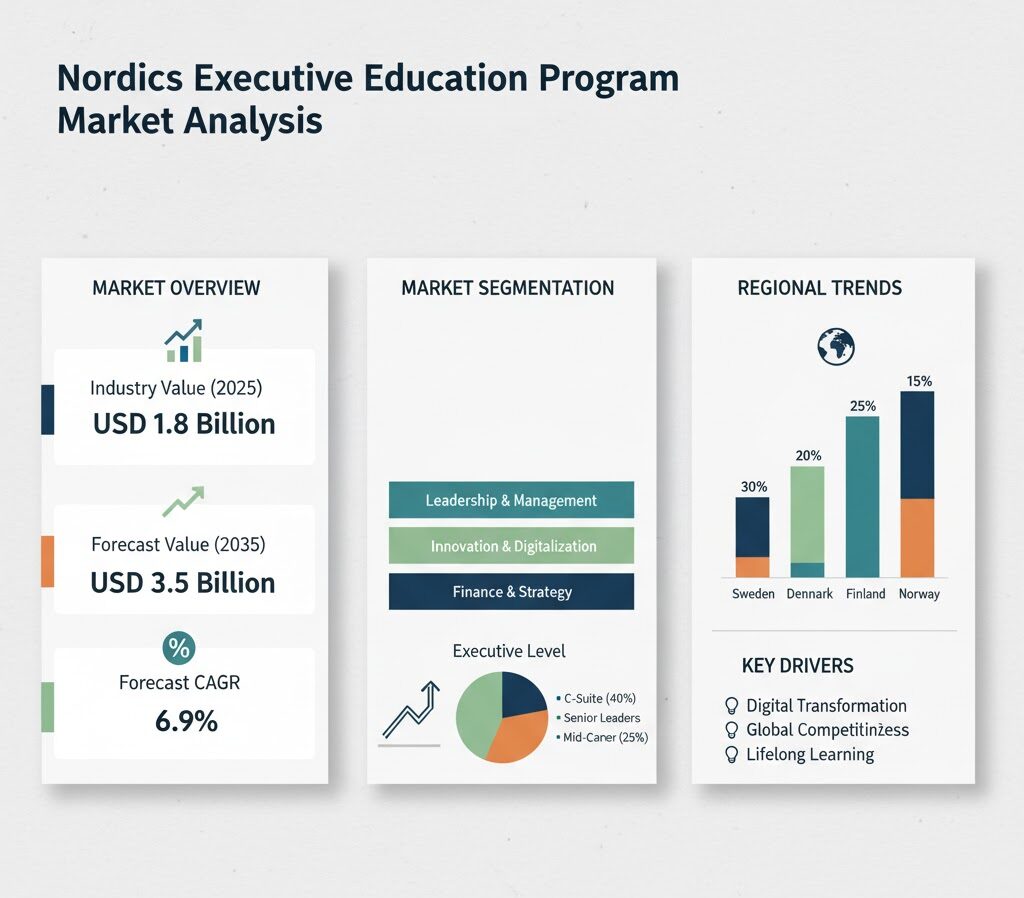
The Nordics Executive Education Program Market is poised for significant growth, estimated at USD 1.8 billion in 2025 and projected to reach USD 3.5 billion by 2035, registering a steady CAGR of 6.9% during the forecast period. The market’s expansion is driven by the region’s strong focus on leadership development, digital transformation, and lifelong learning. The educational institutes segment is expected to lead with a 42.7% share in 2025, supported by renowned institutions such as Aalto University Executive Education, Hanken School of Economics, Copenhagen Business School, BI Norwegian Business School, and Lund University, among others.
Market Overview
The Nordics Executive Education Program Market is entering a transformative decade marked by digital learning, leadership innovation, and sustainability-driven growth. Valued at USD 1.8 billion in 2025, the market is projected to reach USD 3.5 billion by 2035, expanding at a steady CAGR of 6.9%.
This growth is fueled by a strong Nordic culture of lifelong learning, rising corporate training budgets, and the region’s focus on leadership excellence. Organizations are increasingly investing in digital transformation, emotional intelligence, and behavioral leadership programs to enhance strategic decision-making and global competitiveness.
As universities and private institutions integrate hybrid and AI-driven models, executive education is becoming more accessible to busy professionals across Denmark, Sweden, Finland, Norway, and Iceland.
Quick Stats for the Nordics Executive Education Program Market
- Market Size (2025): USD 1.8 billion
- Market Forecast (2035): USD 3.5 billion
- Forecast CAGR (2025–2035): 6.9%
- Top Segment (2025): Educational Institutes – 42.7% share
- Key Growth Markets: Denmark, Sweden, Norway, Finland, Iceland
- Top Institutions: Aalto University, Copenhagen Business School, BI Norwegian Business School, Hanken School of Economics, Lund University
Key Market Drivers
- Demand for Digital Transformation Skills:
Executives seek specialized programs integrating AI, data analytics, and innovation management. - Rise in Hybrid and Flexible Learning:
Blended, modular, and online formats are reshaping accessibility for mid-career professionals. - Sustainability and ESG Focus:
Nordic institutions emphasize green leadership, circular economy, and ethical governance. - Corporate Investment in Talent:
Companies across the Nordics are expanding leadership training budgets to build adaptive, future-ready teams. - Global Partnerships and Technology Integration:
Collaboration between universities and tech companies enhances practical learning through AI, VR, and gamification.
Segmental Insights
- Educational Institutes – 42.7% Market Share (2025)
Educational institutes remain the backbone of executive education in the Nordics. Their credibility, international faculty, and globally accredited programs make them the preferred choice among senior leaders.
- Universities like Aalto, Copenhagen Business School, and BI Norwegian lead the charge in hybrid program design and executive certifications.
- Strategic partnerships with corporates and government agencies have boosted participation rates and diversified curricula.
- Personal Counselling, Social & Behavioral Leadership Courses – 38.6% Share (2025)
Growing awareness of emotional intelligence, inclusive leadership, and behavioral adaptability fuels this segment.
- These programs integrate coaching, psychology, and real-world problem-solving to help executives navigate complex environments.
- As organizations prioritize soft skills and human-centric leadership, this segment will continue to expand steadily.
- Short-Term Programs (Less than 1 Week) – 55.2% Share (2025)
Time-efficient learning remains critical for Nordic executives.
- Intensive boot camps and short modular programs deliver high-impact learning outcomes in compressed timelines.
- Digital tools and blended learning ensure flexibility and continuity without disrupting professional commitments.
Regional Growth Outlook (2025–2035)
| Country | CAGR (2025–2035) | Key Growth Drivers |
| Sweden | 7.3% | Digital readiness, innovation-led programs, AI-driven learning |
| Denmark | 7.1% | Sustainability and ESG integration, hybrid learning adoption |
| Norway | 6.8% | Energy transition leadership, modular credentials |
| Finland | 6.5% | AI and innovation leadership, public-private partnerships |
| Iceland | 5.9% | Tourism, renewable energy, and creative industry leadership |
Trends and Shifts (2024–2035)
2024–2025:
- Focused on hybrid learning and leadership transformation.
- Rising corporate investments in customized programs.
2025–2035:
- AI, VR, and gamified learning will dominate future executive education models.
- Immersive, personalized learning experiences will replace traditional classroom approaches.
- Sustainability, inclusion, and ethical leadership will become central to curriculum design.
Key Developments by Leading Institutions
- Aalto University Executive Education: Launching AI-powered sustainability courses in collaboration with Finland’s tech industry.
- Copenhagen Business School Executive Education: Expanding its ESG-driven leadership programs to meet growing demand from multinational corporations.
- BI Norwegian Business School: Investing in advanced online platforms for blended, experiential learning.
- Hanken School of Economics Executive Education: Introducing diversity-centered executive development and ethical leadership modules.
- Lund University: Strengthening ties with startup ecosystems through innovation leadership labs.
Emerging Opportunities for New Market Entrants
The Nordics executive education ecosystem is ripe for new manufacturers, digital learning providers, and consultancies aiming to expand through:
- Technology Integration: AI-driven analytics, VR learning simulations, and adaptive e-learning systems.
- Corporate Partnerships: Co-branded leadership development programs with industry giants.
- Micro-Credentials & Stackable Learning: Targeted short courses offering modular certifications.
- Sustainability & Governance Education: High growth potential in ESG and climate-risk leadership programs.
Market Segmentation Snapshot
By Type:
- Educational Institutes
- B-Schools
- Management Consultancies
- Industrial Training Institutions
- Personality Development Institutes
- Employment Consultancies
- Industry Associations
By Course Category:
- Leadership & Behavioral Training
- Organizational Leadership
- Data Analytics & Technology
- Finance & Accounting
- HR & Talent Management
- Corporate Governance
- Entrepreneurship / Self-Employment
- Supply Chain, E-Commerce & Legal Assistance
By Duration:
- Less than 1 Week
- 1 Week to 1 Month
- More than 1 Month
By Mode of Delivery:
- Classroom
- Virtual
- Live Online
- Pre-Recorded
- Blended Learning
This Report Now at Just $2000 | Limited-Time Discount Offer! https://www.futuremarketinsights.com/reports/sample/rep-gb-17517
Checkout Now to Access Industry Insights: https://www.futuremarketinsights.com/checkout/17517
About Future Market Insights (FMI)
Future Market Insights, Inc. (ESOMAR certified, recipient of the Stevie Award, and a member of the Greater New York Chamber of Commerce) offers profound insights into the driving factors that are boosting demand in the market. FMI stands as the leading global provider of market intelligence, advisory services, consulting, and events for the Packaging, Food and Beverage, Consumer Technology, Healthcare, Industrial, and Chemicals markets. With a vast team of over 400 analysts worldwide, FMI provides global, regional, and local expertise on diverse domains and industry trends across more than 110 countries.
Contact Us:
Future Market Insights Inc.
Christiana Corporate, 200 Continental Drive,
Suite 401, Newark, Delaware – 19713, USA
T: +1-347-918-3531
For Sales Enquiries: sales@futuremarketinsights.com
Website: https://www.futuremarketinsights.com
LinkedIn| Twitter| Blogs | YouTube