The global urethane concrete sealer market is entering a new phase of growth and transformation, with its value estimated at USD 525.0 million in 2025 and projected to reach USD 855.2 million by 2035. This represents a healthy compound annual growth rate (CAGR) of 5.0% over the forecast period. The expansion is being driven by the rising need for high-performance, long-lasting concrete protection solutions across residential, commercial, and industrial sectors.
As urbanization accelerates and infrastructure modernization gains momentum, urethane-based sealers are becoming the preferred choice among architects, contractors, and homeowners. These products provide superior resistance to abrasion, UV damage, and chemical exposure, making them an essential part of modern surface protection systems.
Drivers Behind the Expanding Urethane Concrete Sealer Market
The growth trajectory of the urethane concrete sealer market is underpinned by a combination of technological advancement, rising sustainability standards, and increased construction activity. Across developed and emerging economies, the demand for durable concrete sealers is surging as property owners and developers prioritize longevity and aesthetic appeal in their structures.
Compared to traditional sealing materials, urethane sealers deliver enhanced flexibility and surface protection, significantly reducing long-term maintenance costs. Their ability to create impermeable coatings that prevent moisture ingress and resist weathering is particularly valued in regions with extreme climatic conditions.
Moreover, evolving environmental regulations have prompted manufacturers to innovate with low-VOC and eco-friendly formulations. This aligns with the global shift toward sustainable construction practices. As a result, established companies like Dow Chemical Company, BASF SE, and Flowcrete Group are focusing on greener solutions without compromising durability or performance. Simultaneously, emerging manufacturers such as Shanghai Ya Rui Industrial and Era Polymers are introducing cost-effective, high-performance alternatives, intensifying competition in the global market.
Market Segmentation: Diverse Applications Across Industries
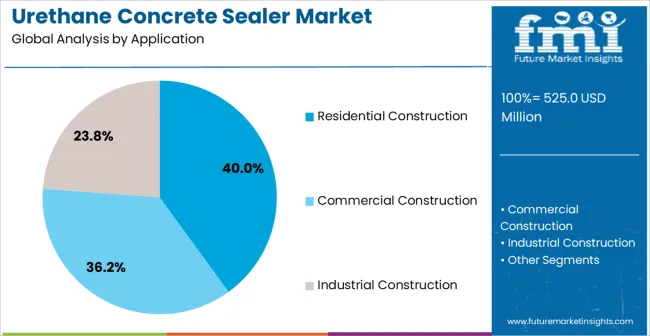
The urethane concrete sealer market is broadly segmented by application, sales channel, and geography. By application, the market is categorized into residential, commercial, and industrial construction, with residential construction expected to dominate with a 40.0% revenue share in 2025. This segment’s strength comes from the growing use of urethane sealers to protect driveways, patios, walkways, and other exterior surfaces. Homeowners and contractors increasingly recognize that urethane coatings offer long-lasting protection while maintaining the aesthetic quality of concrete finishes.
The popularity of home improvement projects, especially in urban and suburban settings, has further propelled demand. Enhanced formulations have made application easier and faster, while improved resistance to staining and wear continues to attract new users. Residential projects now serve as a testing ground for many innovative sealer products that eventually find industrial applications.
In the commercial and industrial sectors, urethane sealers are favored for warehouses, retail outlets, and manufacturing facilities where heavy traffic and chemical exposure are common. The material’s ability to maintain surface integrity under stress positions it as a key component in high-performance flooring systems.
Dominance of Direct Sales Channels in Market Expansion
Direct sales channels are projected to account for 55.0% of market revenue in 2025, highlighting the importance of direct engagement between manufacturers and end-users. This approach allows producers to provide customers with technical advice, training, and customized solutions.
Manufacturers like V-Seal Concrete Sealers & Specialty Coatings and Westcoat Specialty Coating Systems have strengthened their distribution networks and online platforms, ensuring seamless delivery and after-sales support. This strategy not only boosts brand loyalty but also fosters long-term partnerships with contractors, industrial buyers, and property managers.
The rise of digitalization in the construction supply chain has also made it easier for manufacturers to reach a global customer base. Online ordering, virtual consultations, and real-time tracking have transformed how sealers are marketed and delivered, especially in the post-pandemic construction era.
Regional and Country-Level Market Insights
Regionally, North America, Asia-Pacific, and Europe are the leading markets for urethane concrete sealers, each driven by distinct economic and industrial dynamics. North America’s growth is supported by a mature construction industry and a strong preference for sustainable, long-lasting materials. Europe continues to focus on eco-friendly sealing technologies aligned with its carbon neutrality goals. Meanwhile, Asia-Pacific is emerging as the most promising region due to massive investments in housing, infrastructure, and industrial development.
Country-wise, China leads with a projected CAGR of 6.8%, followed by India at 6.3%, reflecting their robust construction growth. Germany and the United Kingdom continue to experience steady expansion, while the USA remains a key market with consistent infrastructure investments. Even mature markets like Japan, growing at 3.8% CAGR, show signs of stable demand supported by modernization projects.
Such geographic diversity ensures that market players can capitalize on varying demand patterns and regulatory environments. For instance, European manufacturers are setting new benchmarks for sustainable product development, while Asian companies are focusing on affordability and scale.
Technological Advancements Reshaping the Market
Innovation remains the cornerstone of growth for the urethane concrete sealer market. Modern formulations now feature faster curing times, enhanced UV stability, and improved bonding characteristics, enabling better performance on both interior and exterior surfaces. Manufacturers are increasingly combining urethane with epoxy primers to achieve superior adhesion and surface hardness.
Companies such as Tennant Coatings and Triangle Coatings are investing heavily in R&D to develop hybrid sealers that combine durability with eco-friendly properties. At the same time, firms like Perma and Era Polymers are exploring nanotechnology and advanced polymer chemistry to introduce sealers that can withstand aggressive industrial environments while maintaining aesthetic appeal.
The industry’s innovation race is also extending to packaging, with several manufacturers adopting recyclable and easy-to-use containers that reduce waste and simplify transportation.
Purchase this Report for USD 5,000 Only | Get an Exclusive Discount Instantly! https://www.futuremarketinsights.com/checkout/8836
Everything You Need—within Your Budget. Request a Special Price Now! https://www.futuremarketinsights.com/reports/sample/rep-gb-8836
Competitive Landscape: Established and Emerging Players Driving Market Momentum
The urethane concrete sealer industry features a mix of global giants and emerging innovators. Market leaders such as Dow Chemical Company and BASF SE leverage decades of experience and a strong research base to dominate large-scale industrial and commercial projects. On the other hand, regional players like Flowcrete Group and Shanghai Ya Rui Industrial are expanding rapidly in emerging economies by offering cost-efficient, locally tailored products.
Start-ups and mid-sized manufacturers are also contributing significantly to the competitive ecosystem. Their agility allows them to respond quickly to shifting customer preferences and sustainability mandates. Collaboration between established and emerging companies has become a common strategy, fostering cross-regional innovation and technology transfer.
These developments indicate that the coming decade will not only witness market growth but also a deeper transformation in how concrete protection technologies are formulated, distributed, and applied globally.
Editor’s Note:
This release is based exclusively on verified and factual market content derived from industry analysis by Future Market Insights. No AI-generated statistics or speculative data have been introduced. This press release highlights significant shifts in the Market, which is experiencing a pivotal change driven by consumer demand for healthier, more transparent products.