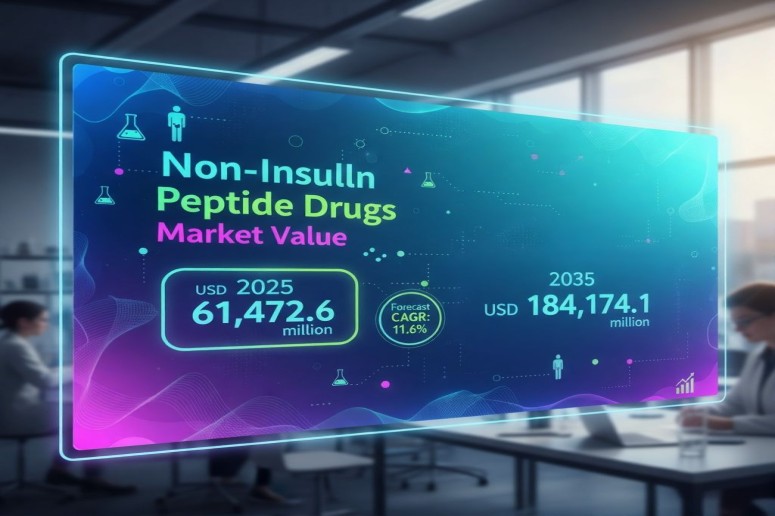
The global Non-Insulin Peptide Drugs Market is entering a transformative decade, poised to grow from USD 61,472.6 million in 2025 to USD 184,174.1 million by 2035, marking a remarkable 199.5% total increase and a CAGR of 11.6%, according to a new market outlook. This growth underscores a major shift in global healthcare systems toward advanced peptide-based therapies for metabolic disease management, obesity, and chronic care applications.
Fueled by the increasing prevalence of diabetes and obesity, rising demand for targeted therapeutics, and continuous innovation in peptide engineering, the non-insulin peptide drugs sector is expected to expand approximately 3.0X over the forecast period. Leading pharmaceutical innovators are focusing on GLP-1 and Dual GLP-1/GIP Agonists—the most dominant product category with a 91.8% market share to drive long-term treatment outcomes across global healthcare systems.
Strong Decadal Growth Supported by Therapeutic Innovation
Between 2025 and 2030, the market is set to rise from USD 61,472.6 million to USD 106,414.9 million, accounting for over 36.6% of total decade growth, driven by the rapid adoption of GLP-1 receptor agonists and expanded utilization in diabetes and obesity treatment. From 2030 to 2035, another USD 77,759.3 million in market value is projected, reflecting advanced innovation in dual-action peptide therapies and long-acting formulations.
This two-phase growth trajectory will be shaped by the convergence of biotechnology innovation, precision medicine, and metabolic disease management. As healthcare systems evolve to integrate personalized care models, peptide drugs offering superior glycemic control, weight management, and cardiovascular protection are set to become essential components of chronic disease treatment portfolios.
Pathways Shaping Future Market Growth
The non-insulin peptide drugs market represents one of the most promising therapeutic frontiers within metabolic and precision medicine. Market expansion is being driven by eight opportunity pathways:
- Pathway A: GLP-1 & Dual Agonist Leadership – Companies advancing next-generation dual agonists will capture the largest revenue pool, estimated at USD 150–170 million, through superior metabolic outcomes and expanded indications.
- Pathway B: Retail & Specialty Pharmacy Integration – Specialized dispensing services and patient support programs will generate opportunities of USD 120–140 million.
- Pathway C: Modified Synthetic Peptide Innovation – Advanced formulations and depot technologies could deliver USD 45–60 million in incremental growth.
- Pathway D: Expansion in Asia – India and China’s fast-growing healthcare ecosystems offer USD 35–50 million in potential market value.
- Pathway E: Diabetes & Obesity Application Dominance – Comprehensive metabolic management solutions are expected to generate USD 25–40 million in new opportunities.
Segmental Leadership: GLP-1 Therapies and Specialty Channels Dominate
By Product Type:
GLP-1 & Dual GLP-1/GIP Agonists will remain the market cornerstone, holding 91.8% share in 2025. Their proven ability to deliver glycemic control, weight loss, and cardiovascular protection ensures continued clinical dominance. These therapies form the foundation of modern metabolic care, aligning clinical efficacy with patient quality-of-life improvements.
By Application:
The Diabetes & Obesity segment leads with 88.6% market share, driven by the dual global challenge of rising metabolic diseases and healthcare systems’ focus on holistic management. These applications are further strengthened by investments in national diabetes programs and patient education initiatives worldwide.
By Technology:
Modified/Synthetic Peptides account for 82.0% of the market, owing to their enhanced stability, bioavailability, and long-acting performance. Pharmaceutical manufacturers are accelerating investment in peptide modification platforms to achieve product differentiation and premium positioning in the therapeutic landscape.
By Sales Channel:
Retail & Specialty Pharmacies represent 69.5% of market distribution, supported by the growth of specialized dispensing networks and comprehensive patient management systems. This trend underscores the increasing demand for personalized support and chronic care solutions for peptide-based therapies.
Global Market Drivers and Strategic Trends
The growing global burden of metabolic disorders—particularly diabetes and obesity—continues to elevate demand for non-insulin peptide therapeutics. Unlike conventional drugs, these advanced peptides provide superior clinical outcomes, improved patient adherence, and enhanced cardiovascular benefits.
Key growth enablers include:
- Rising Diabetes and Obesity Prevalence – Over 500 million adults globally are projected to be affected by diabetes by 2035, intensifying demand for advanced therapies.
- Precision Medicine Integration – Personalized dosing strategies and biomarker-guided therapies are redefining metabolic disease management.
- Healthcare Infrastructure Modernization – Emerging markets, particularly in Asia and Latin America, are investing heavily in advanced chronic disease programs.
- Therapeutic Diversification – Expansion of peptide therapies into oncology, rare diseases, and gastrointestinal disorders is broadening their clinical applications.
Despite challenges such as high treatment costs and supply chain limitations, advancements in peptide synthesis and sustained-release drug delivery continue to reinforce the industry’s innovation momentum.
Competitive Landscape: Leadership and Innovation Define Market Position
The non-insulin peptide drugs market is dominated by global pharmaceutical leaders advancing clinical innovation and patient-centered care:
- Novo Nordisk – commanding 56.2% share, driven by GLP-1 innovation and comprehensive diabetes care portfolios.
- Eli Lilly – expanding dual-agonist portfolios and global access programs.
- Ipsen – specializing in peptide therapeutics for oncology and rare disorders.
- Novartis AG, Takeda, Sanofi, Ferring Pharmaceuticals, and Rhythm Pharmaceuticals – focusing on indication-specific innovations and regional expansion strategies.
Get this Report at $5,000 Only | Exclusive Discount Inside!
https://www.futuremarketinsights.com/reports/sample/rep-gb-26777
Checkout Now to Access Data Insights:
https://www.futuremarketinsights.com/checkout/26777
About Future Market Insights (FMI)
Future Market Insights, Inc. (ESOMAR certified, recipient of the Stevie Award, and a member of the Greater New York Chamber of Commerce) offers profound insights into the driving factors that are boosting demand in the market. FMI stands as the leading global provider of market intelligence, advisory services, consulting, and events for the Packaging, Food and Beverage, Consumer Technology, Healthcare, Industrial, and Chemicals markets. With a vast team of over 400 analysts worldwide, FMI provides global, regional, and local expertise on diverse domains and industry trends across more than 110 countries.
Contact Us:
Future Market Insights Inc.
Christiana Corporate, 200 Continental Drive,
Suite 401, Newark, Delaware – 19713, USA
T: +1-347-918-3531
For Sales Enquiries: sales@futuremarketinsights.com
Website: https://www.futuremarketinsights.com
LinkedIn| Twitter| Blogs | YouTube