

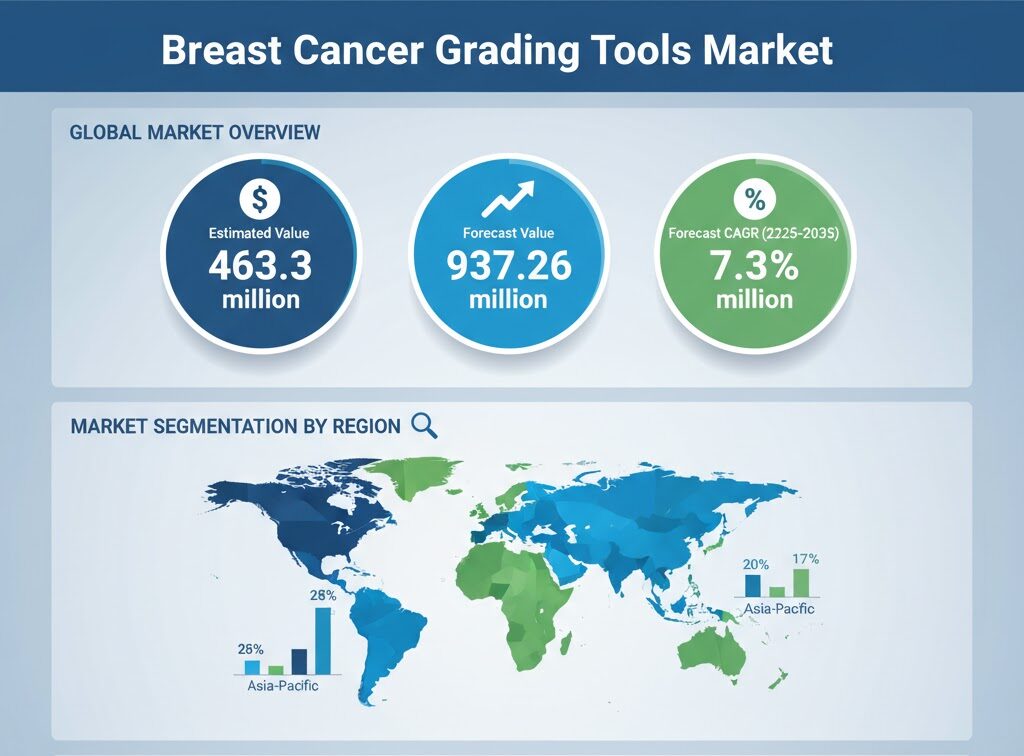
The global Breast Cancer Grading Tools Market is on a robust growth trajectory, projected to expand from USD 463.3 million in 2025 to USD 937.26 million by 2035, reflecting a 7.3% CAGR over the forecast period. The decade-long growth of USD 473.96 million underscores the accelerating integration of AI-powered pathology tools, molecular diagnostics, and personalized oncology workflows. Rising breast cancer incidence, increasing emphasis on early-stage diagnosis, and expanding healthcare digitization are key forces driving this expansion.
Report Coverage & Deliverable
The report offers a comprehensive evaluation of market size, growth projections, competitive landscape, and key regional insights across North America, Europe, Asia Pacific, Latin America, and the Middle East & Africa. It provides in-depth segmentation by Tools (Nottingham, Bloom-Richardson, Molecular Grading Tools), Tumor Grade (Grade 1, Grade 2, Grade 3), Cancer Type (Invasive Ductal Carcinoma, Invasive Lobular Carcinoma, Others), and End User (Hospitals, Diagnostic Centers, Research Institutes). The report further includes company profiles, technological developments, and key regulatory updates influencing global market trends.
Key Factors Shaping Market Dynamics
- Rising Global Breast Cancer Burden
Breast cancer remains the most diagnosed cancer among women worldwide, with over 2.3 million new cases recorded in 2022 (IARC). The increasing prevalence is pushing healthcare systems to adopt advanced diagnostic tools that ensure accuracy and reproducibility in tumor grading—critical for effective treatment planning and prognosis.
- Shift Toward Personalized Medicine
The global oncology landscape is undergoing a paradigm shift toward precision medicine, where patient-specific tumor profiles guide therapeutic decisions. Tools such as Oncotype DX, MammaPrint, and Prosigna (PAM50) are revolutionizing grading accuracy and treatment stratification, particularly for hormone receptor-positive breast cancers.
- Integration of AI and Digital Pathology
The adoption of AI-powered image analysis and digital pathology platforms is transforming diagnostic workflows. Companies like Aiforia and Indica Labs are pioneering AI-based grading systems that minimize observer variability, enhance workflow efficiency, and enable large-scale adoption in hospitals and research labs.
- Technological and Infrastructure Gaps in Emerging Markets
While developed regions lead in digital and molecular diagnostics, many emerging markets still face limited access to advanced grading tools due to inadequate infrastructure, cost barriers, and lack of trained pathologists. However, initiatives like India’s Ayushman Bharat Digital Mission and China’s Healthy China 2030 are addressing these gaps.
Key Takeaways
- Market Valuation: USD 463.3 million in 2025; projected to reach USD 937.26 million by 2035.
- Growth Rate: CAGR of 7.3% from 2025–2035, representing a 2.0X increase in market size.
- Leading Tool: Nottingham Grading System to retain dominance with a 63.1% market share in 2025 due to standardization and cost-effectiveness.
- Top Tumor Grade Segment: Grade 2 tumors to account for 42.7% of total market share owing to their intermediate clinical behavior.
- Major Cancer Type: Invasive Ductal Carcinoma (IDC) to hold 72.4% share, driven by its high global prevalence.
- Primary End User: Hospitals & Clinics to contribute 53.4% of total demand due to their role in diagnosis and treatment planning.
- Leading Player: Aiforia Technologies Plc maintains leadership through CE-IVD-marked AI solutions for breast cancer grading.
Regional Analysis
North America
North America remains the most technologically advanced market, led by the United States, which is projected to grow at a 9.3% CAGR through 2035. The U.S. market benefits from strong adoption of molecular assays like Oncotype DX and MammaPrint, favorable reimbursement policies, and growing integration of AI-enabled digital pathology.
Europe
Europe is expected to grow steadily at a 6.2% CAGR, with Germany (7.0%), France (6.1%), and the UK (5.8%) leading growth. Germany’s robust oncology infrastructure and digital transformation under the Hospital Future Act are key growth enablers. The UK’s NHS modernization programs are accelerating AI adoption in cancer diagnostics.
Asia Pacific
Asia Pacific emerges as the fastest-growing region with a projected CAGR of 6.0% (2025–2030). Rising breast cancer prevalence, rapid diagnostic digitization, and government-backed oncology programs are propelling growth in China (6.9%) and India (6.0%). Japan and South Korea also exhibit steady adoption driven by precision medicine initiatives and aging populations.
Latin America & Middle East
Countries like Brazil (5.0%) are expanding access to diagnostic infrastructure, while Middle Eastern nations invest in oncology centers to address rising breast cancer incidence.
Key Segments of the Market Report
| Category | Segmentation |
| Tools | Nottingham Grading System, Bloom-Richardson Grading System, Molecular Grading Tools |
| Tumor Grade | Grade 1, Grade 2, Grade 3 |
| Cancer Type | Invasive Ductal Carcinoma, Invasive Lobular Carcinoma, Tubular & Mucinous, Others |
| End User | Hospitals & Clinics, Diagnostic & Imaging Centers, Cancer Research Institutes, Others |
| Regions Covered | North America, Latin America, Europe, East Asia, South Asia & Pacific, Middle East & Africa |
Competition Landscape
The global market is moderately fragmented, characterized by established digital pathology leaders, molecular diagnostics firms, and emerging AI innovators.
Key players include:
Aiforia, Primaa, Bruker Spatial Biology Inc., Indica Labs LLC, Leica Biosystems Nussloch GmbH, iCAD Inc., Endomagnetics Ltd., Exact Sciences Corp., Owkin Inc., and SimBioSys.
- Aiforia Technologies Plc dominates with its AI-based digital pathology suite, recently launching a CE-IVD-marked clinical AI solution for breast cancer grading (June 2025).
- SOPHiA GENETICS and AstraZeneca expanded collaboration in 2025 to develop NGS-based precision diagnostic tools.
- Leica Biosystems and Bruker Spatial Biology focus on integrating spatial biology and multiplex imaging for enhanced diagnostic accuracy.
- Startups like Owkin and SimBioSys are pioneering AI-based predictive analytics for tumor modeling and risk assessment.
The market is transitioning from standalone grading tools to AI-integrated diagnostic ecosystems that unify molecular data, histopathology, and clinical decision support.
Grab This Report Now at Just $5000| Limited-Time Discount Offer! https://www.futuremarketinsights.com/reports/sample/rep-gb-26718
Checkout Now to Access Industry Insights: https://www.futuremarketinsights.com/checkout/26718
About Future Market Insights (FMI)
Future Market Insights, Inc. (ESOMAR certified, recipient of the Stevie Award, and a member of the Greater New York Chamber of Commerce) offers profound insights into the driving factors that are boosting demand in the market. FMI stands as the leading global provider of market intelligence, advisory services, consulting, and events for the Packaging, Food and Beverage, Consumer Technology, Healthcare, Industrial, and Chemicals markets. With a vast team of over 400 analysts worldwide, FMI provides global, regional, and local expertise on diverse domains and industry trends across more than 110 countries.
Contact Us:
Future Market Insights Inc.
Christiana Corporate, 200 Continental Drive,
Suite 401, Newark, Delaware – 19713, USA
T: +1-347-918-3531
For Sales Enquiries: sales@futuremarketinsights.com
Website: https://www.futuremarketinsights.com
LinkedIn| Twitter| Blogs | YouTube




