

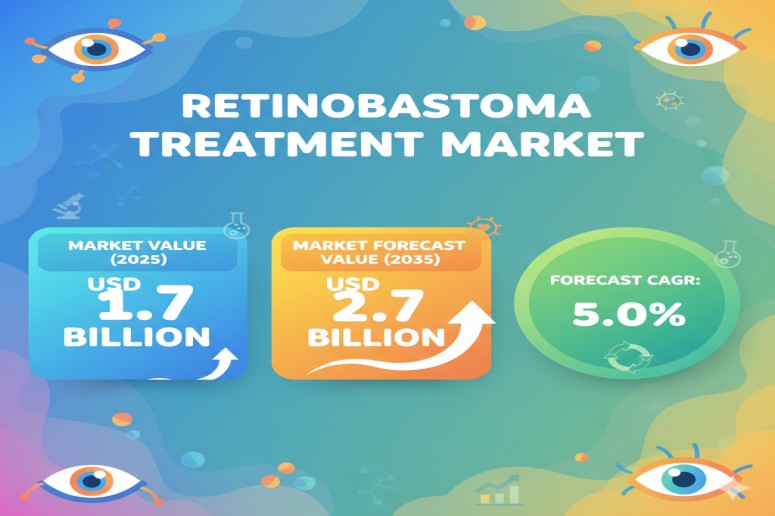
The global Retinoblastoma Treatment Market is poised for sustained growth over the next decade, with its valuation estimated at USD 1.7 billion in 2025 and projected to reach approximately USD 2.7 billion by 2035, reflecting a steady compound annual growth rate (CAGR) of 5.0%. This expansion underscores the increasing focus on early diagnosis, effective treatment interventions, and technological advancements in pediatric oncology, providing hope for children affected by this rare but serious eye cancer.
Rising Demand Driven by Awareness and Early Detection
The growth of the Retinoblastoma Treatment Market is largely fueled by the rising prevalence of retinoblastoma, particularly in children under five years of age. Awareness campaigns targeting both healthcare providers and parents have emphasized the critical importance of early detection, which can dramatically improve patient outcomes. Enhanced understanding of disease progression and the integration of multidisciplinary care approaches have amplified demand for advanced treatment options.
Recent technological developments have further strengthened market growth. Innovations in imaging modalities, surgical techniques, and targeted therapies have allowed clinicians to offer precise and personalized treatment plans. Such advancements not only improve survival rates but also reduce long-term ocular and systemic complications, a major consideration in pediatric oncology care.
Investment and Research Initiatives Boost Market Expansion
Significant investments in pediatric oncology centers, coupled with research in precision medicine, have further supported market growth. Governments and private organizations are increasingly prioritizing childhood cancer management programs, improving therapy accessibility across both developed and emerging regions.
Concurrently, the integration of surgical, pharmacological, and localized treatment modalities is enhancing overall treatment efficacy, while ongoing clinical trials and regulatory approvals for innovative drugs continue to broaden the therapeutic landscape.
Segmental Insights: Disease Type, Stage, and Treatment Modality
The Retinoblastoma Treatment Market is segmented by disease type, stage, treatment type, distribution channel, and geography. By disease type, the market is divided into Sporadic (Non-Hereditary) Retinoblastoma and Congenital (Hereditary) Retinoblastoma. Among these, sporadic retinoblastoma accounts for 57.4% of market revenue in 2025, making it the leading segment. The higher prevalence of unilateral cases that arise spontaneously, along with early diagnosis, has enabled clinicians to implement effective systemic and localized interventions.
Stage-wise, intraocular retinoblastoma dominates the market, accounting for 31.6% of revenue in 2025. Early detection of localized tumors confined to the eye allows for organ-preserving therapies that maintain visual function while reducing the need for enucleation. Advances in intraocular imaging, laser therapies, cryotherapy, and localized drug delivery have enhanced treatment precision and patient outcomes.
Chemotherapy emerges as the leading treatment type, projected to capture 32.2% of market revenue in 2025. Systemic and localized chemotherapeutic approaches, often combined with focal therapies, offer effective tumor control while preserving ocular structure and function. Recent advancements, including intra-arterial and intravitreal drug administration, have improved precision, minimized systemic toxicity, and allowed for tailored dosing schedules according to patient-specific needs.
Regional Market Dynamics
Geographically, North America, Europe, and Asia-Pacific are key growth regions for the Retinoblastoma Treatment Market. China leads with a projected CAGR of 6.8%, followed by India at 6.3%, reflecting increasing healthcare investments and expanding pediatric oncology infrastructure.
Developed European markets, including Germany, France, and the UK, continue to exhibit steady growth, while the USA market is expected to rise from USD 585.1 million in 2025 to USD 887.2 million by 2035 at a CAGR of 4.3%. Latin America and Middle Eastern regions are also witnessing gradual expansion, driven by heightened awareness, improved healthcare delivery systems, and adoption of advanced treatment protocols.
Key Players and Technological Advancements
The market features a mix of established pharmaceutical giants and emerging innovators, all seeking to expand their presence and introduce novel technologies. Major players such as Novartis, Pfizer, Johnson & Johnson, Merck & Co., GlaxoSmithKline, and Bristol-Myers Squibb continue to leverage their extensive research pipelines and global distribution networks to deliver advanced therapies.
At the same time, emerging companies including Cellceutix Corporation, Theriva Biologics, Advancium Health, and Cadila Pharmaceuticals are gaining recognition for their focus on targeted therapeutics, precision medicine approaches, and novel drug delivery systems. Collaborations between established and new entrants are accelerating the development of innovative therapies, ensuring broader treatment options and improved clinical outcomes for children affected by retinoblastoma.
Market Outlook and Opportunities
The outlook for the Retinoblastoma Treatment Market remains positive, with continued growth driven by multiple factors. Ongoing research into novel chemotherapeutic agents, localized treatment modalities, and combination therapy regimens is expected to enhance clinical efficacy and safety. Furthermore, government and private sector initiatives aimed at improving early diagnosis, expanding treatment accessibility, and investing in pediatric oncology infrastructure are likely to reinforce market momentum.
For manufacturers, the evolving market landscape presents opportunities to expand business operations, enter new geographic regions, and develop cutting-edge technologies. Companies focusing on precision medicine, organ-preserving interventions, and minimally invasive procedures are poised to gain a competitive edge, while collaborations and strategic partnerships are expected to drive innovation and accelerate time-to-market for new therapies.
Get Instant Access for Only $5,000 | Don’t Miss This Exclusive Offer!
https://www.futuremarketinsights.com/reports/sample/rep-gb-2783
Checkout Now to Access Industry Insights:
https://www.futuremarketinsights.com/checkout/2783
About Future Market Insights (FMI)
Future Market Insights, Inc. (ESOMAR certified, recipient of the Stevie Award, and a member of the Greater New York Chamber of Commerce) offers profound insights into the driving factors that are boosting demand in the market. FMI stands as the leading global provider of market intelligence, advisory services, consulting, and events for the Packaging, Food and Beverage, Consumer Technology, Healthcare, Industrial, and Chemicals markets. With a vast team of over 400 analysts worldwide, FMI provides global, regional, and local expertise on diverse domains and industry trends across more than 110 countries.
Contact Us:
Future Market Insights Inc.
Christiana Corporate, 200 Continental Drive,
Suite 401, Newark, Delaware – 19713, USA
T: +1-347-918-3531
For Sales Enquiries: sales@futuremarketinsights.com
Website: https://www.futuremarketinsights.com
LinkedIn| Twitter| Blogs | YouTube




