The global corrugated equipment market is entering a period of robust growth, projected to expand from USD 266.6 million in 2025 to USD 379.7 million by 2035, representing a CAGR of 3.6% over the forecast period. As demand for corrugated packaging rises across e-commerce, retail, and food distribution, manufacturers and technology providers are investing heavily in advanced equipment such as rotary die-cutters, flexo-folder-gluers, and high-speed corrugators. These core technologies are the backbone of modern corrugated board production, driving efficiency, precision, and quality in packaging operations worldwide.
Early market value is largely supported by rotary die-cutting systems, which ensure precise, high-speed cutting, while flexo-folder-gluer machines improve finishing and reduce manual intervention. Over the next decade, high-speed corrugators with integrated digital monitoring, IoT sensors, and predictive maintenance tools will increasingly contribute to market growth. By 2035, hybrid systems that combine mechanical efficiency with smart digital controls are expected to dominate, reflecting the industry’s focus on operational efficiency, cost reduction, and scalable production capacity.
Technological Advancements Driving Market Expansion
Automation and digitalization are transforming corrugated equipment production. Advanced machinery allows simultaneous die-cutting, printing, and folding, reducing human error while increasing throughput. Sensors, quality monitoring systems, and real-time analytics enable manufacturers to optimize uptime and reduce waste, boosting both productivity and profitability. These technological upgrades, combined with energy-efficient motors and eco-friendly components, align with environmental regulations and the growing consumer demand for sustainable packaging.
In addition to operational benefits, modular and flexible equipment solutions are gaining traction. Manufacturers can now handle varying board types, sheet sizes, and short-run jobs more effectively, enhancing customization capabilities. Integration with digital printing systems allows rapid adaptation to branding requirements, supporting the growing demand for personalized packaging in the food, beverage, electronics, and pharmaceutical sectors.
Market Segmentation Insights
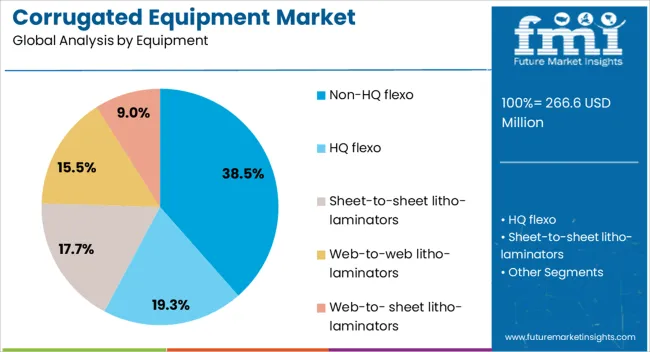
Among equipment types, non-HQ flexo machines dominate with a 38.5% share in 2025, favored for cost-effectiveness, simplicity, and suitability for standard printing needs in medium- to high-volume production. The food and beverages industry emerges as the largest end-use sector, contributing 36.9% of revenue, driven by high demand for hygienic, moisture-resistant, and structurally strong corrugated packaging.
Direct sales remain the primary distribution channel, accounting for 58.7% of market revenue, as manufacturers prefer close collaboration with equipment providers for tailored solutions, long-term service agreements, and co-development of production lines. Strategic partnerships and direct engagement facilitate faster response times, better performance alignment, and enhanced after-sales support.
Regional Growth and Opportunities
Asia-Pacific is the largest manufacturing hub for corrugated equipment, driven by cost advantages, high production volumes, and booming e-commerce. China, growing at a CAGR of 4.9%, dominates the regional market with over 45% of installations in 2023, benefiting from rapid industrial expansion and technology upgrades in folder gluers, die cutters, and flexo printers. India, at 4.5% CAGR, is witnessing accelerated adoption of semi- and fully automated systems for food, beverage, and e-commerce packaging, with domestic manufacturers like EDI, Maheshwari Machinery, and Hindustan Flexo investing in energy-efficient solutions.
Europe shows steady demand, with Germany at 4.1% CAGR, driven by stringent packaging standards, high-quality printing needs, and sustainability regulations. Local players focus on precision engineering, multi-color printing, and automation, supported by investments from global companies such as Bobst, BHS Corrugated, and Emba Machinery. The UK grows at 3.4% CAGR, adopting flexible, high-precision machinery for short-run and customized packaging, while the USA, with 3.1% CAGR, emphasizes modular systems, digital monitoring, and energy-efficient operations, particularly for e-commerce and cold-chain logistics.
Competitive Landscape and Key Players
The market is a mix of global machinery leaders and specialized regional suppliers. BHS Corrugated, Bobst Group, Mitsubishi Heavy Industries, and Barry-Wehmiller lead with high-speed, fully automated production lines integrating printing, converting, and material handling. Mid-sized players such as Sun Automation, Simon Corrugated Machinery, MPS Systems, Mark Andy, OMET, and Walco focus on modular, customizable solutions tailored for small-to-medium manufacturers seeking productivity without extensive capital investment.
Innovation is central to competition, with companies emphasizing inline printing, automated die-cutting, predictive maintenance, and energy efficiency. Strategic partnerships and regional expansions enable broader market penetration and after-sales support. The integration of Industry 4.0-enabled technologies ensures continuous improvement, allowing manufacturers to remain competitive in a rapidly evolving packaging landscape.
Drivers, Challenges, and Market Trends
The market is propelled by the global shift toward sustainable, cost-efficient packaging, the need for high-quality output, and the growth of e-commerce and consumer goods sectors. Automation and digital controls enhance speed, reduce waste, and enable real-time process optimization. Meanwhile, rising adoption of eco-friendly, lightweight, and recyclable corrugated materials aligns with regulatory mandates and consumer preferences.
Challenges include the high capital cost of advanced machinery, the need for skilled operators, and regional disparities in technology adoption. Opportunities exist in developing ready-to-use, modular, and customizable equipment for emerging markets, supporting the rising demand for packaging solutions that are both sustainable and flexible.
Purchase this Report for USD 5,000 Only | Get an Exclusive Discount Instantly! https://www.futuremarketinsights.com/checkout/25836
Everything You Need—within Your Budget. Request a Special Price Now! https://www.futuremarketinsights.com/reports/sample/rep-gb-25836
About Future Market Insights (FMI)
Future Market Insights, Inc. (ESOMAR certified, recipient of the Stevie Award, and a member of the Greater New York Chamber of Commerce) offers profound insights into the driving factors that are boosting demand in the market. FMI stands as the leading global provider of market intelligence, advisory services, consulting, and events for the Packaging, Food and Beverage, Consumer Technology, Healthcare, Industrial, and Chemicals markets. With a vast team of over 400 analysts worldwide, FMI provides global, regional, and local expertise on diverse domains and industry trends across more than 110 countries.
Contact Us:
Future Market Insights Inc.
Christiana Corporate, 200 Continental Drive,
Suite 401, Newark, Delaware – 19713, USA
T: +1-347-918-3531
For Sales Enquiries: sales@futuremarketinsights.com
Website: https://www.futuremarketinsights.com
LinkedIn| Twitter| Blogs | YouTube