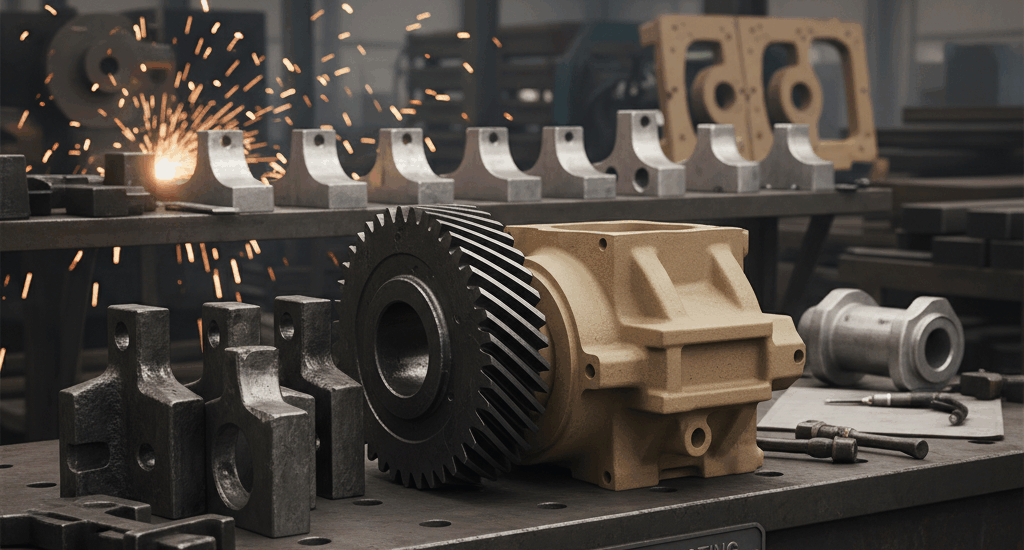
The Forged and Casting Component Market is entering a dynamic growth phase, projected to surge from USD 10.2 billion in 2025 to USD 17.8 billion by 2035, registering a steady CAGR of 5.7%. The market’s expansion is being fueled by robust demand across automotive, defense, and industrial machinery sectors, alongside innovations in materials, automation, and precision manufacturing.
Get this Report at $5000 | Claim Your Report at a Discount: https://www.futuremarketinsights.com/reports/sample/rep-gb-18445
Automotive Segment Leads the Growth Curve
Holding nearly 32.7% market share in 2025, the automotive segment continues to dominate the forged and casting component industry. Manufacturers are increasingly turning to high-strength, lightweight materials to enhance vehicle performance and fuel efficiency. From engine assemblies to transmission housings, forged and cast parts are essential for achieving safety, efficiency, and durability in modern vehicles.
Collaborations between component manufacturers and OEMs have intensified, ensuring streamlined production and higher quality control. With rising adoption of electric and hybrid vehicles, component suppliers such as Robert Bosch GmbH, ZF Friedrichshafen AG, and Denso Corporation are investing in precision forging technologies and advanced casting methods to meet evolving mobility standards.
Aluminum Alloys Powering the Future of Manufacturing
On the materials front, aluminum alloy 6xxx and 7xxx series remain the most sought-after due to their exceptional strength-to-weight ratios, corrosion resistance, and recyclability. The 6xxx series alone accounts for 38.4% of the material type segment, driven by its use in automotive chassis, transportation equipment, and lightweight structural applications.
Continuous innovation in heat treatment, alloy composition, and forming processes is boosting performance while enabling cost efficiency. The market’s focus on sustainable, recyclable materials positions aluminum alloys as a cornerstone of next-generation manufacturing.
Casting Process Dominates Due to Efficiency and Design Flexibility
The casting process accounts for over 41% of the total manufacturing process segment, benefiting from its versatility and ability to produce intricate geometries. Advancements in mold design, metallurgical control, and automation have significantly improved casting precision, surface finish, and mechanical strength.
From automotive components to heavy industrial machinery, the process’s scalability and lower cost make it a preferred choice for manufacturers worldwide. Automation, process simulation, and defect minimization technologies continue to enhance production efficiency and output consistency.
Regional Insights: North America, Europe, and Asia-Pacific Drive Global Expansion
The global market’s geographic growth is led by China, the United States, Japan, Germany, and South Korea, all experiencing rapid industrialization and modernization.
- China dominates the market with an expected valuation of USD 4,002.7 million by 2035, driven by rising investments in defense manufacturing and domestic infrastructure.
- The United States, forecasted to reach USD 2,264.0 million by 2035, is leveraging its robust manufacturing and renewable energy sectors to strengthen demand for forged and casting components.
- Germany, known for its engineering excellence, continues to lead in high-performance electronics and automotive applications, fostering innovation and precision engineering.
- In Japan, the accelerating shift toward electric vehicles and lightweight automotive design is creating new avenues for advanced forged components.
- South Korea’s rapid industrial growth and technological integration are enhancing production scalability and product innovation.
Key Growth Drivers: Innovation and Industrial Modernization
- Advancements in Forging and Casting Technologies:
Automation, digital simulation, and materials innovation are revolutionizing manufacturing processes. Companies are integrating digital twin technology to simulate real-world component performance, reducing prototyping time and costs while improving accuracy. - Rapid Urbanization and Infrastructure Development:
The growing need for resilient infrastructure and efficient machinery in urban environments is driving demand for high-quality, precision-engineered forged and cast components. - Rising Focus on Electric Vehicles and Renewable Energy:
Components optimized for lightweight strength, heat resistance, and energy efficiency are in high demand across EVs, wind turbines, and solar power systems.
Challenges: Supply Chain Constraints and Alternative Materials
Despite its promising growth, the market faces supply chain disruptions arising from material shortages and geopolitical tensions. Additionally, the growing adoption of composite materials and advanced plastics presents competition due to their lightweight and corrosion-resistant properties.
To address these challenges, manufacturers are diversifying supplier networks, investing in sustainable sourcing, and innovating hybrid material solutions.
Competitive Landscape: Established Leaders and Emerging Innovators
Prominent players such as Continental AG, Magna International, Valeo S.A., Schaeffler AG, and Hitachi Astemo Ltd. are intensifying R&D investments to introduce next-generation forged and casting solutions.
Recent developments include:
- Schaeffler AG (February 2025): Launched the TriFinity bearing for EVs, enhancing chassis energy efficiency.
- Schaeffler India (November 2024): Opened a bearing refurbishing center in Jamshedpur to promote sustainable industrial production.
- Hitachi Ltd. (November 2025): Introduced the Lumada Alliance Program, uniting partners across IT and operational technology domains.
Emerging manufacturers are also entering the landscape with a focus on automation, additive manufacturing integration, and eco-efficient alloy development, creating new opportunities for collaboration and technology sharing.
Get Instant Access & Discount: https://www.futuremarketinsights.com/checkout/18445
Market Outlook: A Decade of Sustainable Growth and Innovation
The forged and casting component industry is on the verge of a technological renaissance. With a forecast CAGR of 6.0% between 2025 and 2035, the sector is set to benefit from global trends in industrial electrification, automation, and defense modernization.
Both established leaders and new entrants are expected to capitalize on this opportunity by embracing digital manufacturing, sustainability, and strategic partnerships. As industries worldwide pursue higher efficiency and precision, forged and casting components will remain indispensable to the global manufacturing ecosystem.
About Future Market Insights (FMI)
Future Market Insights, Inc. (ESOMAR certified, recipient of the Stevie Award, and a member of the Greater New York Chamber of Commerce) offers profound insights into the driving factors that are boosting demand in the market. FMI stands as the leading global provider of market intelligence, advisory services, consulting, and events for the Packaging, Food and Beverage, Consumer Technology, Healthcare, Industrial, and Chemicals markets. With a vast team of over 400 analysts worldwide, FMI provides global, regional, and local expertise on diverse domains and industry trends across more than 110 countries.
Contact Us:
Future Market Insights Inc.
Christiana Corporate, 200 Continental Drive,
Suite 401, Newark, Delaware – 19713, USA
T: +1-347-918-3531
For Sales Enquiries: sales@futuremarketinsights.com
Website: https://www.futuremarketinsights.com
LinkedIn| Twitter| Blogs | YouTube