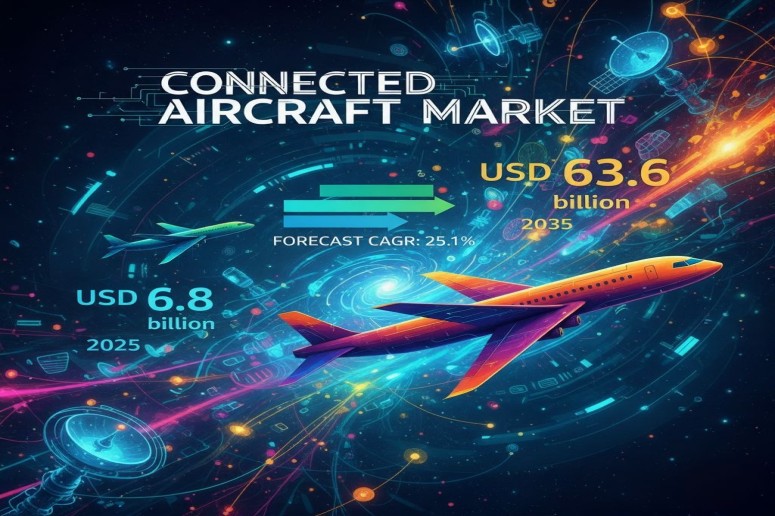
The global Connected Aircraft Market is poised for a remarkable expansion, with its market value estimated at USD 6.8 billion in 2025, and projected to skyrocket to USD 63.6 billion by 2035, reflecting an impressive compound annual growth rate (CAGR) of 25.1% over the forecast period. This surge underscores the aviation industry’s growing focus on operational efficiency, safety, and the passenger experience through advanced connectivity solutions.
As the aviation landscape evolves, airlines and operators worldwide are embracing high-performance connectivity technologies to enable real-time data exchange between aircraft and ground stations. This shift is not only supported by regulatory encouragement for safety management systems but also by the rising adoption of predictive maintenance practices. Today, connected platforms are integral in helping airlines reduce downtime, optimize flight operations, and enhance overall operational efficiency.
Passenger Expectations Driving Connectivity Demand
Passenger demand for seamless digital experiences is fueling significant investment in inflight entertainment and connectivity services, particularly in commercial aviation. Travelers now expect high-speed internet access and uninterrupted streaming capabilities, making reliable connectivity a key differentiator for airlines. Technological advancements in satellite communications, coupled with the availability of higher bandwidths, have enabled more robust connectivity options for both cockpit and cabin applications.
Airlines increasingly prioritize solutions that improve fuel efficiency, facilitate proactive decision-making through data analytics, and reduce operational costs. With global aviation traffic projected to grow steadily, and digital transformation accelerating across airlines, the connected aircraft market is positioned for sustained, high-growth momentum. Continuous infrastructure upgrades and innovations in connectivity solutions are expected to drive the market forward in the coming decade.
Segmental Insights: Components and Technologies
The Aircraft Communication & Reporting System (ACRS) is the leading component segment, accounting for 48.3% of the connected aircraft market revenue in 2025. This segment’s dominance stems from its critical role in enabling secure and continuous communication between aircraft and ground systems.
ACRS ensures reliable flight tracking, weather updates, and performance monitoring, enhancing situational awareness and optimizing routing decisions for cost savings and safety improvements. Its integration with advanced satellite technologies ensures uninterrupted data flow across diverse operating environments, cementing its position as a market leader.
On the technology front, Ka-band connectivity is projected to capture 52.3% of the market revenue in 2025, establishing itself as the leading connectivity technology. Ka-band’s high bandwidth and fast data transfer capabilities support modern aircraft operations, including real-time data analytics, predictive maintenance, and passenger entertainment services.
The ongoing deployment of advanced satellite constellations has further strengthened Ka-band’s adoption, offering broader coverage, higher reliability, and enhanced capacity for simultaneous, data-intensive applications.
Market Overview: The Connected Aircraft Revolution
The era of connected aircraft has transformed aviation by delivering unprecedented levels of communication, safety, and passenger satisfaction. Leading companies such as Honeywell International Inc., Thales Group, Raytheon Technologies Corporation, BAE Systems PLC, Viasat Inc., TE Connectivity Ltd., and Gogo Inc. are pioneering solutions that enhance both operational efficiency and passenger experience. Their satellite communication products provide reliable, high-speed broadband connections for business aviation, commercial airlines, and helicopters globally.
These key players not only offer connectivity hardware but also maintain comprehensive maintenance plans, tools, and services that equip airline teams with accurate, real-time data and diagnostics. Airlines benefit from advanced analytics platforms that optimize flight operations, reduce fuel consumption, improve on-time performance, and drive sustainability initiatives. More than 100 airlines have leveraged these analytics solutions to implement and optimize projects that enhance both flight and maintenance operations, reinforcing the demand for connected aircraft solutions.
Technological Leadership and Market Expansion
Established players in the market maintain a competitive edge by offering wide-ranging solutions, from satellite communication hardware to software applications that manage data from “satellite to services, airtime to applications.” Their expertise in avionics, propulsion systems, mechanical components, and satellite communications positions them uniquely to lead market adoption. In addition, these companies are investing in cybersecurity centers of excellence to protect critical aviation data, further solidifying their market leadership.
Next-generation aviation Satcom systems and proprietary aviation-specific networks offer airlines unmatched connectivity reliability, ensuring operational efficiency, passenger satisfaction, and safety-critical services. With a strong technological roadmap and commitment to innovation, these providers are redefining inflight entertainment and passenger experience.
A recent collaboration between OneWeb and a key market player to support its Low Earth Orbit (LEO) network for commercial aircraft globally exemplifies the industry’s commitment to technological expansion. This multi-orbit solution enables market-leading inflight connectivity services, advancing the vision of IoT-enabled connected aircraft. Wireless connectivity devices and data-driven solutions now help airlines enhance both operational efficiency and passenger experience.
Country-Level Growth: Asia Leads the Way
The connected aircraft market exhibits varied growth trajectories across countries. China leads the market with the highest CAGR of 33.9%, followed closely by India at 31.4%. Developed European markets such as Germany, France, and the UK are expanding steadily, while the USA is expected to grow at a consistent 21.3% CAGR.
Brazil, with a lower CAGR of 18.8%, still underscores a positive growth trend, reflecting a global appetite for connected aviation solutions. Germany alone is expected to grow at 28.9% CAGR, maintaining its dominance in Western Europe. In Asia, Japan and South Korea are projected to reach USD 370.2 million and USD 218.7 million respectively by 2025, indicating strong regional adoption.
Get Instant Access for Only $5,000 | Don’t Miss This Exclusive Offer!
https://www.futuremarketinsights.com/reports/sample/rep-gb-1910
Checkout Now to Access Industry Insights:
https://www.futuremarketinsights.com/checkout/1910
About Future Market Insights (FMI)
Future Market Insights, Inc. (ESOMAR certified, recipient of the Stevie Award, and a member of the Greater New York Chamber of Commerce) offers profound insights into the driving factors that are boosting demand in the market. FMI stands as the leading global provider of market intelligence, advisory services, consulting, and events for the Packaging, Food and Beverage, Consumer Technology, Healthcare, Industrial, and Chemicals markets. With a vast team of over 400 analysts worldwide, FMI provides global, regional, and local expertise on diverse domains and industry trends across more than 110 countries.
Contact Us:
Future Market Insights Inc.
Christiana Corporate, 200 Continental Drive,
Suite 401, Newark, Delaware – 19713, USA
T: +1-347-918-3531
For Sales Enquiries: sales@futuremarketinsights.com
Website: https://www.futuremarketinsights.com
LinkedIn| Twitter| Blogs | YouTube