The aircraft de-icing market is entering a phase of sustained evolution, driven by the aviation industry’s commitment to operational safety, sustainability, and efficiency in challenging winter conditions. Valued at USD 1.8 billion in 2025, the market is expected to climb to USD 2.8 billion by 2035, registering a CAGR of 4.6% during the forecast period. This steady rise underscores the aviation sector’s increasing reliance on advanced de-icing technologies and environmentally conscious formulations that ensure flight safety while reducing ecological impact.
While growth is steady at a global level, the pace of expansion varies across regions. Asia-Pacific emerges as the most dynamic growth hub, with rapid airport expansion, increasing fleet sizes, and rising passenger air travel creating strong demand for de-icing services and technologies. The region’s ascent from USD 1.8 billion in 2025 to USD 2.8 billion by 2035 represents an industry-wide shift toward modernized ground operations and safety-oriented infrastructure. In contrast, Europe’s growth is tempered by mature infrastructure but strengthened by strict regulations surrounding de-icing fluid management and chemical use, ensuring a consistent yet measured expansion. Meanwhile, North America, home to one of the world’s most established aviation sectors, continues to upgrade de-icing efficiency through technological innovation rather than capacity expansion.
Growing Demand Anchored in Safety, Regulation, and Technology
At its core, the aircraft de-icing market serves as a critical segment within the global ground support and aviation safety industry. It accounts for approximately 4.7% of the total aviation ground operations market, underpinned by a growing emphasis on safety, regulatory compliance, and timely performance. Within the de-icing fluids and chemicals sector, the market commands a 5.2% share, reflecting increasing adoption of propylene glycol, ethylene glycol, and advanced eco-friendly additives.
Rising global air traffic, evolving weather patterns, and stringent safety mandates from aviation authorities are among the primary factors fueling demand. The industry is moving toward biodegradable, low-toxicity fluids and automated systems that reduce fluid consumption and environmental runoff. Key players such as BASF SE, Clariant, Cryotech (General Atomics), DuPont de Nemours Inc., and Kilfrost Limited are leading the innovation wave, developing next-generation formulations with higher performance efficiency and minimal environmental footprint.
Technological Advancements Define the Future of De-icing
Technology is reshaping the aircraft de-icing market in profound ways. Ground support specialists and aviation solution providers like Tronair, Vestergaard Company, and Oshkosh Aerotech (JBT Corporation) are introducing automated de-icing vehicles, precision fluid dispensers, and remote monitoring systems that streamline operations. Predictive weather analytics and integrated scheduling systems are further improving responsiveness during snow or frost events, reducing flight delays and turnaround times.
Fluid innovation is also taking center stage, with research focusing on enhancing biodegradability and freeze-point suppression while lowering viscosity for improved spray performance. The combination of advanced sensors, automated control systems, and thermal efficiency mechanisms ensures that aircraft are de-iced uniformly and safely, preserving both aerodynamic integrity and fuel efficiency.
Why the Market Is Growing: Climate, Compliance, and Capacity
The market’s robust outlook is shaped by three converging factors: climate variability, regulatory compliance, and airport infrastructure expansion. As climate unpredictability increases, airlines and airport operators are prioritizing preparedness through enhanced de-icing capacity. Regions such as China and India are investing heavily in new airports and expanding cold-weather operational infrastructure, creating fresh opportunities for equipment manufacturers and service providers.
Stringent aviation safety regulations by authorities such as the FAA and EASA have further strengthened compliance requirements. These regulations mandate rigorous de-icing procedures to ensure that ice, snow, and frost do not compromise lift, control, or takeoff safety. The rising number of winter operations globally, combined with the growing size of the global aircraft fleet, ensures continuous demand for both equipment and fluid solutions.
Segmental Overview: Methods, Offerings, and Applications
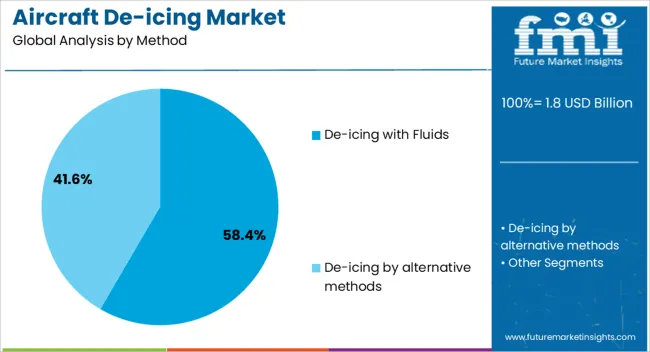
The de-icing with fluids segment dominates the market with a 58.4% share, largely due to its speed, reliability, and adaptability across aircraft models. This method remains the global standard for removing frost and ice buildup, and its growth is supported by advancements in glycol-based and eco-friendly formulations.
On the product front, de-icing chemicals and fluids represent the largest offering, accounting for 62.7% of market share. High-performance formulations, including Type I and Type IV fluids, continue to see strong demand from commercial airlines seeking regulatory compliance and reliable protection.
The commercial aviation segment holds approximately 71.5% of market share, highlighting the critical importance of de-icing in maintaining on-time performance across global passenger and cargo operations. Investments in automated de-icing systems, digital monitoring tools, and eco-optimized fluids have become integral to the commercial sector’s operations.
Regional Market Highlights: Asia-Pacific Takes the Lead
China remains the frontrunner with a 6.2% CAGR, driven by its expanding aviation network and integration of automated de-icing systems. Collaborative projects between domestic manufacturers and international suppliers are promoting the use of biodegradable fluids and high-efficiency systems.
India, growing at 5.8%, is experiencing rapid adoption of automated spray systems and high-performance fluids, particularly across airports in northern regions prone to winter weather. Partnerships between global equipment providers and local service firms are advancing operational reliability.
In Europe, Germany (5.3% CAGR) and the UK (4.4% CAGR) are at the forefront of regulatory compliance and efficiency upgrades. Germany’s investment in predictive maintenance and weather monitoring systems enables precise de-icing scheduling, while the UK focuses on eco-friendly fluid adoption and airport readiness programs.
The United States, with a 3.9% CAGR, continues to prioritize modernization and environmental responsibility, with leading companies like Textron Ground Support Equipment Inc., Tronair Inc., and Vestergaard Company focusing on innovation and performance optimization.
Environmental Sustainability: A Central Market Driver
Environmental responsibility has evolved from a secondary consideration to a defining market force. The adoption of biodegradable, low-toxicity fluids and fluid recovery systems demonstrates how sustainability is now embedded in de-icing operations. Airports in regions like Europe and North America are investing in advanced fluid recycling technologies to limit waste and chemical runoff, aligning with global environmental mandates.
Companies such as Inland Technologies and Ground Support Specialists are developing closed-loop systems that reclaim and purify used de-icing fluids, reducing operational waste and lowering costs. The growing alignment between aviation safety and environmental sustainability reflects a broader industry transformation toward responsible innovation.
Competitive Landscape: Innovation and Integration Lead the Way
The aircraft de-icing market is defined by a balance between chemical formulation innovators and equipment solution providers. Global leaders such as BASF SE, Clariant, Cryotech (General Atomics), and DuPont are at the forefront of fluid innovation, while Tronair, Textron Ground Support, and Oshkosh Aerotech focus on advanced de-icing vehicle systems.
Purchase this Report for USD 5,000 Only | Get an Exclusive Discount Instantly! https://www.futuremarketinsights.com/checkout/26054
Everything You Need—within Your Budget. Request a Special Price Now! https://www.futuremarketinsights.com/reports/sample/rep-gb-26054
About Future Market Insights (FMI)
Future Market Insights, Inc. (ESOMAR certified, recipient of the Stevie Award, and a member of the Greater New York Chamber of Commerce) offers profound insights into the driving factors that are boosting demand in the market. FMI stands as the leading global provider of market intelligence, advisory services, consulting, and events for the Packaging, Food and Beverage, Consumer Technology, Healthcare, Industrial, and Chemicals markets. With a vast team of over 400 analysts worldwide, FMI provides global, regional, and local expertise on diverse domains and industry trends across more than 110 countries.
Contact Us:
Future Market Insights Inc.
Christiana Corporate, 200 Continental Drive,
Suite 401, Newark, Delaware – 19713, USA
T: +1-347-918-3531
For Sales Enquiries: sales@futuremarketinsights.com
Website: https://www.futuremarketinsights.com
LinkedIn| Twitter| Blogs | YouTube