The global alternative fuel vehicles (AFV) market is on an impressive trajectory, valued at USD 912.4 billion in 2025 and projected to soar to USD 3,564.9 billion by 2035. Registering a robust CAGR of 14.6%, the market’s rise reflects a worldwide transformation in transportation priorities—toward sustainability, energy diversification, and technological modernization. This shift is underpinned by emission control mandates, fuel efficiency standards, and a wave of government incentives supporting the deployment of low- and zero-emission vehicles.
The surge in adoption of electric, hydrogen, and hybrid vehicles is more than a consumer trend—it’s the outcome of cohesive policy frameworks, stringent environmental regulations, and massive investment in sustainable transport infrastructure. Between 2025 and 2035, regulatory momentum, technology diversification, and infrastructure expansion will be key to the market’s growth, reshaping both consumer and industrial mobility worldwide.
Regulatory Support and Policy Frameworks Drive Market Expansion
Government actions have been pivotal in transforming the AFV landscape. Across the U.S., Europe, and Asia-Pacific, emission targets for internal combustion engines are tightening, compelling manufacturers to innovate rapidly. Tax credits, subsidies, and rebates for electric and hydrogen fuel cell vehicles have eased adoption barriers, while heavy penalties on high-emission models have prompted fleet transitions across logistics and public transport sectors.
Policy instruments now extend beyond subsidies—they encompass mandatory fleet electrification programs, infrastructure development grants, and safety and performance standards that enhance consumer trust. From the U.S. Department of Energy’s clean vehicle incentives to the European Green Deal’s emission-free mobility goals, regulation has evolved into a powerful market accelerator. The cumulative impact has transformed compliance into opportunity, encouraging both established automakers and new entrants to invest in scalable, energy-efficient mobility solutions.
Electric Vehicles Lead the Transition to Clean Mobility
Among alternative fuel types, electric vehicles (EVs) remain the undisputed market leader, commanding approximately 51.6% of total market share in 2025. This dominance stems from rapid advancements in battery technology, cost reductions in lithium-ion cells, and widespread charging network development.
Automotive giants such as Tesla, BYD, BMW, Toyota, and Hyundai have continued to refine EV performance through longer ranges, faster charging, and enhanced software integration. The rise of solid-state batteries, modular platforms, and smart energy management systems has further propelled adoption.
Governments worldwide have recognized the significance of electrification. Public and private collaborations in charging infrastructure, coupled with urban low-emission zone initiatives, have enabled wider accessibility. The electric vehicle segment is thus not only a technological breakthrough but also the foundation of a sustainable transportation future.
Passenger Vehicles Dominate with Urban and Suburban Demand
Passenger vehicles account for roughly 62.4% of the alternative fuel vehicle market, driven by the growing demand for personal eco-friendly mobility. Urban consumers are increasingly choosing electric and hybrid cars over traditional combustion vehicles, supported by incentives like reduced road taxes, toll exemptions, and free parking in emission-controlled zones.
Manufacturers are responding with expanded product portfolios across all price tiers—from compact urban EVs to high-performance electric SUVs. Companies such as Honda, Ford, and Mercedes-Benz are enhancing consumer accessibility through subscription-based ownership models, financing options, and integrated charging packages.
As city governments worldwide pursue carbon neutrality, personal transportation is at the forefront of this green evolution. The continued surge in passenger vehicle electrification underscores a social shift toward sustainable living and energy responsibility.
Commercial & Fleet Segment Gains Traction with Cost Efficiency
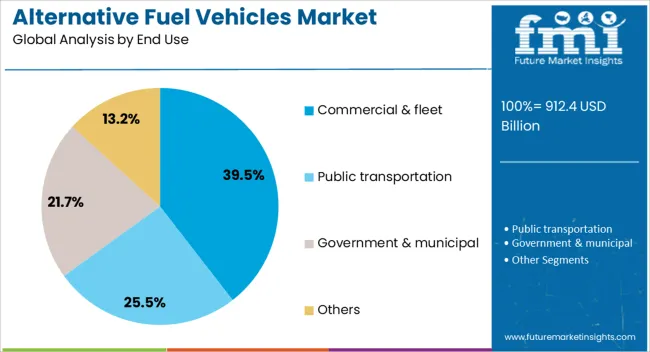
The commercial and fleet vehicle segment, accounting for about 39.5% of the AFV market, is emerging as one of the strongest growth engines. Logistics operators, e-commerce companies, and municipal transport authorities are transitioning to electric, hybrid, and hydrogen-powered fleets to meet sustainability commitments and reduce operational costs.
Fleet electrification offers tangible benefits: lower fuel and maintenance expenses, regulatory compliance, and enhanced brand reputation. Industry leaders like Ford Motor, General Motors, and Toyota are partnering with fleet management companies and energy providers to deploy integrated charging hubs and telematics systems. These innovations support route optimization, real-time performance analytics, and long-term cost efficiency.
As global supply chains modernize, commercial fleets represent a vital segment for large-scale adoption, particularly in last-mile delivery and urban logistics.
Technological Innovation Fuels the Next Decade of Growth
The next wave of AFV growth will be powered by advancements in electrification, hydrogen fuel cells, and connected mobility. Breakthroughs in battery chemistry—especially solid-state and graphene-based systems—are expected to reduce charging times and increase durability. Hydrogen-powered vehicles, favored for their fast refueling and long range, are gaining prominence in heavy-duty transport sectors.
Furthermore, automakers are integrating artificial intelligence and Internet of Things (IoT) solutions to enhance vehicle monitoring, predictive maintenance, and energy optimization. As mobility becomes smarter and cleaner, AFVs are evolving from an alternative to a mainstream standard.
Regional Analysis: Asia-Pacific and Europe Lead Global Adoption
Asia-Pacific dominates global AFV production and consumption, with China and India at the forefront. China alone is projected to record a 19.7% CAGR, supported by strong domestic manufacturing, extensive charging networks, and government subsidies. India follows with 18.3%, propelled by local EV production, startup innovation, and government initiatives such as the FAME II program.
In Europe, countries like Germany (16.8%), France (15.3%), and the UK (13.9%) are advancing through stringent emission regulations, infrastructure investments, and consumer incentives. The European Union’s ban on new combustion engine car sales by 2035 has provided additional momentum.
Meanwhile, the United States continues to expand its EV ecosystem with a 12.4% CAGR, driven by federal tax credits, state-level incentives, and major automaker commitments to full electrification. North America’s focus on energy independence and sustainable infrastructure will remain a cornerstone of AFV expansion in the coming decade.
Competitive Landscape: Innovation and Partnerships Define Leadership
The global alternative fuel vehicles market is characterized by dynamic competition between established automotive leaders and emerging innovators. Major players—including Audi, BMW, Mercedes-Benz, BYD Company, Toyota, Hyundai Motor, Ford Motor, General Motors, Honda Motors, and Fiat Chrysler Automobiles—are shaping the industry through aggressive R&D, sustainability targets, and strategic partnerships.
Collaborations between automakers, battery manufacturers, and renewable energy providers are accelerating the transition to clean mobility. Companies are investing heavily in circular battery recycling, sustainable materials, and intelligent manufacturing.
Purchase this Report for USD 5,000 Only | Get an Exclusive Discount Instantly! https://www.futuremarketinsights.com/checkout/26049
Everything You Need—within Your Budget. Request a Special Price Now! https://www.futuremarketinsights.com/reports/sample/rep-gb-26049
About Future Market Insights (FMI)
Future Market Insights, Inc. (ESOMAR certified, recipient of the Stevie Award, and a member of the Greater New York Chamber of Commerce) offers profound insights into the driving factors that are boosting demand in the market. FMI stands as the leading global provider of market intelligence, advisory services, consulting, and events for the Packaging, Food and Beverage, Consumer Technology, Healthcare, Industrial, and Chemicals markets. With a vast team of over 400 analysts worldwide, FMI provides global, regional, and local expertise on diverse domains and industry trends across more than 110 countries.
Contact Us:
Future Market Insights Inc.
Christiana Corporate, 200 Continental Drive,
Suite 401, Newark, Delaware – 19713, USA
T: +1-347-918-3531
For Sales Enquiries: sales@futuremarketinsights.com
Website: https://www.futuremarketinsights.com
LinkedIn| Twitter| Blogs | YouTube