

The aerospace forging materials market is entering a transformative phase, projected to expand from USD 13.5 billion in 2025 to USD 23.8 billion by 2035, growing at a CAGR of 5.8%. This steady rise reflects the aerospace industry’s demand for lightweight, high-strength, and durable materials that can withstand extreme operating conditions in both commercial and defense aviation.
Between 2021 and 2025, the sector demonstrated strong resilience, growing from USD 10.2 billion to USD 13.5 billion. This consistent expansion has been underpinned by the integration of advanced alloys—particularly titanium, nickel-based superalloys, and aerospace-grade aluminum—into mission-critical aircraft components such as landing gear, airframes, and engine shafts.
Driving Forces Behind the Market Momentum
The industry’s trajectory is defined by global shifts in aviation. Rising air travel, modernization of defense fleets, and the push toward next-generation aircraft designs are driving demand for forging materials that combine strength with reduced weight. These materials are not only critical for enhancing aircraft performance but are also instrumental in meeting stricter safety and sustainability standards.
With new aircraft production accelerating and aging fleets requiring replacement, aerospace manufacturers are turning to high-performance alloys like titanium, known for its superior strength-to-weight ratio and corrosion resistance. Simultaneously, nickel-based alloys are becoming indispensable in high-temperature engine environments, while aluminum continues to serve as a versatile material for airframe construction.
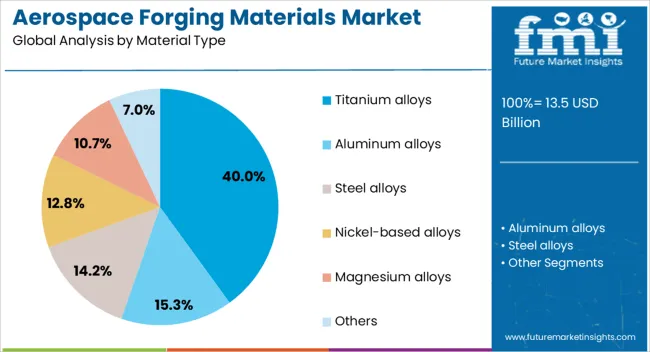
Titanium and Closed Die Forging Take the Lead
Titanium alloys are expected to dominate the aerospace forging materials market with a 40% revenue share in 2025. Their exceptional performance under high stress and compatibility with precision forging techniques make them the backbone of modern aerospace manufacturing.
In terms of techniques, closed die forging remains the industry’s cornerstone, anticipated to command 55% of market share by 2025. This method allows manufacturers to deliver complex, high-precision components with superior mechanical properties—vital for critical aerospace applications such as turbine blades and landing gear assemblies.
Airframe Components as the Largest Application Segment
Airframe components will account for 32.5% of the aerospace forging materials market in 2025. The integrity of an aircraft’s frame is non-negotiable, requiring materials that deliver durability, fatigue resistance, and performance under fluctuating stresses. Forged alloys have become indispensable in achieving lighter, stronger, and safer airframes, aligning with the industry’s focus on fuel efficiency and long service life.
Opportunities and Challenges in a Changing Market
The aerospace forging materials sector stands at the intersection of innovation and challenge. On one hand, technological advancements such as near-net forging, isothermal processes, and hybrid additive-forge methods are reducing waste and enabling more complex geometries. On the other hand, the industry faces hurdles including rising raw material costs, qualification barriers, and supply chain vulnerabilities tied to geopolitical uncertainties.
Capacity constraints in large-scale forging presses, shortages of skilled metallurgists, and fluctuating energy prices add further complexities. However, companies investing in larger presses, advanced die designs, and predictive digital technologies are well-positioned to capture new growth opportunities.
Regional Dynamics: Growth Anchored in Asia and Europe
The global market outlook highlights regional differences in growth trajectories. China is expected to lead with a CAGR of 7.8%, fueled by booming aircraft production and government-backed aerospace programs. India follows closely with a 7.3% CAGR, driven by its defense modernization efforts and the “Make in India” initiative that strengthens domestic aerospace manufacturing.
Germany remains a hub of innovation in Europe, growing at 6.7% CAGR with strong demand for titanium and nickel-based alloys. The United Kingdom, with its established aerospace and engine manufacturing expertise, is projected to expand at 5.5% CAGR. Meanwhile, the United States, despite its mature market, continues to demonstrate steady growth at 4.9%, supported by defense budgets, commercial aircraft programs, and expanding space exploration initiatives.
Competitive Landscape: Established Leaders and Emerging Challengers
The aerospace forging materials market is highly competitive, with a handful of established global leaders and a rising group of regional players seeking to expand. Howmet Aerospace stands out with a broad catalog spanning titanium mill products, forged rings, and structural components. Bharat Forge, headquartered in India, is expanding aggressively with AS9100-certified facilities and new investments in ring mill technology.
Arconic continues to play a crucial role at the feedstock and structural level, providing high-strength alloys for fuselage and wing components. Scot Forge holds its niche in large-diameter open-die forgings and rolled rings for high-load aerospace applications, while Larsen & Toubro (L&T) brings multidisciplinary engineering expertise to complex build-to-print packages.
Emerging players across Asia-Pacific and Eastern Europe are also gaining momentum, investing in advanced forging technologies to meet international standards and capture new contracts. These newcomers represent both competition and collaboration opportunities for established manufacturers, broadening the global aerospace supply chain.
Purchase this Report for USD 5,000 Only | Get an Exclusive Discount Instantly! https://www.futuremarketinsights.com/checkout/24742
Everything You Need—within Your Budget. Request a Special Price Now! https://www.futuremarketinsights.com/reports/sample/rep-gb-24742
About Future Market Insights (FMI)
Future Market Insights, Inc. (ESOMAR certified, recipient of the Stevie Award, and a member of the Greater New York Chamber of Commerce) offers profound insights into the driving factors that are boosting demand in the market. FMI stands as the leading global provider of market intelligence, advisory services, consulting, and events for the Packaging, Food and Beverage, Consumer Technology, Healthcare, Industrial, and Chemicals markets. With a vast team of over 400 analysts worldwide, FMI provides global, regional, and local expertise on diverse domains and industry trends across more than 110 countries.
Contact Us:
Future Market Insights Inc.
Christiana Corporate, 200 Continental Drive,
Suite 401, Newark, Delaware – 19713, USA
T: +1-347-918-3531
For Sales Enquiries: sales@futuremarketinsights.com
Website: https://www.futuremarketinsights.com
LinkedIn| Twitter| Blogs | YouTube
