The Asia Pacific stick packaging machines market is on an impressive upward trajectory, reflecting both evolving consumer lifestyles and the rapid adoption of innovative packaging technologies. Valued at USD 213.7 billion in 2025, the market is forecast to expand to USD 353.5 billion by 2035, representing a compound annual growth rate of 5.2%.
This expansion reflects the increasing demand for portion-controlled, portable, and sustainable packaging solutions across diverse industries, from food and beverage to pharmaceuticals, cosmetics, and personal care.
Stakeholders—ranging from established manufacturers to new entrants—are finding fertile ground to expand operations, invest in new technologies, and capture market share in a dynamic region where urbanization, rising disposable incomes, and a preference for convenience are reshaping the packaging landscape.
Why the Market is Growing
The surge in demand for stick packaging machines is closely tied to lifestyle shifts. Consumers in Asia Pacific are increasingly seeking compact, travel-friendly packaging for everyday items like instant coffee, spices, sugar, medicines, skincare products, and cosmetics. The region’s fast-growing e-commerce industry further amplifies this trend, as packaging needs to be lightweight, durable, and attractive while minimizing waste.
Stick packs not only deliver convenience but also meet growing regulatory and consumer expectations around sustainability. Manufacturers are adopting machines with advanced automation, improved sealing mechanisms, and digital control systems to keep pace with the dual demands of efficiency and eco-friendly operations.
Segmental Insights
Vertical Form Fill Seal (VFFS) Machines Dominate
Among machine types, Vertical Form Fill Seal (VFFS) machines are expected to lead with a 57.3% market share in 2025. Their efficiency in material usage, versatility in handling multiple formats, and cost-effectiveness make them an essential choice for food, pharmaceutical, and personal care manufacturers. Their ability to deliver high-speed production while accommodating sustainability requirements ensures they remain the backbone of packaging operations in the region.
Single Lane Machines Serve SMEs
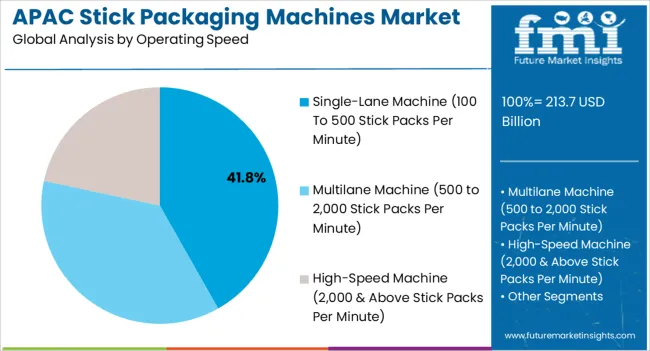
The single lane machine segment, operating at speeds of 100 to 500 stick packs per minute, is projected to hold 41.8% of revenues by 2025. This reflects strong demand from small and medium-sized enterprises that prioritize efficiency and affordability without compromising quality. These machines, known for their compact footprint and low maintenance, are especially appealing to growing businesses eager to scale up production capacity.
Granules Hold the Lead in Product Form
By product form, granules are expected to account for 44.6% of market share in 2025, driven largely by the need for precise packaging of sugar, coffee, spices, and pharmaceutical granules. The rising consumption of instant beverages and ready-to-mix products underscores the strength of this segment. Granule-based stick packs offer consistent dosing, enhanced shelf life, and consumer-friendly convenience—all critical factors in today’s fast-moving retail and e-commerce ecosystems.
Consumer Trends: Personal Care and Cosmetics
Beyond food and beverages, personal care and cosmetics are emerging as powerful drivers of stick packaging adoption. Consumers increasingly prefer skincare, haircare, and cosmetic products in stick formats for their portability, ease of use, and precise application. Stick packaging machines allow companies to deliver compact and sleek designs that elevate branding while offering controlled dosage—an essential attribute in beauty and healthcare products.
Cosmogen’s 2025 launch of its patented FSC-certified paper stick highlights how innovation and sustainability are converging in the cosmetics segment, paving the way for more eco-conscious packaging solutions.
Regional Outlook
China will retain the largest share of the Asia Pacific stick packaging machines market with 39.5% in 2025, though this will moderate slightly to 37.3% by 2035. India, meanwhile, is poised for robust growth, expanding from 22.7% to 24.0% market share over the same period. India’s booming retail sector, projected to hit USD 2 trillion by 2035, and its rising demand for single-serve pharmaceuticals, food, and personal care products make it a significant hub for machine manufacturers.
Japan continues to stand out for its cosmetics and personal care market, accounting for 15.9% of share in 2025. The country’s focus on premium skincare and haircare products positions it as a strong adopter of sachet stick packaging machines. South Korea, ASEAN nations, and Australia & New Zealand also show steady growth, reflecting a broad regional embrace of stick packaging.
Competitive Landscape
The market is highly competitive, with global leaders and regional innovators investing heavily in product development and partnerships. Key players include Omori Machinery Co., Ltd., Pakona Engineers, Perfect Automation Pty Ltd., Emrich Packaging Machinery Pty Ltd., TNA Australia Pty Ltd., Mentpack Packaging Machines, Mespack SL, Sanko Machinery Co. Ltd., UFlex Ltd., Syntegon Technology GmbH, Korber AG, Marchesini Group S.p.A, TOYO MACHINE MANUFACTURING CO., LTD., Wraptech Machines Pvt. Ltd., IMA Group, and BSP Packaging Co Ltd.
These companies are focusing on expanding multi-lane capabilities, enhancing machine flexibility, and developing sustainable solutions. In 2025, for instance, Mespack SL launched a compact stick-pack machine tailored for the pharmaceutical sector and later partnered with Famartec to deliver integrated primary and secondary packaging solutions. Such innovations are reshaping the market and inspiring new entrants to explore niche opportunities.
Outlook for Stakeholders
For stakeholders—including established players, suppliers, distributors, and investors—the Asia Pacific stick packaging machines market offers a wealth of opportunities. While challenges such as high initial costs, technical complexities, and lack of standardization exist, the overall momentum points to sustained growth.
As automation deepens, sustainability becomes non-negotiable, and consumer demand for convenience continues to rise, companies that invest early in cutting-edge technologies and eco-friendly solutions will stand out. For new manufacturers, partnerships and collaborations provide a strategic path into this high-potential market.
Purchase this Report for USD 5,000 Only | Get an Exclusive Discount Instantly! https://www.futuremarketinsights.com/checkout/17482
Everything You Need—within Your Budget. Request a Special Price Now! https://www.futuremarketinsights.com/reports/sample/rep-gb-17482
About Future Market Insights (FMI)
Future Market Insights, Inc. (ESOMAR certified, recipient of the Stevie Award, and a member of the Greater New York Chamber of Commerce) offers profound insights into the driving factors that are boosting demand in the market. FMI stands as the leading global provider of market intelligence, advisory services, consulting, and events for the Packaging, Food and Beverage, Consumer Technology, Healthcare, Industrial, and Chemicals markets. With a vast team of over 400 analysts worldwide, FMI provides global, regional, and local expertise on diverse domains and industry trends across more than 110 countries.
Contact Us:
Future Market Insights Inc.
Christiana Corporate, 200 Continental Drive,
Suite 401, Newark, Delaware – 19713, USA
T: +1-347-918-3531
For Sales Enquiries: sales@futuremarketinsights.com
Website: https://www.futuremarketinsights.com
LinkedIn| Twitter| Blogs | YouTube