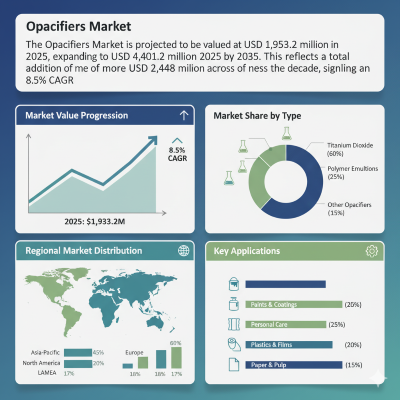
The global Opacifiers Market is projected to witness remarkable expansion from USD 1,953.2 million in 2025 to USD 4,401.2 million by 2035, registering a steady 8.5% CAGR. This surge—adding over USD 2,448 million across the decade—underscores the growing role of opacifiers in enhancing the appearance, texture, and performance of personal care, cosmetics, and industrial formulations.
As brands race to deliver uniform, sensory-rich, and sustainable products, both established industry leaders and new entrants are investing heavily in next-generation technologies, particularly in liquid dispersion systems that now command 52.6% of the global market.
Get this Report at $2000 | Grab Your Market Insights Today: https://www.futuremarketinsights.com/reports/sample/rep-gb-26547
Steady Growth Driven by Performance and Sustainability
Between 2025 and 2030, the market is expected to climb from USD 1,953.2 million to USD 2,932.0 million, accounting for nearly 40% of total decade growth. This early phase will be dominated by mass and premium personal care categories—such as shampoos, lotions, and conditioners—where consumers increasingly link product opacity with quality and luxury.
The second half of the forecast period (2030–2035) is poised for sharper gains, adding more than USD 1,469 million in incremental value. Rising demand for premium appearance-enhancing formulations, which already account for 47.1% of the market in 2025, will remain a defining growth driver. Markets like China and India are expected to outpace mature economies, while North America and Europe sustain expansion through compliance-driven reformulations and stable specification lock-ins.
Regional Insights: Asia Leads Global Momentum
The Asia Pacific region is emerging as the powerhouse of opacifier growth.
- India is forecast to register the fastest CAGR of 11.3%, fueled by capacity expansions in domestic manufacturing and premiumization trends in urban retail. Local contract manufacturing organizations (CMOs) are rapidly adopting dispersion-stable systems to meet large-scale production requirements.
- China, with a 10.0% CAGR, continues to lead in innovation and scale, driven by strong demand for premium beauty, rapid product refresh cycles, and compliance-focused reformulations.
- Japan (8.1% CAGR) showcases advanced adoption of liquid dispersions in high-value formulations emphasizing precision and consistency.
Meanwhile, Europe—particularly the UK (6.5%) and Germany (4.9%)—maintains its reputation for stringent sustainability and regulatory standards. The U.S. market, valued at USD 485.93 million in 2025, will experience moderate yet consistent growth at 4.2% CAGR, reaching USD 973.31 million by 2035.
Segment Analysis: Titanium Dioxide and Liquid Dispersions Remain Key
Chemistry Segment:
Titanium dioxide remains the cornerstone of opacifier chemistry, holding a 48.3% market share in 2025 (USD 943.40 million). Despite regulatory pressures, its reliability, opacity, and cost efficiency continue to make it indispensable for both mass and premium applications. However, alternative systems are gaining traction as brands pursue clean-label and eco-compliant formulations.
Function Segment:
Appearance enhancement dominates with a 47.1% share, worth USD 919.96 million in 2025. As consumer expectations evolve toward richer textures and consistent opacity, this function remains central to brand differentiation and premium positioning.
Physical Form Segment:
Liquid dispersion leads with a 52.6% market share, valued at USD 1,027.38 million in 2025, reflecting its operational advantages—faster processing, reduced dust exposure, and enhanced color uniformity. This form continues to anchor large-scale personal care and home care manufacturing.
Key Growth Drivers and Emerging Trends
- Regulatory and Sustainability Reformulations:
Tightening global regulations are accelerating reformulation cycles. Manufacturers are pivoting toward biodegradable and compliant chemistries, with growing emphasis on lifecycle assessments and environmental impact transparency. - Premiumization and Texture Innovation:
The rise of premium and “masstige” brands has made opacity synonymous with quality. This shift is fueling innovation in dispersion stability and dosage efficiency, enabling brands to achieve superior appearance at reduced environmental cost. - Supply Chain Localization:
To counter raw material volatility, global players are establishing regional manufacturing bases and dual-sourcing models. These measures not only stabilize supply but also shorten qualification timelines and improve process control.
Competitive Landscape: Collaboration and Innovation at the Forefront
The Opacifiers Market remains moderately fragmented, with BASF leading at 8.1% global share in 2025. The company’s recent launch of Lamesoft OP Plus, a natural wax-based biodegradable opacifier introduced at in-cosmetics Global 2025, marked a pivotal shift toward sustainable solutions.
Other major participants include Clariant, Dow, Evonik, Croda, Ashland, Wacker Chemie, Sensient, Lubrizol, and Kobo Products, all of which are focusing on dispersion stability, regulatory compliance, and efficient chemistries to cater to both mass and premium personal care applications.
In June 2025, Syensqo unveiled Miracare Biopacify in Europe—a biodegradable opacifier designed for detergents and pouch systems, compliant with EU microplastic restrictions. Industry analysts hailed this as a breakthrough aligning opacity performance with sustainability mandates.
These advancements reflect a broader trend: competition is shifting from commodity supply to integrated, sustainable value propositions, where manufacturers that offer lifecycle transparency, documentation depth, and technical service partnerships will gain strategic edge.
Looking Ahead: Opportunities for Emerging Players
The next decade promises vast opportunities for new entrants and smaller manufacturers aiming to capture niche segments through technology differentiation. Partnerships with multinational formulators, investments in localized production, and innovations in eco-certified opacifiers are set to define the competitive landscape.
As opacity, texture, and sensory performance continue to influence consumer perception, the opacifiers market will remain indispensable to the personal care and industrial sectors. With sustainability shaping every formulation and manufacturing decision, companies capable of blending technical performance with environmental responsibility will lead the next era of market growth.
Access Premium Reports – Get Your Copy Today: https://www.futuremarketinsights.com/checkout/26547
Report Title: Opacifiers Market Size and Share Forecast Outlook 2025 to 2035
Forecast Period: 2025–2035
Market Value: USD 1,953.2 Million (2025) → USD 4,401.2 Million (2035)
CAGR: 8.5%
Leading Form: Liquid Dispersion (52.6%)
Top Regions: China, India, North America, Europe
Key Players: BASF, Clariant, Dow, Evonik, Croda, Ashland, Wacker Chemie, Sensient, Lubrizol, Kobo Products
About Future Market Insights (FMI)
Future Market Insights, Inc. (ESOMAR certified, recipient of the Stevie Award, and a member of the Greater New York Chamber of Commerce) offers profound insights into the driving factors that are boosting demand in the market. FMI stands as the leading global provider of market intelligence, advisory services, consulting, and events for the Packaging, Food and Beverage, Consumer Technology, Healthcare, Industrial, and Chemicals markets. With a vast team of over 400 analysts worldwide, FMI provides global, regional, and local expertise on diverse domains and industry trends across more than 110 countries.
Contact Us:
Future Market Insights Inc.
Christiana Corporate, 200 Continental Drive,
Suite 401, Newark, Delaware – 19713, USA
T: +1-347-918-3531
For Sales Enquiries: sales@futuremarketinsights.com
Website: https://www.futuremarketinsights.com
LinkedIn| Twitter| Blogs | YouTube