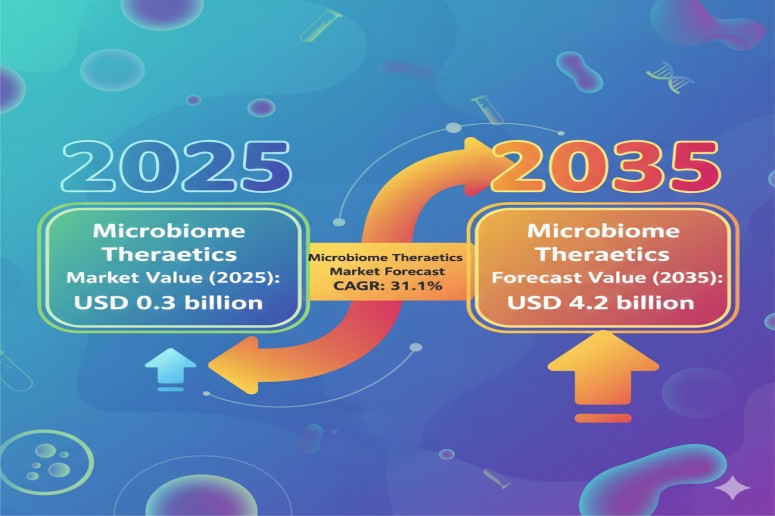
The global Microbiome Therapeutics Market is on the verge of a transformative decade. Valued at USD 0.3 billion in 2025, the market is projected to reach an impressive USD 4.2 billion by 2035, expanding at a CAGR of 31.1%. This surge reflects the increasing recognition of the human microbiome’s crucial role in health, disease prevention, and personalized medicine.
Growing Awareness and Advancements in Microbiome Research
The microbiome therapeutics industry is witnessing exponential growth driven by a deeper understanding of how gut and microbial health influence overall human well-being. With rising cases of lifestyle-related disorders, gastrointestinal diseases, and metabolic syndromes, demand for targeted microbiome-based therapies is on the rise. Researchers and companies alike are leveraging genomics, metagenomics, and bioinformatics to design precision-based therapeutics tailored to an individual’s microbiome composition.
Rising Collaboration Among Established and Emerging Players
The microbiome therapeutics space is characterized by robust partnerships between pharmaceutical giants and biotechnology innovators. For instance, Vedanta Biosciences, a trailblazer in microbiome drug development, recently licensed its investigational IBD therapy (VE-202) to Johnson & Johnson, reflecting growing confidence from established pharma leaders. Similarly, Synlogic has joined forces with AbbVie to co-develop novel microbiome-derived medicines targeting inflammatory bowel diseases.
Leading players such as Seres Therapeutics, Enterome, Ferring Pharmaceuticals, and Finch are pushing the frontiers of microbial therapy through advanced clinical-stage programs. Meanwhile, new entrants like AOB Pharma, MaaT Pharma, and Intralytix are exploring innovative delivery systems and combination therapies to expand the potential applications of microbiome science. This synergy between legacy firms and agile startups underscores a maturing ecosystem primed for technological disruption and therapeutic breakthroughs.
Probiotics Segment: The Cornerstone of Market Growth
Among all product types, probiotics dominate the microbiome therapeutics landscape, accounting for an estimated 41.2% market share in 2025. Their efficacy in managing digestive disorders, enhancing immunity, and improving overall metabolic health continues to drive strong adoption. Probiotics are increasingly integrated into dietary supplements, functional foods, and clinical-grade therapies, bridging the gap between consumer health and medical treatment.
Ongoing innovations in strain development, encapsulation technologies, and targeted delivery systems are improving product efficacy and expanding clinical applications. As the global focus shifts toward preventive healthcare, probiotics are expected to maintain their leadership through clinical validation, safety, and high consumer trust.
Hospital Pharmacies: Strengthening Clinical Integration
The hospital pharmacies distribution channel is anticipated to hold 33.8% of the market share in 2025, making it the leading sales channel. The growing reliance on hospital pharmacies stems from the need for regulated dispensing, accurate dosing, and patient monitoring—particularly for chronic conditions such as irritable bowel syndrome, Crohn’s disease, and metabolic syndromes.
Hospitals are increasingly integrating microbiome therapies into standard treatment pathways, ensuring physician oversight and improved patient compliance. This regulated environment not only reinforces confidence among healthcare professionals but also strengthens therapeutic outcomes. With rising hospital admissions for gastrointestinal and immune-related conditions, hospital pharmacies will continue to play a critical role in market expansion and clinical trust-building.
Digestive Health: The Leading Application Segment
The digestive health segment, projected to hold 39.3% of total revenue in 2025, represents the largest application area for microbiome therapeutics. The global burden of digestive disorders such as inflammatory bowel disease (IBD), irritable bowel syndrome (IBS), and chronic constipation has driven the need for therapies that restore microbial balance and enhance gut health.
Consumer awareness of the gut-brain axis—and its link to mental wellness and overall immunity—has also strengthened demand for microbiome-based interventions. Moreover, the integration of probiotics and synbiotics into functional foods and beverages is expanding accessibility, reaching consumers through everyday products. As digestive health remains central to preventive medicine, this segment is expected to maintain dominance, supported by continuous clinical validation and innovation.
Regional Insights: Asia-Pacific Leads the Growth Trajectory
The microbiome therapeutics market demonstrates diverse growth dynamics across regions. China is forecast to lead the global expansion with an astounding CAGR of 42.0%, followed closely by India (38.9%) and Germany (35.8%). The surge in Asia-Pacific reflects rising healthcare investments, growing consumer awareness, and government-backed initiatives to promote gut health and preventive medicine.
Meanwhile, the United States, estimated at USD 96.6 million in 2025, is projected to surpass USD 1.0 billion by 2035, growing at a CAGR of 26.4%. Developed markets in Western Europe, including France and the UK, continue to post steady growth, while emerging markets like Brazil are expected to expand at a solid pace of 23.3% CAGR.
Innovative Technologies and the Future Outlook
The next decade is poised to redefine microbiome therapeutics through the integration of artificial intelligence (AI), machine learning, and metagenomic sequencing. These technologies are enhancing microbiome profiling, predictive modeling, and drug discovery, enabling companies to develop precision-based microbial therapies with higher efficacy and safety.
Additionally, advancements in formulation science, delivery systems, and next-generation sequencing (NGS) are driving the evolution of personalized microbiome interventions. As companies increasingly adopt AI-driven bioinformatics platforms, the ability to decode microbial signatures and design targeted therapies will significantly accelerate.
Key Players Transforming the Market Landscape
Prominent industry participants include Aardvark Therapeutics, AOB Pharma, Enterome, Ferring Pharmaceuticals, Finch, Inlife, Intralytix, LNC Therapeutics, MaaT Pharma, OPENBIOME, Seres Therapeutics, and Vedanta Biosciences. These companies are spearheading advancements in clinical microbiology, bioinformatics, and synthetic biology, ensuring that microbiome-based solutions transition from laboratory innovation to mainstream healthcare adoption.
Both established and emerging manufacturers are expanding their research footprints and forming new technological alliances to address unmet clinical needs. Their efforts are focused on enhancing microbial formulation stability, improving efficacy, and scaling production to meet growing global demand.
Grab This Report Now at Just $5,000 | Limited-Time Discount Offer!
https://www.futuremarketinsights.com/reports/sample/rep-gb-2831
Checkout Now to Access Industry Insights:
https://www.futuremarketinsights.com/checkout/2831
About Future Market Insights (FMI)
Future Market Insights, Inc. (ESOMAR certified, recipient of the Stevie Award, and a member of the Greater New York Chamber of Commerce) offers profound insights into the driving factors that are boosting demand in the market. FMI stands as the leading global provider of market intelligence, advisory services, consulting, and events for the Packaging, Food and Beverage, Consumer Technology, Healthcare, Industrial, and Chemicals markets. With a vast team of over 400 analysts worldwide, FMI provides global, regional, and local expertise on diverse domains and industry trends across more than 110 countries.
Contact Us:
Future Market Insights Inc.
Christiana Corporate, 200 Continental Drive,
Suite 401, Newark, Delaware – 19713, USA
T: +1-347-918-3531
For Sales Enquiries: sales@futuremarketinsights.com
Website: https://www.futuremarketinsights.com
LinkedIn| Twitter| Blogs | YouTube