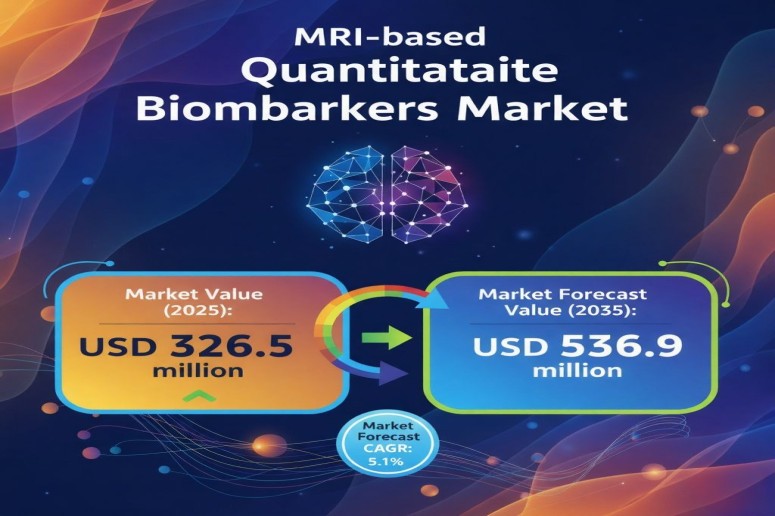
The global MRI-based Quantitative Biomarkers Market is poised for steady and transformative growth, projected to expand from USD 326.5 million in 2025 to USD 536.9 million by 2035, registering a compound annual growth rate (CAGR) of 5.1%. This represents an absolute market expansion of USD 210.4 million, reflecting the growing importance of precision medicine, AI-assisted diagnostics, and the global shift toward data-driven healthcare solutions.
The decade ahead will see MRI-based quantitative biomarkers evolve from niche diagnostic tools into mainstream technologies that enable objective, reproducible, and high-accuracy medical assessments. These biomarkers are becoming indispensable for personalized treatment planning, early disease detection, and real-time monitoring across oncology, neurology, cardiology, and other clinical specialties.
Precision Medicine and AI Lead the Next Wave of Medical Imaging Innovation
Between 2025 and 2030, the market is expected to grow by USD 99.7 million, driven by the rising adoption of quantitative imaging biomarkers and their application in clinical trials and treatment monitoring. As hospitals and diagnostic centers increasingly prioritize automation and measurement accuracy, medical imaging companies are integrating AI and machine learning algorithms into MRI platforms to improve precision and accelerate diagnosis.
From 2030 to 2035, the next phase of expansion—valued at USD 110.7 million—will be characterized by the fusion of AI, deep learning, and predictive modeling within MRI technologies. These innovations will transform traditional image interpretation into quantitative, evidence-based decision-making tools.
Manufacturers such as CaliberMRI, Olea Medical, Biosyn, Invitae, VIDA Diagnostics, Synthetic MR, and Imbio are spearheading these advances. They are investing heavily in R&D, clinical validation programs, and software innovation to ensure that their biomarker solutions meet regulatory and clinical accuracy standards.
A Market Fueled by Precision, Performance, and Personalization
The MRI-based quantitative biomarkers market operates at the intersection of medical imaging, artificial intelligence, and data analytics, offering unmatched potential for innovation. The growing preference for objective diagnostic assessment and standardized measurement protocols is transforming MRI systems into precision diagnostic instruments that go beyond visual interpretation.
Metabolic biomarkers continue to dominate, holding a 23.0% share, due to their critical role in assessing metabolic disorders and monitoring treatment response. Meanwhile, diagnostic imaging centers, representing 31.5% of end-user demand, are emerging as the primary hubs for advanced biomarker deployment, thanks to their investment in next-generation imaging infrastructure and workflow-integrated analytics.
The neurology segment also remains a key growth driver, commanding 24.5% of market share in 2025. Neurological disorders such as Alzheimer’s, Parkinson’s, and multiple sclerosis are increasingly being evaluated using MRI-based biomarkers that quantify subtle changes in brain structure and function—delivering insights previously impossible through traditional imaging techniques.
Opportunity Pathways: A New Frontier for Industry Expansion
- Metabolic Biomarker Technology Leadership:
Companies advancing metabolic quantification algorithms and clinical validation programs are expected to capture up to USD 140 million in revenue. - Diagnostic Imaging Center Integration:
The largest end-user segment, with an opportunity pool of USD 160–180 million, benefits from workflow-optimized, AI-enabled solutions that improve throughput and precision. - Advanced AI and Machine Learning Integration:
Innovators developing deep learning algorithms and predictive modeling solutions stand to gain USD 80–100 million in premium market share. - Geographic Expansion in High-Growth Asian Markets:
With healthcare modernization accelerating in India (7.6% CAGR) and China (6.9% CAGR), local partnerships and cost-effective technology deployment could unlock USD 90–120 million in opportunities. - Clinical Application Specialization:
Disease-specific biomarker development for oncology, neurology, and cardiology can create an additional USD 60–80 million in market value. - Regulatory Compliance and Validation:
Firms investing in FDA and CE approvals and robust clinical validation programs are positioned to gain USD 50–70 million in strategic advantage. - Academic and Research Institution Collaboration:
Research-focused solutions and trial support systems could generate USD 40–60 million in new opportunities. - Enterprise Software and Platform Integration:
AI-powered, cloud-compatible imaging platforms integrating with electronic health records could achieve USD 70–90 million in enterprise-level adoption.
Regional Growth Leaders: Asia Pacific Takes the Lead
The market’s global footprint is expanding, with Asia Pacific emerging as the growth epicenter. India leads with a 7.6% CAGR, fueled by government investment in healthcare infrastructure and modernization of medical imaging capabilities. China follows closely at 6.9%, benefiting from large-scale clinical research initiatives and a robust precision medicine ecosystem.
Brazil is projected to grow at 6.0%, supported by healthcare infrastructure investments and the integration of advanced imaging in public and private hospitals. Europe, led by Germany (2.7%), France (3.6%), and the UK (3.4%), continues to emphasize R&D excellence, clinical validation, and technology standardization.
In the United States, the market maintains steady growth at 2.9%, supported by mature healthcare infrastructure, established adoption of AI in medical imaging, and continued innovation by domestic manufacturers.
Competitive Landscape: Established Leaders and Emerging Innovators
The market remains highly competitive, with both global leaders and emerging firms advancing the next generation of quantitative imaging.
- CaliberMRI leads through innovations in quantitative imaging and AI-powered analysis software.
- Olea Medical continues to deliver advanced visualization tools with global reach.
- Biosyn focuses on biomarker analytics tailored to precision medicine.
- Invitae merges genomics and imaging data to advance personalized medicine.
- VIDA Diagnostics specializes in pulmonary imaging and quantitative assessment tools.
- Synthetic MR and Imbio emphasize automated image processing and workflow optimization for clinical and research settings.
Get this Report at $5,000 Only | Exclusive Discount Inside!
https://www.futuremarketinsights.com/reports/sample/rep-gb-26765
Checkout Now to Access Market Report:
https://www.futuremarketinsights.com/checkout/26765
About Future Market Insights (FMI)
Future Market Insights, Inc. (ESOMAR certified, recipient of the Stevie Award, and a member of the Greater New York Chamber of Commerce) offers profound insights into the driving factors that are boosting demand in the market. FMI stands as the leading global provider of market intelligence, advisory services, consulting, and events for the Packaging, Food and Beverage, Consumer Technology, Healthcare, Industrial, and Chemicals markets. With a vast team of over 400 analysts worldwide, FMI provides global, regional, and local expertise on diverse domains and industry trends across more than 110 countries.
Contact Us:
Future Market Insights Inc.
Christiana Corporate, 200 Continental Drive,
Suite 401, Newark, Delaware – 19713, USA
T: +1-347-918-3531
For Sales Enquiries: sales@futuremarketinsights.com
Website: https://www.futuremarketinsights.com
LinkedIn| Twitter| Blogs | YouTube