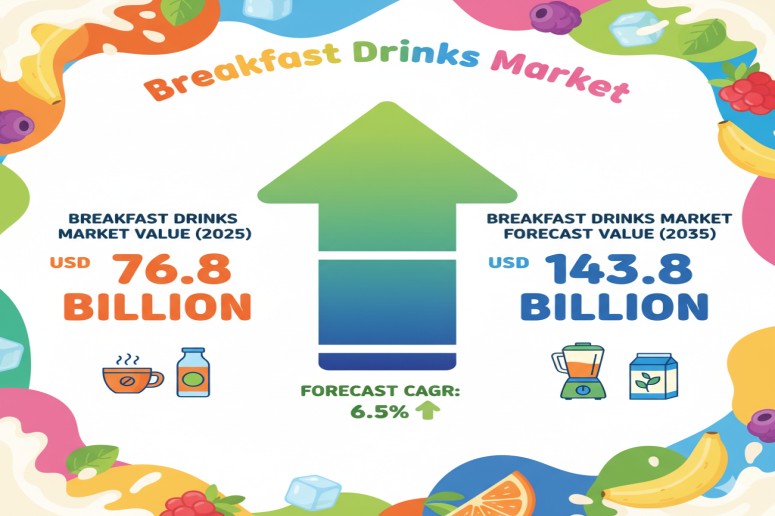
The global Breakfast Drinks Market is poised for substantial expansion, climbing from USD 76.8 billion in 2025 to an impressive USD 143.8 billion by 2035, at a steady CAGR of 6.5%. This growth highlights a major transformation in consumer eating habits—driven by the increasing preference for convenient, nutritious, and portable breakfast options among health-conscious and time-constrained consumers worldwide.
Convenience Meets Nutrition: The Core of Market Growth
The global market for breakfast drinks continues to thrive as consumers shift toward products that combine functionality, nutrition, and convenience. With busier lifestyles and growing awareness of the importance of a balanced diet, individuals are turning to ready-to-drink breakfast beverages that deliver essential nutrients while fitting seamlessly into their daily routines.
Breakfast drinks—typically made by blending cereals, milk, and fortified ingredients—are marketed as healthy, fast, and energy-boosting alternatives to traditional breakfast meals. Their shelf-stable, portable design makes them ideal for working professionals, students, and individuals on the go. Moreover, the rise in single-person households and the increasing participation of women in the workforce are contributing to this changing consumption pattern.
High Protein Segment Leads the Charge
Among various product offerings, high protein breakfast drinks are projected to capture 32.2% of the market revenue in 2025, maintaining their position as the leading segment. The surge in consumer interest toward fitness, muscle recovery, and weight management has positioned protein-enriched beverages as a daily essential rather than a niche product.
Manufacturers are responding with advanced formulation technologies that ensure optimal protein content, smooth texture, and great taste. From whey and soy to plant-based proteins, companies are increasingly using natural, clean-label ingredients that align with consumer demand for transparency and sustainability.
The trend also supports the broader movement toward functional foods, where nutrition and performance go hand in hand. As more consumers seek convenient yet complete meal replacement solutions, the high protein segment will continue to dominate market dynamics.
Carton Packaging: Sustainability and Convenience Combined
In terms of packaging, carton formats are expected to account for 58.4% of market share by 2025, emerging as the most preferred choice among manufacturers and consumers alike. Carton packaging provides a perfect balance between functionality and sustainability—it is lightweight, recyclable, and offers protection against light and oxygen, preserving both taste and nutritional integrity.
Brands are leveraging carton designs to improve portability and shelf life, catering to the growing population of consumers who prefer on-the-go nutrition. Many companies are also introducing resealable single-serve cartons, providing enhanced convenience and supporting the trend toward sustainable, minimal-waste consumption.
Chocolate Flavor Remains the Consumer Favorite
When it comes to flavor, chocolate continues to reign supreme, accounting for 32.1% of total revenue in 2025. Its broad appeal across age groups makes it a staple choice for both children and adults seeking a balance between indulgence and nutrition.
Manufacturers are introducing enhanced chocolate formulations enriched with vitamins, minerals, and protein to ensure that taste and health benefits go hand in hand. The familiarity and comfort associated with chocolate flavor drive repeat purchases and brand loyalty, particularly in established markets such as North America and Europe.
Regional Outlook: Asia-Pacific and North America Drive Growth
Geographically, North America, Asia-Pacific, and Europe remain the most prominent markets for breakfast drinks. The U.S. market alone is projected to grow from USD 27.6 billion in 2025 to USD 47.2 billion by 2035, at a CAGR of 5.5%. Consumers in the region increasingly seek nutritious, portable beverages that align with fast-paced lifestyles.
Meanwhile, Asia-Pacific is emerging as the fastest-growing region, led by China (8.7% CAGR) and India (8.1% CAGR). Rapid urbanization, increasing disposable incomes, and a younger population receptive to Western dietary habits are propelling the demand for breakfast drinks in these markets.
European countries such as Germany (7.5% CAGR), France (6.8%), and the UK (6.2%) are also witnessing a strong shift toward functional, fortified beverages. Even in developing regions like Latin America and the Middle East, the growing emphasis on nutrition and convenience is creating new opportunities for market entrants.
Established Players and Emerging Innovators Reshape the Market
The Breakfast Drinks Market is characterized by a mix of global giants and emerging innovators competing through product differentiation, technology advancement, and sustainability. Key players include Kellogg, Quaker Oats, MOMA, General Mills, Sanitarium, Anchor, Nosh Drinks, Arla Foods, Whole Foods Market, and SmithKline Beecham.
These established brands are investing heavily in R&D, flavor innovation, and nutrient fortification to stay ahead in a market that rewards innovation and health benefits. For instance, Kellogg and Quaker Oats continue to lead through product diversification and global reach, while MOMA and Nosh Drinks focus on niche segments like plant-based and lactose-free offerings.
Emerging players are also finding space by introducing specialized formulations catering to dietary restrictions such as gluten-free, high-fiber, and lactose-free options. Their agility in adapting to evolving consumer preferences gives them a competitive advantage, especially in developing economies.
Innovation and Technology: The Future of Breakfast Drinks
The next decade of growth in the breakfast drinks market will be driven by technological advancements in formulation, packaging, and distribution. Manufacturers are increasingly investing in sustainable sourcing, advanced fortification processes, and intelligent packaging technologies that improve product traceability and freshness.
Flavor enhancement systems and plant-based protein extraction methods are also enabling new formulations that meet diverse dietary needs without compromising taste or texture. On the distribution front, the rise of e-commerce and direct-to-consumer models is helping brands reach wider audiences with personalized marketing strategies.
Get this Report at $3,500 Only | Exclusive Discount Inside!
https://www.futuremarketinsights.com/reports/sample/rep-gb-2780
Checkout Now to Access Industry Insights:
https://www.futuremarketinsights.com/checkout/2780
About Future Market Insights (FMI)
Future Market Insights, Inc. (ESOMAR certified, recipient of the Stevie Award, and a member of the Greater New York Chamber of Commerce) offers profound insights into the driving factors that are boosting demand in the market. FMI stands as the leading global provider of market intelligence, advisory services, consulting, and events for the Packaging, Food and Beverage, Consumer Technology, Healthcare, Industrial, and Chemicals markets. With a vast team of over 400 analysts worldwide, FMI provides global, regional, and local expertise on diverse domains and industry trends across more than 110 countries.
Contact Us:
Future Market Insights Inc.
Christiana Corporate, 200 Continental Drive,
Suite 401, Newark, Delaware – 19713, USA
T: +1-347-918-3531
For Sales Enquiries: sales@futuremarketinsights.com
Website: https://www.futuremarketinsights.com
LinkedIn| Twitter| Blogs | YouTube