The global reprocessed medical devices market is on the cusp of a decade-long transformation. Valued at USD 2.3 billion in 2025, the market is projected to expand rapidly, reaching USD 11.1 billion by 2035 at a remarkable compound annual growth rate (CAGR) of 17.0%. This extraordinary pace of growth reflects a collective shift across healthcare systems toward cost efficiency, sustainable practices, and technological innovation, ensuring that high-quality patient care remains accessible without the burden of escalating expenses.
Reducing Costs and Promoting Sustainability
The surge in demand for reprocessed medical devices is fueled by two compelling drivers: the need to cut healthcare costs and the urgency of sustainable resource utilization. Hospitals and clinics across the globe face unprecedented financial pressures, balancing rising demand for advanced treatments with limited budgets. Reprocessed devices offer a proven solution, providing the same safety and reliability standards as new devices but at a fraction of the cost.
At the same time, the ecological footprint of healthcare systems has come under increasing scrutiny. By refurbishing, sterilizing, and validating devices for reuse, healthcare providers not only save costs but also reduce medical waste, aligning with global sustainability initiatives. For many stakeholders, adopting reprocessed devices has become both a financial and ethical imperative.
Technology and Regulation Strengthen Market Confidence
Advancements in sterilization techniques, quality control, and device monitoring have fundamentally changed perceptions of reprocessed medical devices. Processes involving disinfection, testing, sterilization, and relabeling are now governed by stringent regulatory frameworks, which ensure that reprocessed devices meet the same performance standards as new ones. This has reinforced trust among clinicians, procurement managers, and patients alike.
Continuous innovation is also shaping the industry. Automation, advanced tracking systems, and data-driven quality assurance are minimizing risks and improving outcomes. Hospitals increasingly view reprocessed devices not as alternatives but as integral components of their operational strategy.
Market Segmentation: Cardiovascular Devices at the Forefront
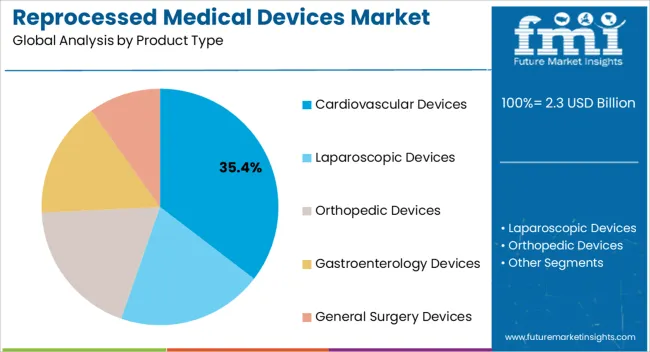
Within product categories, cardiovascular devices are set to lead the market in 2025, accounting for 35.4% of total revenue. Cardiovascular procedures are among the most frequent and resource-intensive in healthcare, creating sustained demand for reliable instruments. Reprocessed cardiovascular devices offer hospitals a powerful combination of safety, performance, and cost efficiency, ensuring they remain the preferred choice in high-volume surgical and interventional settings.
Orthopedic, laparoscopic, gastroenterology, and general surgery devices are also gaining momentum. Each segment benefits from growing demand for specialized procedures coupled with healthcare providers’ ongoing commitment to controlling costs and reducing waste.
Hospitals Lead as Primary End Users
Among end users, hospitals are projected to dominate with 50.2% of market revenue in 2025. This dominance reflects hospitals’ role as primary hubs of surgical and diagnostic procedures, as well as their acute need to manage budgets effectively. By adopting reprocessed devices, hospitals can significantly reduce procurement costs, improve inventory management, and optimize resource utilization without compromising patient safety.
Specialty clinics and ambulatory surgical centers are also embracing reprocessed medical devices, drawn by the dual benefits of affordability and sustainability. However, the hospital sector’s sheer scale ensures it will remain the largest and most influential segment.
Regional and Country-Level Insights
Geographically, North America, Europe, and Asia-Pacific represent the strongest markets. Each region reflects unique dynamics, but all share a common theme: growing acceptance of reprocessed devices as healthcare systems seek cost-efficient, compliant, and eco-friendly solutions.
China leads globally with a forecast CAGR of 22.9%, driven by expanding healthcare infrastructure and government support for sustainable practices. India follows with 21.2%, underscoring rapid growth in emerging Asian markets. Germany and France are expanding steadily at 19.5% and 17.8% respectively, reinforcing Europe’s commitment to both cost efficiency and environmental responsibility.
In North America, the United States remains a cornerstone market, valued at USD 834.5 million in 2025 and expected to reach USD 3.2 billion by 2035 at a CAGR of 14.4%. The region’s mature regulatory environment, coupled with the presence of global industry leaders, ensures consistent growth. Brazil, though growing at a slower CAGR of 12.7%, highlights the steady adoption of reprocessed devices across Latin America.
Key Players: Leaders and New Entrants
The reprocessed medical devices market is characterized by a diverse mix of established global leaders and emerging innovators. Companies such as Stryker, Johnson & Johnson MedTech, GE Healthcare, and Cardinal Health are leveraging their scale and expertise to drive industry standards and maintain global dominance. Their investments in advanced reprocessing technologies and partnerships with hospitals continue to set benchmarks for quality and compliance.
At the same time, new and specialized players such as Innovative Health, NEScientific, SureTek Medical, and Soma Tech Intl are carving out niches by focusing on cost-effective solutions, advanced sterilization techniques, and tailored offerings for healthcare providers. Medline Industries, LP., and Arjo are further strengthening their global footprints with targeted investments in sustainability and supply chain resilience.
This blend of established corporations and agile newcomers is creating a competitive and dynamic marketplace, offering hospitals and clinics diverse options to integrate reprocessed devices into their care models. For stakeholders and potential investors, the opportunity lies in aligning with companies that not only deliver economic benefits but also prioritize innovation and environmental responsibility.
Purchase this Report for USD 5,000 Only | Get an Exclusive Discount Instantly! https://www.futuremarketinsights.com/checkout/2611
Everything You Need—within Your Budget. Request a Special Price Now! https://www.futuremarketinsights.com/reports/sample/rep-gb-2611
About Future Market Insights (FMI)
Future Market Insights, Inc. (ESOMAR certified, recipient of the Stevie Award, and a member of the Greater New York Chamber of Commerce) offers profound insights into the driving factors that are boosting demand in the market. FMI stands as the leading global provider of market intelligence, advisory services, consulting, and events for the Packaging, Food and Beverage, Consumer Technology, Healthcare, Industrial, and Chemicals markets. With a vast team of over 400 analysts worldwide, FMI provides global, regional, and local expertise on diverse domains and industry trends across more than 110 countries.
Contact Us:
Future Market Insights Inc.
Christiana Corporate, 200 Continental Drive,
Suite 401, Newark, Delaware – 19713, USA
T: +1-347-918-3531
For Sales Enquiries: sales@futuremarketinsights.com
Website: https://www.futuremarketinsights.com
LinkedIn| Twitter| Blogs | YouTube