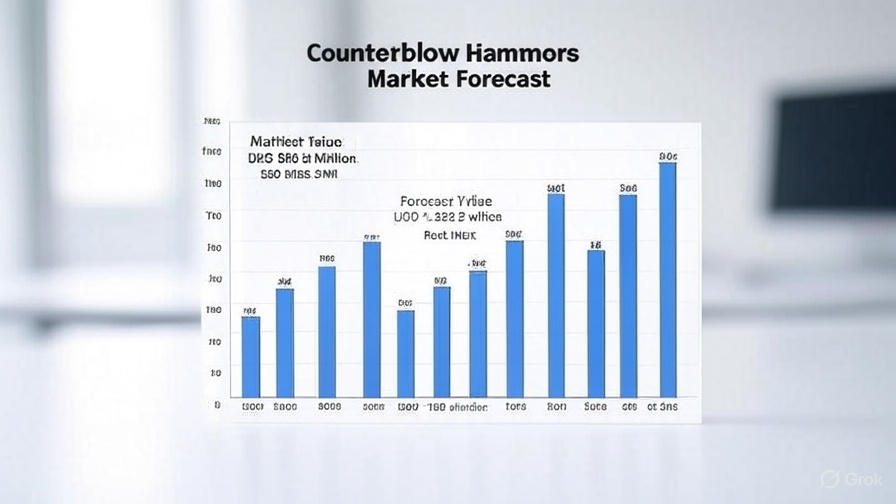
The global counterblow hammers market is on a solid growth trajectory, with projections showing an increase from USD 820.0 million in 2025 to USD 1,123.5 million by 2035. This expansion reflects an absolute rise of USD 303.5 million, supported by a 3.2% CAGR across the decade. As industries embrace advanced forging solutions, the market is expected to grow by nearly 1.37 times, with aerospace, automotive, and defense sectors driving demand.
Full Market Report available for delivery. For purchase or customization, please request here: https://www.futuremarketinsights.com/reports/sample/rep-gb-25288
Market Growth Supported by Forging Innovation
Counterblow hammers are gaining prominence because of their ability to handle complex geometries and high-strength materials with remarkable efficiency. Unlike conventional forging systems, these hammers reduce vibrations, foundation loads, and energy consumption through equal and opposite force application. This efficiency makes them indispensable in sectors demanding precision, including aerospace components, automotive drivetrains, defense equipment, and renewable energy systems.
The demand for lightweight yet durable parts in modern vehicles and aircraft is a major catalyst. Aerospace manufacturers increasingly use aluminum and titanium alloys, while the automotive sector is accelerating the adoption of lightweight materials to support electrification and fuel efficiency. At the same time, advancements in automation and digital monitoring technologies are improving reliability and cost-effectiveness, creating a strong business case for adoption.
Market Expansion Over Time
Between 2020 and 2025, the counterblow hammers market grew from USD 715.7 million to USD 820.0 million, recovering steadily after pandemic-driven disruptions. This period saw rising adoption of automated safety features and productivity-focused enhancements. From 2025 to 2030, the market is expected to gain another USD 139.9 million, supported largely by aerospace forging needs. The final leg, 2030 to 2035, will add USD 163.6 million, shaped by widespread integration of digital controls and predictive maintenance systems.
Key Growth Drivers
The success of counterblow hammers lies in their unique ability to support sustainability and efficiency goals. These machines can produce near-net-shape components that minimize material waste, while energy efficiency improvements lower operating costs and environmental impact. Furthermore, their dual-ram system delivers superior force distribution, ensuring high-quality output with reduced tool wear.
Segmental Insights
By hammer class, counterblow systems dominate the market, representing 60% of total share in 2025. Their unmatched ability to deliver precision and productivity ensures their leadership position across industries. From an end-use perspective, the automotive industry commands 38% of the market, as demand grows for forged crankshafts, gears, and suspension parts. The steel and alloy steel segment also remains strong, holding 55% market share, thanks to cost efficiency and widespread applications in high-performance parts manufacturing.
Regional Highlights
Growth rates vary across regions, with India leading at a CAGR of 4.5%, propelled by expanding aerospace and automotive industries. The country’s “Make in India” initiative and defense sector investment are creating significant opportunities for forging technologies.
China follows with a 3.8% CAGR, benefiting from its strong manufacturing ecosystem and government-led industrial modernization efforts. Aerospace ambitions and a robust automotive sector keep China at the forefront of adoption.
Germany, with a 2.9% CAGR, continues to uphold its reputation for engineering excellence, supplying both domestic industries and global export markets with advanced forging technologies. Meanwhile, the USA at 2.8% CAGR remains a leader in aerospace and defense, supported by modernization programs and reshoring initiatives. The UK rounds out the top five with 2.6% CAGR growth, strengthened by its high-value aerospace manufacturing capabilities.
Competitive Landscape
The counterblow hammers market is defined by a mix of established global players and emerging innovators. Each brings unique strengths, from technological breakthroughs to regional specialization.
Anyang Forging Press of China continues to expand its export footprint, offering cost-effective heavy forging equipment. India’s Bharat Forge integrates counterblow technologies with scalable industrial solutions, while Germany’s Bêché (Lasco) delivers high-performance hammer systems tailored to customer needs. ERIE Press Systems in the USA emphasizes process integration and durability, while Hasenclever and Lasco Umformtechnik in Germany advance energy-efficient, automated designs.
Further strengthening the competitive field, MECOLPRESS of Italy offers flexible machines for diverse applications, while global giants SMS group and Schuler Group drive digital innovation in forging processes. Weber Pressen, also from Germany, focuses on durable and customized hammer solutions. Together, these players are shaping the market’s direction, balancing tradition with cutting-edge technology.
Request a Draft Report Here: https://www.futuremarketinsights.com/reports/brochure/rep-gb-25288
Opportunities for Manufacturers
The next decade presents opportunities for both established manufacturers and new entrants. With industries demanding more efficient, automated, and environmentally compliant forging solutions, companies that innovate in digitalization, predictive maintenance, and energy efficiency will find strong growth prospects. Aerospace and automotive, in particular, are sectors where manufacturers can introduce specialized hammer systems optimized for lightweight and high-strength materials.
Outlook to 2035
As the global economy pivots toward sustainable, high-precision manufacturing, counterblow hammers are set to play a crucial role. Their ability to reduce waste, improve efficiency, and deliver consistent high-quality forged components positions them as indispensable tools in modern industry. With a projected market value of USD 1,123.5 million by 2035, the stage is set for further advancements that will define the future of forging.
Related Reports:
Pick to Light Market- https://www.futuremarketinsights.com/reports/pick-to-light-market
Neutron Detectors Market- https://www.futuremarketinsights.com/reports/neutron-detectors-market
Emergency Light Sticks Market- https://www.futuremarketinsights.com/reports/emergency-light-sticks-market
About Future Market Insights (FMI)
Future Market Insights, Inc. (ESOMAR certified, recipient of the Stevie Award, and a member of the Greater New York Chamber of Commerce) offers profound insights into the driving factors that are boosting demand in the market. FMI stands as the leading global provider of market intelligence, advisory services, consulting, and events for the Packaging, Food and Beverage, Consumer Technology, Healthcare, Industrial, and Chemicals markets. With a vast team of over 400 analysts worldwide, FMI provides global, regional, and local expertise on diverse domains and industry trends across more than 110 countries.
Join us as we commemorate 10 years of delivering trusted market insights. Reflecting on a decade of achievements, we continue to lead with integrity, innovation, and expertise.
Contact Us:
Future Market Insights Inc.
Christiana Corporate, 200 Continental Drive,
Suite 401, Newark, Delaware – 19713, USA
T: +1-347-918-3531
For Sales Enquiries: sales@futuremarketinsights.com
Website: https://www.futuremarketinsights.com
LinkedIn| Twitter| Blogs | YouTube