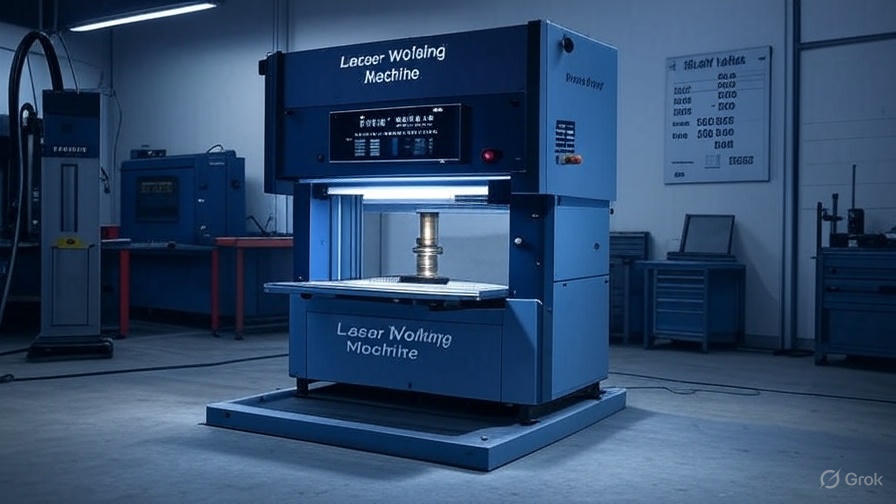
The global laser welding machine market is poised for significant growth, with an estimated valuation of USD 2.8 billion in 2025, projected to reach USD 4.7 billion by 2035, reflecting a steady compound annual growth rate of 5.2%. The market expansion is fueled by increasing adoption of high-precision welding solutions across automotive, aerospace, electronics, and medical device manufacturing, where speed, accuracy, and reduced material distortion offer a decisive advantage over conventional welding methods.
Full Market Report available for delivery. For purchase or customization, please request here: https://www.futuremarketinsights.com/reports/sample/rep-gb-25207
Driving Forces Behind Market Growth
Technological advancements, including fiber laser systems and seamless automation integration, are transforming manufacturing operations across regions. Fiber lasers are capturing market share from CO₂ and solid-state alternatives due to superior energy efficiency and adaptability. Automotive and electronics sectors are witnessing pronounced growth, driven by the production of electric vehicles and miniaturization trends in consumer electronics. Meanwhile, traditional heavy industrial segments experience slight erosion as modernization occurs more gradually.
The market opportunity of USD 1.9 billion between 2025 and 2035 reflects the balance of regional expansion and adoption of advanced technologies countering incremental declines in mature markets. Established players in North America and Europe face moderate market share erosion, while Asia Pacific manufacturers, supported by cost advantages and thriving electronics and automotive industries, are expanding their revenue contributions.
Segment Insights
Fiber lasers lead the technology segment, accounting for 47.6% of revenue in 2025. Their high-speed welding capability, minimal thermal distortion, and adaptability for thin and reflective materials make them ideal for precision applications. Compact and portable fiber laser systems have also gained attention, offering flexible deployment across various production environments. Integration with robotic arms further enhances throughput and consistency, especially in automotive and electronics manufacturing.
The automotive end-use segment remains the dominant industrial user, expected to contribute 38.2% of market revenue. Laser welding is critical for body-in-white assembly, battery module fabrication, and joining lightweight materials without additional fillers. The growth of electric vehicles has further amplified demand for clean, contactless welding solutions, enabling manufacturers to optimize safety, performance, and operational efficiency.
Direct distribution channels are projected to generate 61.4% of revenue, emphasizing the need for customized solutions, training, and post-sales support. Close collaboration during installation and calibration allows manufacturers to ensure consistent system performance and operational reliability, making direct engagement the preferred route for enterprises investing in capital-intensive laser welding solutions.
Regional Dynamics and Growth Trends
Asia Pacific is emerging as a dominant growth region, holding 41% of the market share, driven primarily by China, Japan, and South Korea. China’s market is expected to expand at a CAGR of 7.0%, with industrial hubs in Jiangsu, Guangdong, and Zhejiang ramping up production for both domestic consumption and exports. Local and global suppliers, including Han’s Laser, HGTech, and Trumpf China, are focusing on compact fiber laser solutions with higher precision and lower operating costs.
India follows closely with a projected CAGR of 6.5%, fueled by rapid adoption in automotive, construction equipment, and electronics manufacturing. Domestic players such as SLTL and Sahajanand Laser Technology are actively competing with multinational firms to provide cost-effective, high-speed welding solutions, catering to both infrastructure growth and lightweight component production.
Europe, led by Germany, France, and Italy, continues to emphasize high-value applications in automotive and aerospace, with Germany’s market forecasted to grow at 6.0% CAGR. The United Kingdom anticipates moderate growth at 4.9%, while North America, with established industrial bases in the USA, maintains steady adoption at 4.4% CAGR, primarily in aerospace, defense, and medical device manufacturing.
Technological Innovations Driving Market Expansion
Technological progress is enhancing precision, energy efficiency, and operational reliability. Fiber lasers demonstrate up to 25–30% higher energy efficiency compared to CO₂ lasers, while advanced beam delivery systems reduce defects by 15–20%. Integration with robotics and AI-driven monitoring improves high-speed production, quality assurance, and minimizes downtime. Industry 4.0 adoption, remote diagnostics, and modular laser systems are further boosting market appeal across sectors requiring precision and scalability.
Expanding applications in electronics, medical devices, and energy storage sectors are broadening market opportunities. Electronics account for 20% of global usage, while medical devices contribute 12%, emphasizing implants, surgical tools, and pacemakers. Energy applications such as battery packs, fuel cells, and solar panels represent an additional 10%, reinforcing the diverse industrial relevance of laser welding technologies.
Request a Draft Report Here: https://www.futuremarketinsights.com/reports/brochure/rep-gb-25207
Competitive Landscape
Key market players include CHIRON Group, Coherent, Emerson Electric, Han’s Laser Technology Industry Group, Huagong Laser Engineering, IPG Photonics, Jenoptik, KEYENCE, Laser Technologies, Laserline, Laser Star Technologies, Penta Laser, Precitec, and TRUMPF. These companies are focusing on automation integration, energy-efficient solutions, multi-material capabilities, and comprehensive service offerings to strengthen global reach and customer adoption.
With rising demand across high-growth manufacturing sectors, continued innovation in fiber lasers, automation, and robotics, and strategic investments by global and regional players, the laser welding machine market is set for sustained expansion. Manufacturers are increasingly positioned to leverage technological advancements to meet evolving industry requirements, enhance production efficiency, and deliver precision-driven solutions worldwide.
Related Reports:
Safety Interlock Switches Market- https://www.futuremarketinsights.com/reports/safety-interlock-switches-market
Steel Sections Market- https://www.futuremarketinsights.com/reports/steel-sections-market
Tapping Sleeves Market- https://www.futuremarketinsights.com/reports/tapping-sleeves-market
About Future Market Insights (FMI)
Future Market Insights, Inc. (ESOMAR certified, recipient of the Stevie Award, and a member of the Greater New York Chamber of Commerce) offers profound insights into the driving factors that are boosting demand in the market. FMI stands as the leading global provider of market intelligence, advisory services, consulting, and events for the Packaging, Food and Beverage, Consumer Technology, Healthcare, Industrial, and Chemicals markets. With a vast team of over 400 analysts worldwide, FMI provides global, regional, and local expertise on diverse domains and industry trends across more than 110 countries.
Join us as we commemorate 10 years of delivering trusted market insights. Reflecting on a decade of achievements, we continue to lead with integrity, innovation, and expertise.
Contact Us:
Future Market Insights Inc.
Christiana Corporate, 200 Continental Drive,
Suite 401, Newark, Delaware – 19713, USA
T: +1-347-918-3531
For Sales Enquiries: sales@futuremarketinsights.com
Website: https://www.futuremarketinsights.com
LinkedIn| Twitter| Blogs | YouTube