

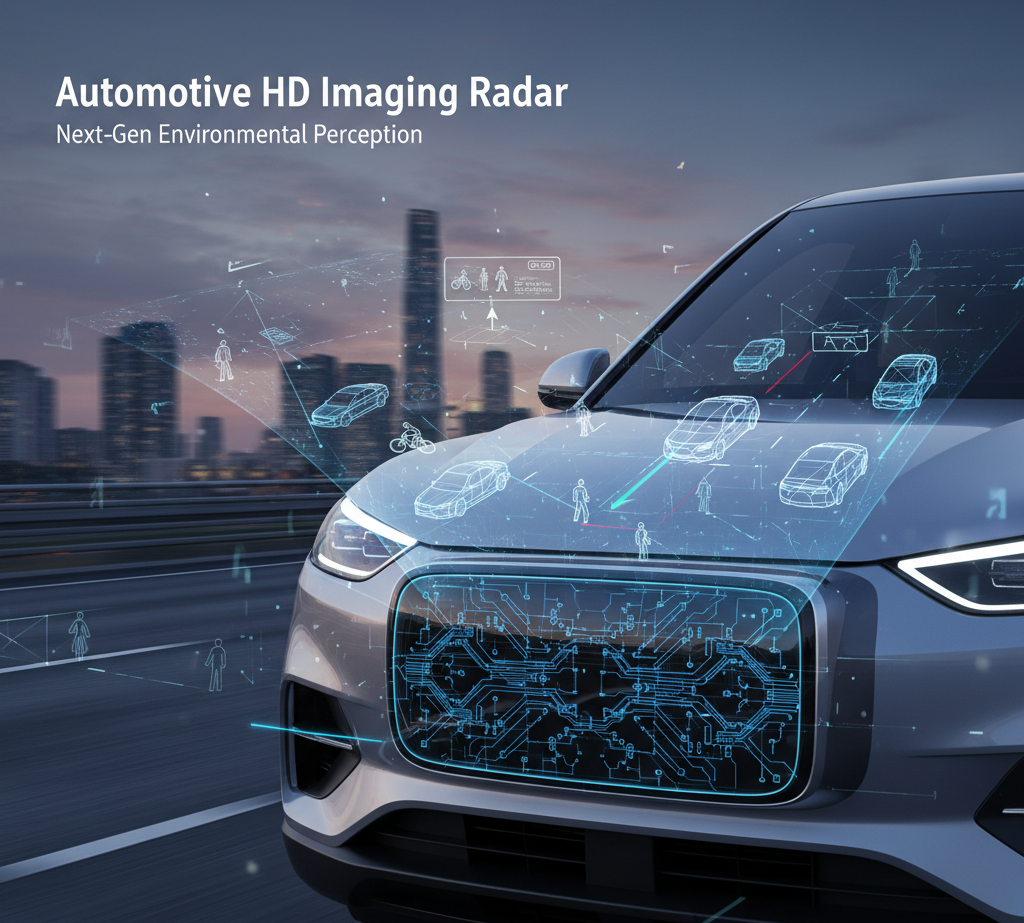
The global automotive HD/Imaging Radar Market is witnessing a remarkable growth trajectory. Valued at USD 10.1 billion in 2023, it is projected to reach USD 14.8 billion by 2025, before surging to USD 88.11 billion by 2035 at a CAGR of 23.61%. Rising adoption of advanced driver-assistance systems (ADAS), the race toward autonomous mobility, and stricter safety regulations worldwide are fueling this unprecedented expansion.
HD radar is quickly becoming the backbone of safer, smarter, and connected vehicles by providing high-resolution environmental awareness that underpins ADAS and autonomous functions. AI-powered 4D radar promises to revolutionize vehicle perception and decision-making by 2035, enabling real-time target tracking and predictive analytics.
Full Market Report available for delivery. For purchase or customization, please request here – https://www.futuremarketinsights.com/reports/sample/rep-gb-16854
Report Coverage & Deliverables
The report provides an in-depth analysis of:
- Market size and forecasts (2025–2035)
- Competitive landscape and key company strategies
- Regional and country-level insights
- Market segmentation by range and frequency band
- Risk assessment and supply chain evaluation
- Future innovations, including AI-powered radar, V2X integration, and quantum radar technologies
Deliverables include comprehensive data tables, segment analysis, and strategic recommendations for OEMs, suppliers, and investors navigating this fast-evolving market.
Key Factors Shaping Market Dynamics
- ADAS and Autonomous Driving Expansion
Increasing integration of ADAS features such as adaptive cruise control, lane-keeping assistance, and automatic emergency braking is driving radar adoption. Autonomous driving will make HD radar indispensable. - Shift to High-Frequency Bands
Transition from 24 GHz to 77/79 GHz bands significantly boosts resolution, range, and detection accuracy, establishing the technical backbone for next-gen safety features. - Cost & Supply Chain Challenges
High production costs and semiconductor shortages remain hurdles, particularly in scaling 4D imaging radar, which costs 3–4x more than 3D radar. - AI-Driven Advancements
By 2035, AI-enabled 4D imaging radar will deliver real-time target tracking, predictive analytics, and seamless sensor fusion with LiDAR and cameras. - Regulatory Push
Stringent mandates in the U.S., Europe, Japan, and South Korea are accelerating adoption. Governments now require safety compliance backed by advanced radar systems.
Key Takeaways
- Market to expand from USD 14.8 billion (2025) to USD 88.11 billion (2035).
- Long-range radar dominates the market, enabling detection beyond 250 meters.
- 77/79 GHz radars expected to replace older 24 GHz systems due to superior accuracy.
- AI-powered 4D radar, radar-on-chip (RoC) technology, and V2X connectivity to be game-changers.
- Europe and North America lead regulations; Asia-Pacific set for fastest growth, led by China, Japan, and South Korea.
- Key players include Continental AG, Bosch, Aptiv, NXP Semiconductors, Arbe Robotics, among others.
Regional Analysis
- North America (USA, Canada)
Strong regulatory mandates (NHTSA) and rapid adoption of ADAS fuel demand. Tesla, Ford, and GM are leveraging AI-driven radar for improved safety in all conditions. - Europe (Germany, France, UK, EU nations)
Euro NCAP’s strict crash-avoidance regulations push automakers toward high-resolution imaging radar. Bosch, Continental, and Valeo lead innovation in 4D radar and sensor fusion. - Asia-Pacific (China, Japan, South Korea)
Fastest-growing market. China dominates vehicle production with ADAS integration, while Japan pursues a zero-accident vision with millimeter-wave radar. South Korea pioneers miniaturized 4D radars and 5G-enabled edge radar solutions. - Rest of the World (Latin America, Middle East, Africa)
Emerging demand in Brazil, Mexico, UAE, and Saudi Arabia, where ADAS adoption and safety features in commercial vehicles are accelerating.
Key Segments of the Market Report
By Range
- Long-Range Radar (largest share): Enables collision avoidance, highway driving assistance, and predictive hazard detection beyond 250 meters.
- Short- & Medium-Range Radar: Complementary for close-range detection (blind spot monitoring, parking assistance).
By Frequency
- 77/79 GHz: Dominates next-gen radar systems due to precision and multi-target recognition.
- 24 GHz: Still used in lower-cost ADAS features but being phased out in favor of 7X-GHz systems.
Stay Ahead – Grab the Report: https://www.futuremarketinsights.com/reports/brochure/rep-gb-16854
About Future Market Insights (FMI)
Future Market Insights, Inc. (ESOMAR certified, recipient of the Stevie Award, and a member of the Greater New York Chamber of Commerce) offers profound insights into the driving factors that are boosting demand in the market. FMI stands as the leading global provider of market intelligence, advisory services, consulting, and events for the Packaging, Food and Beverage, Consumer Technology, Healthcare, Industrial, and Chemicals markets. With a vast team of over 400 analysts worldwide, FMI provides global, regional, and local expertise on diverse domains and industry trends across more than 110 countries.
Contact Us:
Future Market Insights Inc.
Christiana Corporate, 200 Continental Drive,
Suite 401, Newark, Delaware – 19713, USA
T: +1-347-918-3531
For Sales Enquiries: sales@futuremarketinsights.com
Website: https://www.futuremarketinsights.com
LinkedIn| Twitter| Blogs | YouTube




