

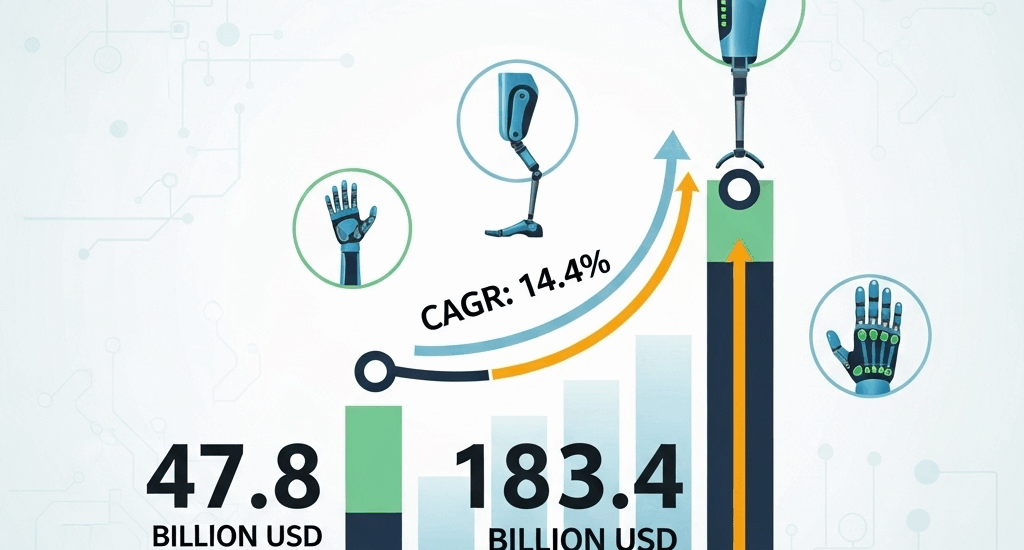
The global Motorized Prosthesis Market is on the cusp of transformative growth, projected to rise from USD 47.8 billion in 2025 to an impressive USD 183.4 billion by 2035, expanding at a compound annual growth rate (CAGR) of 14.4%. This robust expansion reflects increasing demand for advanced rehabilitation technologies, driven by innovations in bionics, artificial intelligence, and personalized healthcare solutions.
Industry Outlook and Growth Drivers
The acceleration of the motorized prosthesis market is fueled by multiple converging factors. First, the rise in amputation cases among adults due to trauma, vascular diseases, and workplace accidents is creating sustained demand for prosthetic solutions. Adults are expected to represent 61.4% of total market revenue in 2025, underscoring the need for robust, high-performance devices designed for everyday mobility.
Secondly, technological breakthroughs such as electromyography (EMG) sensors, AI-powered limb control, and integration with wearable health ecosystems are revolutionizing patient care. These advancements are improving the functional responsiveness of prosthetics, enabling users to achieve greater independence and mobility.
Additionally, broader healthcare support is fueling market momentum. Governments and insurers are increasingly offering coverage for advanced prosthetic devices, making them more accessible to patients worldwide. This, combined with rising investments in digitized orthopedic workflows and localized manufacturing, is expected to democratize access to motorized prostheses, especially in emerging economies.
Click Here for More Information:- https://www.futuremarketinsights.com/reports/motorized-prosthesis-market
Competitive Landscape
The motorized prosthesis market is highly competitive, with established leaders and new entrants innovating aggressively. Key players include:
- Össur hf.
- Advanced Arm Dynamics
- Bionic Prosthetics and Orthotics
- BionX Medical Technologies, Inc.
- Otto Bock HealthCare GmbH
- Mobius Bionics LLC
- Freedom Innovations, LLC
- Sensars Neuroprosthetics
- Touch Bionics Inc.
- Faulhaber Group
In 2025, Advanced Arm Dynamics launched an early prosthetic fitting program for children with upper limb absence, while Bionic Prosthetics introduced a neurobotic sensory-motor arm in 2024 that restores natural motor behavior with intuitive grip and touch capabilities. Such product launches highlight the race for innovation in the industry.
Competitively, motorized prosthesis companies are benchmarking themselves not just against one another but also against adjacent medtech sectors, such as exoskeleton technologies and robotic-assisted rehabilitation devices. This cross-industry benchmarking accelerates the pace of innovation and broadens the scope of patient solutions.
Regional Trends
- North America is projected to dominate the global landscape, holding 49.5% of the market in 2025, supported by advanced healthcare infrastructure, strong R&D spending, and favorable reimbursement policies.
- Europe follows closely, with a 29.7% share, propelled by state-funded healthcare systems, supportive legislation, and high disposable incomes. Western Europe, in particular, benefits from strong public-private collaboration in medical device innovation.
- Asia-Pacific is forecasted to register the fastest growth rate, fueled by rising healthcare investments, expanded insurance coverage, and rapid adoption of advanced technologies in countries like China, India, and Japan.
End-User Insights
Orthopedic clinics are expected to account for 39.7% of total market share in 2025, emerging as the leading channel for prosthetic delivery. Their dominance is attributed to direct access to prosthetists, advanced fitting technologies, and comprehensive rehabilitation programs. Hospitals and trauma centers remain vital, particularly in acute care and post-injury rehabilitation scenarios.
Opportunities and Challenges
While the market outlook is positive, several challenges persist. Weight and battery dependency of motorized prostheses remain barriers to wider adoption, as body-powered alternatives continue to offer lighter solutions. Additionally, cost remains a consideration in low- and middle-income regions, despite government subsidies and NGO support.
Nonetheless, opportunities abound. With the global healthcare system increasingly shifting toward value-based care, motorized prostheses are positioned as critical tools in reducing long-term disability, improving quality of life, and enabling workforce reintegration.
Get Sample Report: – https://www.futuremarketinsights.com/reports/sample/rep-gb-4914
Industry Trends to Watch
- AI & Robotics Integration – Neural-linked prosthetics with adaptive AI controls are expected to redefine mobility.
- Wearable Ecosystem Convergence – Motorized prostheses integrated with health-tracking wearables will allow real-time monitoring of patient performance.
- Local Manufacturing Expansion – Emerging economies are scaling localized production to reduce costs and improve accessibility.
- Sustainability in Materials – Advances in lightweight, durable, and eco-friendly prosthetic materials are gaining traction.
About Future Market Insights (FMI)
Future Market Insights, Inc. (ESOMAR certified, recipient of the Stevie Award, and a member of the Greater New York Chamber of Commerce) offers profound insights into the driving factors that are boosting demand in the market. FMI stands as the leading global provider of market intelligence, advisory services, consulting, and events for the Packaging, Food and Beverage, Consumer Technology, Healthcare, Industrial, and Chemicals markets. With a vast team of over 400 analysts worldwide, FMI provides global, regional, and local expertise on diverse domains and industry trends across more than 110 countries.
Contact Us:
Future Market Insights Inc.
Christiana Corporate, 200 Continental Drive,
Suite 401, Newark, Delaware – 19713, USA
T: +1-347-918-3531
For Sales Enquiries: sales@futuremarketinsights.com
Website: https://www.futuremarketinsights.com
LinkedIn| Twitter| Blogs | YouTube




