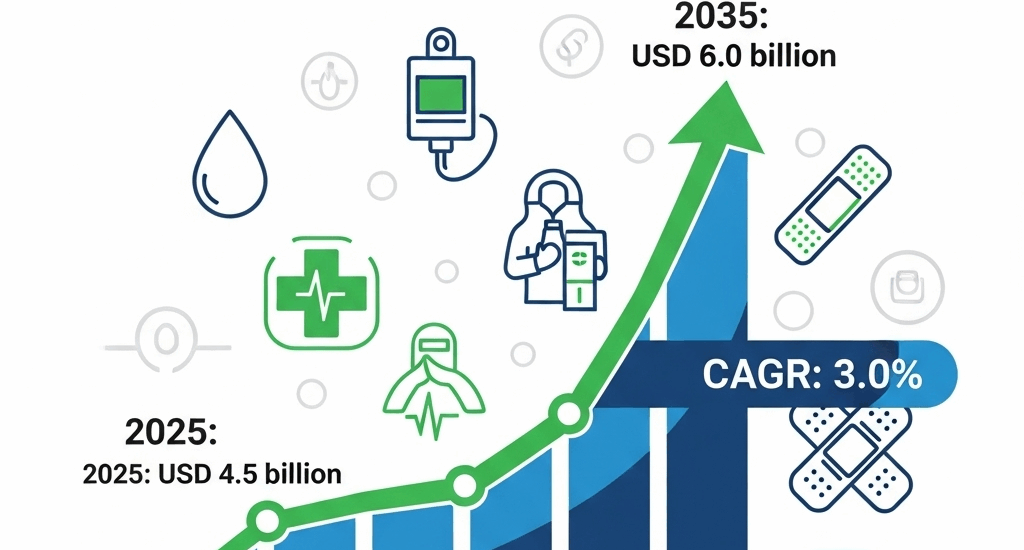
The global Hemorrhage Control System Market is poised for steady growth, with projections indicating an increase from USD 4.5 billion in 2025 to USD 6.0 billion by 2035, at a compound annual growth rate (CAGR) of 3.0%, according to the latest market analysis. This growth trajectory reflects the rising incidence of trauma, cardiovascular disorders, and complex surgical procedures, underscoring the vital role of advanced bleeding control solutions in modern healthcare.
Market Overview and Growth Drivers
The demand for hemorrhage control systems is being fueled by multiple factors, including the increasing global surgical volume, the growing prevalence of chronic illnesses, and the rising number of traumatic injuries linked to road accidents and sports activities. Innovations in device design—such as enhanced tissue compatibility, bioactive coatings, and faster coagulation technologies—are propelling adoption in both emergency and elective care settings.
Government-backed initiatives to improve surgical outcomes and reduce transfusion dependency further bolster market expansion. Hospitals and Ambulatory Surgical Centers (ASCs), which account for 58.3% of market revenue, remain the leading adopters of hemorrhage control systems owing to stringent safety protocols and advanced surgical capabilities.
Click Here for More Information:- https://www.futuremarketinsights.com/reports/hemorrhage-control-system-market
Segmental Insights: Hemostatic Devices Lead with 54.2% Share
Among product types, hemostatic devices dominate the market, representing 54.2% of total revenue in 2025. These devices provide rapid clot formation, localized bleeding control, and better hemodynamic stability—making them indispensable for trauma care, cardiovascular surgery, and minimally invasive procedures.
The cardiovascular surgery application segment accounts for 47.6% of total revenue, driven by the increasing prevalence of heart disease and the complexity of surgical interventions. As cardiac surgeries often involve significant blood loss, the integration of advanced bleeding control systems is critical to improving survival rates and reducing post-operative complications.
Regional Outlook: North America and Asia-Pacific in Focus
North America remains the largest market for hemorrhage control systems, supported by robust healthcare infrastructure, high surgical volumes, and rapid adoption of cutting-edge medical technologies. Meanwhile, Asia-Pacific is emerging as the fastest-growing region, fueled by increasing healthcare expenditure, rising trauma cases, and growing awareness of advanced hemostatic solutions.
Competitive Landscape and Industry Benchmarks
The hemorrhage control system market is characterized by strong competition among global players, including Medtronic, RevMedx, Organon, Stryker, Delfi Medical Innovations Inc., and TacMed Solutions. These companies are investing heavily in research and development, aiming to introduce cost-effective, technologically advanced solutions that cater to the evolving needs of surgical environments.
Key strategies among leading players include:
- Innovation and Product Differentiation: Introduction of biologically active agents and absorbable materials for enhanced patient safety.
- Strategic Collaborations: Partnerships with healthcare facilities to promote the adoption of advanced hemorrhage control protocols.
- Regulatory Approvals: Accelerated approvals for innovative devices across multiple geographies to gain a competitive edge.
Industry benchmarks show that companies prioritizing R&D and cost optimization across their value chain are more likely to capture a larger share of the projected market growth.
Emerging Trends: A Shift Toward Minimally Invasive and Portable Solutions
Key market trends shaping the industry include:
- Surge in Laparoscopic and Robotic Surgeries: Driving demand for compact, easy-to-use hemorrhage control systems.
- Portable Trauma Kits: Increasing adoption in military and emergency response settings.
- Regulatory Push for Safety Standards: Stricter guidelines on intraoperative bleeding control are compelling hospitals to invest in advanced systems.
The growing emphasis on patient safety, reduced recovery times, and improved clinical outcomes continues to redefine the hemorrhage control landscape, signaling significant opportunities for both established and emerging players.
Get Sample Report: – https://www.futuremarketinsights.com/reports/sample/rep-gb-1635
Future Outlook
With the global surgical ecosystem evolving rapidly, the hemorrhage control system market is expected to witness sustained demand through 2035. Manufacturers focusing on technological innovation, cost efficiency, and expanded regulatory approvals will be well-positioned to capitalize on growth opportunities.
About Future Market Insights (FMI)
Future Market Insights, Inc. (ESOMAR certified, recipient of the Stevie Award, and a member of the Greater New York Chamber of Commerce) offers profound insights into the driving factors that are boosting demand in the market. FMI stands as the leading global provider of market intelligence, advisory services, consulting, and events for the Packaging, Food and Beverage, Consumer Technology, Healthcare, Industrial, and Chemicals markets. With a vast team of over 400 analysts worldwide, FMI provides global, regional, and local expertise on diverse domains and industry trends across more than 110 countries.
Contact Us:
Future Market Insights Inc.
Christiana Corporate, 200 Continental Drive,
Suite 401, Newark, Delaware – 19713, USA
T: +1-347-918-3531
For Sales Enquiries: sales@futuremarketinsights.com
Website: https://www.futuremarketinsights.com
LinkedIn| Twitter| Blogs | YouTube