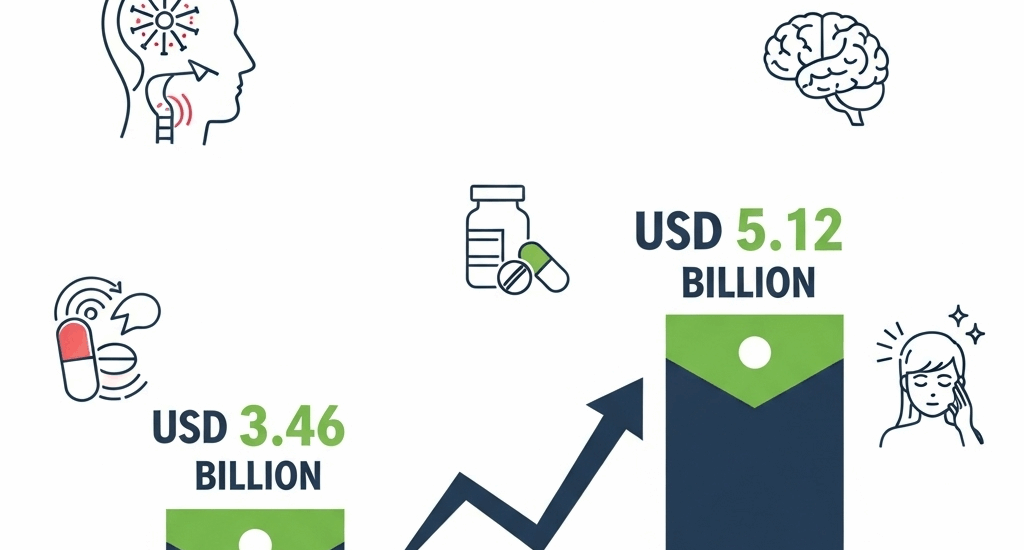
The global migraine treatment market is projected to grow from USD 3.46 billion in 2025 to USD 5.12 billion by 2035, marking a compound annual growth rate (CAGR) of 4.0%, according to industry analysis. This sustained growth reflects the rising prevalence of migraine disorders, increased awareness, and rapid adoption of innovative therapies, including calcitonin gene-related peptide (CGRP) inhibitors, neuromodulation devices, and AI-driven digital health solutions.
Market Drivers and Trends
Migraine, the second leading cause of disability worldwide, has emerged as a focal point for pharmaceutical innovation and healthcare reform. Post-pandemic stress factors and enhanced diagnostic capabilities have fueled demand for early intervention and long-term management strategies. As healthcare systems pivot toward personalized and preventive care, next-generation biologics and digital therapeutics are transforming treatment paradigms.
Click Here for More Information:- https://www.futuremarketinsights.com/reports/migraine-treatment-market
Key growth factors include:
- Innovation in CGRP inhibitors: Widely recognized for their dual preventive and acute efficacy.
- Digital health integration: Telemedicine and AI-based migraine management tools improving patient adherence.
- Emerging market access: Asia-Pacific and Latin America represent high-growth opportunities due to expanding healthcare infrastructure.
Competitive Landscape and Market Positioning
The migraine treatment market remains highly competitive, with global leaders such as Teva Pharmaceutical, Hoffmann-La Roche Ltd., Johnson & Johnson, Amgen, AstraZeneca, Pfizer Inc., and Novartis AG investing aggressively in R&D and strategic alliances. These companies are racing to diversify portfolios with novel delivery systems and mechanism-specific drugs.
- Triptans continue to dominate as the most prescribed class, holding 48.90% of the revenue share in 2025 due to their clinical efficacy and insurance-backed accessibility.
- Prescription drugs account for 78.32% of sales channels, reinforcing the role of physician-supervised treatment in chronic disease management.
- Hospital pharmacies lead distribution with 42.35% market share, serving as primary hubs for advanced biologics and injectable therapies.
Recent Developments:
- The FDA approved Atzumi™ nasal powder (dihydroergotamine) in 2025, introducing a non-invasive alternative for acute migraine treatment.
- Axsome Therapeutics launched SYMBRAVO®, a multi-mechanistic oral medicine combining meloxicam and rizatriptan, offering rapid and sustained relief.
Regional Insights
- North America dominates due to advanced treatment adoption and robust insurance networks. The U.S. market, projected to grow at 4.8% CAGR, benefits from high uptake of CGRP inhibitors and digital health solutions despite reimbursement challenges.
- Asia-Pacific offers the fastest growth trajectory, with China (5.1% CAGR) and India (5.3% CAGR) leading the expansion. Government-backed healthcare reforms and local production of biosimilars are increasing affordability and access.
- Western Europe emphasizes cost-effectiveness and neuromodulation adoption, while Japan remains conservative with slower uptake of innovative therapies.
Opportunities and Strategic Imperatives
To capture market share, stakeholders must:
- Accelerate Next-Gen Therapy Development: Prioritize R&D in CGRP inhibitors, gepants, and RNA-based therapies.
- Expand Digital Health Integration: Leverage telemedicine and AI-powered migraine trackers for better patient engagement.
- Strengthen Market Access: Form partnerships in high-growth regions, focusing on regulatory alignment and local distribution.
Get Sample Report: – https://www.futuremarketinsights.com/reports/sample/rep-gb-16751
Risks to Monitor
- Regulatory Delays: Stringent FDA and EMA approval processes can impact time-to-market.
- Pricing Pressures: Generic competition and cost-containment policies may squeeze margins.
- Technological Disruptions: Rapid advancements in digital therapeutics and alternative treatments could shift market dynamics.
Future Outlook
The migraine treatment ecosystem is transitioning from traditional symptom management to holistic, technology-enabled care. Companies that invest in precision medicine, digital health platforms, and patient-centric models will gain a competitive edge. Strategic mergers and acquisitions, especially in biotech and AI-driven healthcare startups, will play a pivotal role in shaping the next decade of growth.
About Future Market Insights (FMI)
Future Market Insights, Inc. (ESOMAR certified, recipient of the Stevie Award, and a member of the Greater New York Chamber of Commerce) offers profound insights into the driving factors that are boosting demand in the market. FMI stands as the leading global provider of market intelligence, advisory services, consulting, and events for the Packaging, Food and Beverage, Consumer Technology, Healthcare, Industrial, and Chemicals markets. With a vast team of over 400 analysts worldwide, FMI provides global, regional, and local expertise on diverse domains and industry trends across more than 110 countries.
Contact Us:
Future Market Insights Inc.
Christiana Corporate, 200 Continental Drive,
Suite 401, Newark, Delaware – 19713, USA
T: +1-347-918-3531
For Sales Enquiries: sales@futuremarketinsights.com
Website: https://www.futuremarketinsights.com
LinkedIn| Twitter| Blogs | YouTube