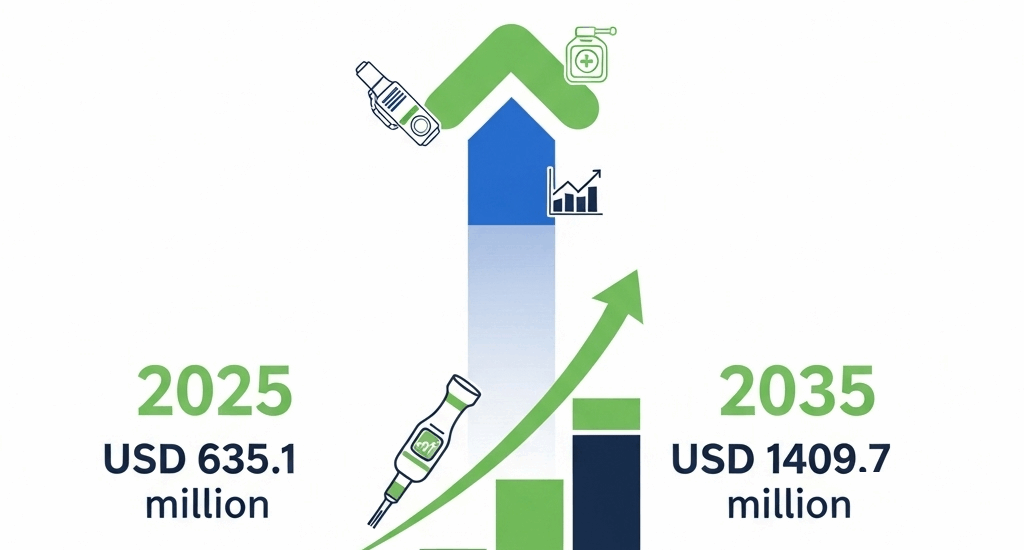
The global Small Bowel Enteroscopes Market is set to experience robust growth, with market size projected to rise from USD 635.1 million in 2025 to USD 1,409.7 million by 2035, reflecting a healthy compound annual growth rate (CAGR) of 8.3%. This expansion is fueled by a rising incidence of gastrointestinal disorders, increasing adoption of minimally invasive diagnostic procedures, and ongoing technological advancements in endoscopic imaging.
Market Overview
Small bowel enteroscopy has emerged as a critical tool for the diagnosis and management of complex gastrointestinal conditions. With growing emphasis on early detection of obscure gastrointestinal bleeding and small bowel tumors, demand for advanced visualization solutions has increased significantly. Healthcare providers are rapidly adopting enteroscopes that enable improved access to the small intestine, reducing the likelihood of repeat diagnostic workups and enhancing patient outcomes.
In particular, the obscure gastrointestinal bleeding segment is expected to dominate, accounting for 51.2% of market revenue in 2025. Meanwhile, hospitals are projected to capture 58.9% of the market, driven by their advanced diagnostic infrastructure, skilled gastroenterology teams, and integrated care models.
Click Here for More Information:- https://www.futuremarketinsights.com/reports/small-bowel-enteroscopes-market
Industry Trends and Growth Drivers
Several key trends are reshaping the competitive landscape of the small bowel enteroscope market:
- AI-Assisted Imaging: Integration of artificial intelligence for image analysis is enhancing diagnostic accuracy and enabling quicker identification of lesions, vascular abnormalities, and ulcers.
- Shift Toward Single-Use Devices: Growing concerns over infection control are accelerating the adoption of disposable enteroscopes, aligning with broader healthcare safety protocols.
- Expansion in Emerging Markets: Rapidly evolving healthcare systems in Asia-Pacific—particularly in China and India—are opening significant opportunities, supported by government initiatives and rising healthcare expenditure.
- Rising Gastrointestinal Disorder Cases: In North America, the prevalence of inflammatory bowel syndrome and obscure bleeding cases is driving demand for advanced enteroscopic diagnostics.
Regional Outlook
- North America: A key growth hub, supported by high disease prevalence, advanced healthcare infrastructure, and strong R&D investments.
- Asia-Pacific: Anticipated to witness the fastest growth due to population density, rising healthcare awareness, and adoption of cutting-edge diagnostic tools.
- Europe: Expected to maintain steady growth, with demand driven by aging populations and increasing gastrointestinal disorder incidence.
Competitive Landscape
The market remains highly competitive, with Pentax Medical, Olympus Corporation, and FUJIFILM Holdings America Corporation leading innovation. These companies are actively investing in clinical trials, new product launches, and portfolio diversification to strengthen their global footprint. Strategic collaborations, R&D investment in AI-based imaging, and emphasis on ergonomic and patient-friendly designs are likely to shape the next phase of industry evolution.
Competitor benchmarks indicate a strong push toward expanding indication coverage beyond obscure gastrointestinal bleeding. Trials investigating use in Crohn’s disease, refractory celiac disease, and small bowel obstruction are expected to broaden clinical adoption.
Get Sample Report: – https://www.futuremarketinsights.com/reports/sample/rep-gb-9579
Growth Factors and Challenges
Key growth factors:
- Rising patient demand for accurate, minimally invasive diagnostic techniques.
- Advancements in device design and imaging clarity.
- Expansion of hospital-based endoscopy units.
Challenges:
- High procedural costs in emerging economies.
- Shortage of skilled professionals trained in enteroscopy.
- Longer procedural times compared to alternative diagnostic tools.
Despite these hurdles, industry experts anticipate strong demand driven by evolving clinical needs, government healthcare initiatives, and increasing investments in advanced diagnostic infrastructure.
Market Outlook
According to analysts, the small bowel enteroscope market offers substantial long-term potential. Between 2025 and 2035, the sector is expected to nearly double in value, underscoring its importance in the broader endoscopy and gastrointestinal diagnostics industry.
As healthcare systems worldwide prioritize early disease detection and personalized patient management, small bowel enteroscopy is set to play a vital role in improving outcomes for millions of patients globally.
About Future Market Insights (FMI)
Future Market Insights, Inc. (ESOMAR certified, recipient of the Stevie Award, and a member of the Greater New York Chamber of Commerce) offers profound insights into the driving factors that are boosting demand in the market. FMI stands as the leading global provider of market intelligence, advisory services, consulting, and events for the Packaging, Food and Beverage, Consumer Technology, Healthcare, Industrial, and Chemicals markets. With a vast team of over 400 analysts worldwide, FMI provides global, regional, and local expertise on diverse domains and industry trends across more than 110 countries.
Contact Us:
Future Market Insights Inc.
Christiana Corporate, 200 Continental Drive,
Suite 401, Newark, Delaware – 19713, USA
T: +1-347-918-3531
For Sales Enquiries: sales@futuremarketinsights.com
Website: https://www.futuremarketinsights.com
LinkedIn| Twitter| Blogs | YouTube