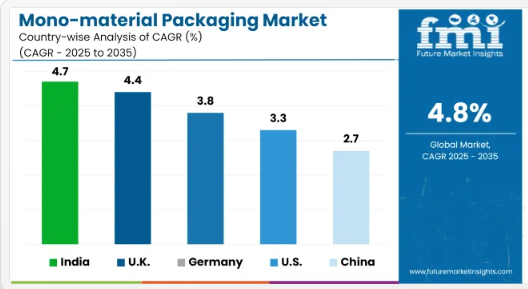
The global mono-material packaging market is experiencing significant expansion, projected to grow from USD 4.9 billion in 2025 to USD 7.8 billion by 2035, at a Compound Annual Growth Rate (CAGR) of 4.8%. This robust growth underscores a critical shift in the packaging industry, as manufacturers increasingly seek recyclable, low-complexity solutions that align with evolving regulatory demands and consumer preferences for sustainable products.
Manufacturers today face a dual challenge: meeting stringent environmental targets while optimizing production and supply chain efficiencies. Mono-material packaging, crafted from a single polymer such as polyethylene (PE) or polypropylene (PP), offers a compelling solution. It simplifies the recycling process, reduces material complexity, and enhances brand alignment with circular economy principles, positioning it as a strategic imperative for future growth.
Request Mono-Material Packaging Market Draft Report: https://www.futuremarketinsights.com/reports/sample/rep-gb-22433
The Promise of True Circularity for Manufacturers
Mono-material solutions are rapidly gaining traction across food, personal care, household, and e-commerce sectors. This adoption is driven by ongoing advancements in film technologies that significantly enhance durability and functionality, proving that sustainable packaging does not necessitate a compromise on performance. As regulatory expectations rise and consumers increasingly favor low-waste options, brands are leveraging mono-material packaging to strengthen their environmental commitment and reinforce consumer trust.
Currently, mono-materials account for 28-32% of the flexible packaging market and represent 35-40% of new packaging developments worldwide. Europe leads this transition with 50-55% market presence, signaling a strong regional commitment to these simplified packaging systems.
Key Segments Driving Manufacturer Investment
The mono-material packaging market is characterized by strategic investments across several high-impact segments, offering distinct advantages for manufacturers:
- Polyethylene (PE): The Dominant Material Choice Polyethylene (PE) remains the leading material, commanding approximately 62% of total consumption. Its widespread adoption is attributed to its processing flexibility, thermoformability, and a broad seal temperature range (110-140°C), which enhances production adaptability for converters. PE films support downgauging initiatives through high elongation and strength-to-weight ratios, allowing up to 20-25% faster line throughput in co-extrusion film manufacturing while maintaining seal integrity at lower thermal thresholds, translating to significant energy savings per cycle for manufacturers.
- Food & Beverage: A Core Application Segment The food and beverage sector represents approximately 46% of the total application base for mono-material packaging. This demand is fueled by increasing output across processed food, snacks, dairy, and chilled categories. Mono-material structures, primarily PE and PP, support essential features like barrier control, hot-fill, and Modified Atmosphere Packaging (MAP) compatibility. Manufacturers benefit from solutions designed for low oxygen transmission rates (<0.5 cc/m²/day), ensuring extended shelf life and freshness retention.
- Pouch Formats: Versatility and Efficiency Pouches account for over 40% of mono-material packaging format usage, owing to their favorable volume-to-material ratio and adaptable design. Form-fill-seal systems utilizing mono-PE or PP pouches operate at high speeds of 300-400 units/min, offering exceptional efficiency for large-scale production. These formats enable up to 60-70% material savings over rigid equivalents and support full-bleed surface printing for enhanced shelf visibility and branding, providing a versatile and cost-effective solution for manufacturers.
- High-Barrier Films: Meeting Sensitive Packaging Needs High-barrier mono-material films address 35% of moisture- and oxygen-sensitive packaging applications. Achieving barrier levels as low as 0.06 cc/m²/day (OTR) and <1.5 g/m²/day (WVTR) through EVOH-layer integration, these films are crucial for vacuum packs, retort pouches, and medical-grade overwraps. They maintain structural stability during retort sterilization at 121°C and cold storage below -20°C, ensuring product integrity for ready meals, frozen items, and pet food.
For more on their methodology and market coverage, visit! https://www.futuremarketinsights.com/about-us
Navigating Market Dynamics and Regional Nuances
While mono-material packaging is gaining traction as brands replace multilayer films to meet recyclability targets and improve line efficiency, its growth remains uneven due to technical limits in barrier performance, resin price fluctuations, and gaps in supporting recycling infrastructure in certain markets.
Manufacturers are actively engaged in compliance-driven substitution and equipment retooling. Between Q3 2024 and Q2 2025, mono-polyethylene and mono-polypropylene films replaced multi-layer laminates in 47% of new snack and legume SKUs launched in Germany, Spain, and the Netherlands. Retrofitting of vertical form-fill-seal (VFFS) machines for single-polymer compatibility increased by 22% among contract packers in Poland and Turkey, reducing downtime and material mismatch errors. However, performance limitations in oxygen and moisture resistance continue to restrict mono-material usage in high-fat or high-moisture applications, leading to shelf-life reductions of up to 27% in some cases.
Editor’s Note:
This release is based exclusively on verified and factual market content derived from industry analysis by Future Market Insights. No AI-generated statistics or speculative data have been introduced. This press release highlights significant shifts in the Mono-Material Packaging Market, which is experiencing a pivotal change driven by consumer demand for healthier, more transparent products.
Related Reports:
United States and Canada Tray Sealing Machines Market: https://www.futuremarketinsights.com/reports/united-states-and-canada-tray-sealing-machines-market
United States Scented Garbage Bags Market: https://www.futuremarketinsights.com/reports/united-states-scented-garbage-bags-market
Artificial Intelligence in Packaging Market: https://www.futuremarketinsights.com/reports/artificial-intelligence-in-packaging-market
About Future Market Insights (FMI)
Future Market Insights, Inc. (ESOMAR certified, recipient of the Stevie Award, and a member of the Greater New York Chamber of Commerce) offers profound insights into the driving factors that are boosting demand in the market. FMI stands as the leading global provider of market intelligence, advisory services, consulting, and events for the Packaging, Food and Beverage, Consumer Technology, Healthcare, Industrial, and Chemicals markets. With a vast team of over 400 analysts worldwide, FMI provides global, regional, and local expertise on diverse domains and industry trends across more than 110 countries.
Join us as we commemorate 10 years of delivering trusted market insights. Reflecting on a decade of achievements, we continue to lead with integrity, innovation, and expertise.
Contact Us:
Future Market Insights Inc.
Christiana Corporate, 200 Continental Drive,
Suite 401, Newark, Delaware – 19713, USA
T: +1-347-918-3531
For Sales Enquiries: sales@futuremarketinsights.com
Website: https://www.futuremarketinsights.com
LinkedIn| Twitter| Blogs | YouTube