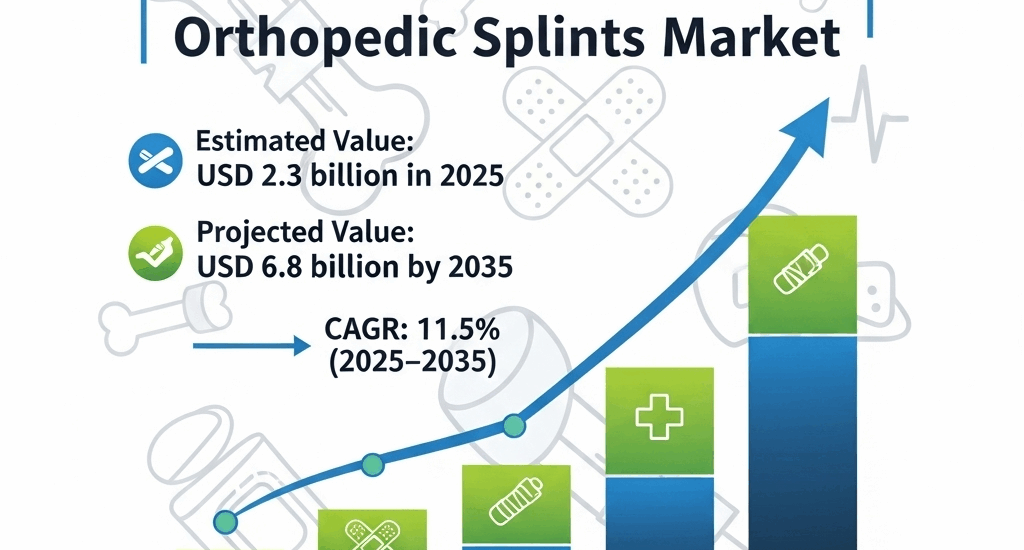
The global orthopedic splints market, valued at USD 2.3 billion in 2025, is forecast to grow at an impressive compound annual growth rate (CAGR) of 11.5% to reach USD 6.8 billion by 2035, according to the latest industry analysis. Rising incidences of musculoskeletal injuries, a growing elderly population, and increasing sports participation are among the key factors propelling demand.
Competitive Landscape Overview: Global Leaders Drive Innovation and Market Reach
The orthopedic splints industry is dominated by a blend of multinational healthcare conglomerates and specialized manufacturers, including 3M Company, DeRoyal Industries Inc., Zimmer Biomet Holdings Inc., Medi GmbH & Co. KG, Orthosys, Valued Medicare, Sam Medical, BSN Medical, Essity, Stryker Corporation, Ottobock SE & Co. KGaA, and Breg Inc.
Recent strategic moves include Essity’s 2024 acquisition of ABIGO Medical, expanding its wound care and immobilization portfolio; Breg Inc.’s launch of the Pinnacle and Ascend spinal orthoses for improved spinal injury care; and Stryker’s acquisition of Wright Medical, reinforcing its lower extremity and biologics offerings. These developments are sharpening competitive advantages in product diversity, distribution, and geographic expansion.
Competitive Landscape Overview: North America Maintains Market Dominance
North America accounts for over 35% of the global orthopedic splints market revenue, led by the United States. Aging demographics are a significant driver, with the population over 65 expected to rise from 1.3 million in 2020 to 6.8 million by 2035. Sports injuries also fuel demand—ankle and knee injuries represent over 37% of all time-loss injuries among U.S. soccer players aged 5–17, according to the American Academy of Pediatrics.
The U.S. market is projected to grow at a CAGR of 12.4%, reaching USD 1.6 billion by 2035. The Centers for Disease Control and Prevention estimates that 78 million Americans will suffer from arthritis by 2040, underscoring the sustained need for immobilization solutions.
Click Here for More Information:- https://www.futuremarketinsights.com/reports/orthopedic-splints-market
Competitive Landscape Overview: Asia-Pacific Emerges as the Fastest-Growing Region
Asia-Pacific is set to be the most lucrative regional market, supported by rising hip fracture rates, obesity-related injuries, and a growing geriatric population. In India, 467,044 road accidents were reported in 2020, driving demand for upper and lower extremity splints. Japan, with nearly 5,000 hospitals offering orthopedic surgery, faces an anticipated surge in lower extremity splint usage as hip fractures increase.
The region’s cost-effective healthcare infrastructure and expanding medical tourism, particularly in India and China, further strengthen its growth trajectory.
Competitive Landscape Overview: Product Segmentation Highlights Plaster Splints Leadership
Plaster splints remain the most widely adopted product type, expected to account for 47.3% of market revenue in 2025. Known for their moldability, rigidity, and affordability, plaster splints retain their relevance despite advances in fiberglass materials. Their rapid setting time and adaptability in acute care make them a preferred choice across both developed and emerging markets.
Upper extremity splints dominate by application, representing 42.6% of 2025 revenue, largely due to the prevalence of hand, wrist, and forearm fractures from sports, falls, and workplace incidents.
Competitive Landscape Overview: Sustainable Materials Create a New Growth Path
Natural fibre-based splints, projected to capture 37.5% of market share by 2025, are gaining traction as healthcare providers and patients seek eco-friendly, skin-friendly, and biodegradable alternatives. Institutional sustainability policies and consumer preference for green products are accelerating adoption in both hospital and outpatient settings.
Competitive Landscape Overview: Challenges Temper Growth Momentum
Despite strong demand drivers, the orthopedic splints market faces constraints, including risks of compartment syndrome, pressure sores, and thermal injuries during application. The high cost of fiberglass splints—such as BSN Medical’s Articast Fiberglass Casting Tape retailing at Rs. 1,144 in India—remains a barrier in price-sensitive regions. Manufacturers are responding with cost-optimized materials and enhanced patient safety designs.
Competitive Landscape Overview: Outlook Through 2035
From 2020 to 2024, the global orthopedic splints market expanded at a CAGR of 10.6%, with fiberglass splints gaining traction due to their lightweight and durable properties. Looking ahead, the market is projected to maintain its upward momentum, driven by the increasing prevalence of osteoporosis and arthritis, as well as rising sports-related injuries and traffic accidents.
The lower extremity segment, in particular, is expected to grow at a CAGR of 10.3%, fueled by the global rise in osteoporosis-related hip fractures—occurring every three seconds, according to the International Osteoporosis Foundation.
Get Sample Report: – https://www.futuremarketinsights.com/reports/sample/rep-gb-15792
About Future Market Insights (FMI)
Future Market Insights, Inc. (ESOMAR certified, recipient of the Stevie Award, and a member of the Greater New York Chamber of Commerce) offers profound insights into the driving factors that are boosting demand in the market. FMI stands as the leading global provider of market intelligence, advisory services, consulting, and events for the Packaging, Food and Beverage, Consumer Technology, Healthcare, Industrial, and Chemicals markets. With a vast team of over 400 analysts worldwide, FMI provides global, regional, and local expertise on diverse domains and industry trends across more than 110 countries.
Contact Us:
Future Market Insights Inc.
Christiana Corporate, 200 Continental Drive,
Suite 401, Newark, Delaware – 19713, USA
T: +1-347-918-3531
For Sales Enquiries: sales@futuremarketinsights.com
Website: https://www.futuremarketinsights.com
LinkedIn| Twitter| Blogs | YouTube