

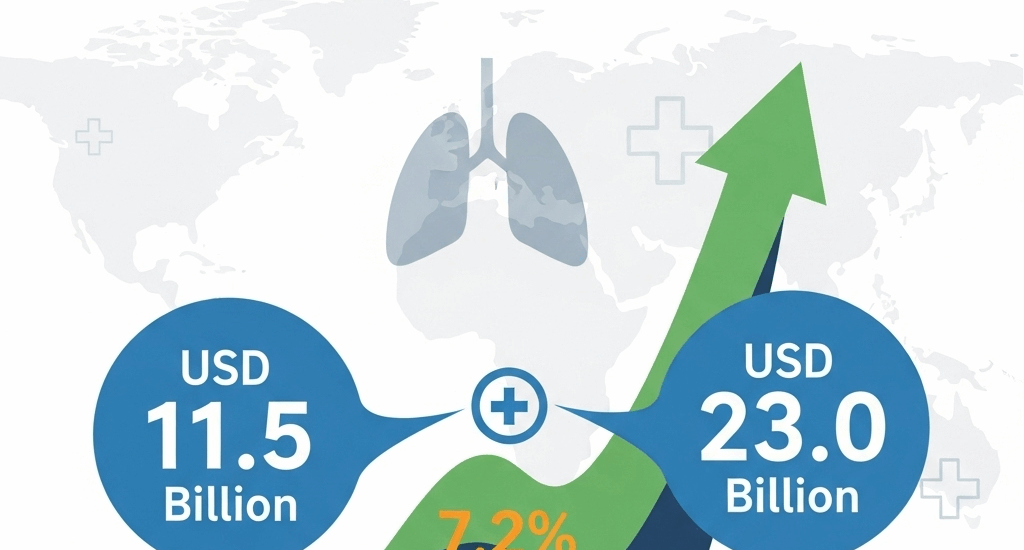
The global non-small cell lung cancer (NSCLC) market is on a robust growth trajectory, with a new report projecting its value to soar from an estimated USD 11.5 billion in 2025 to USD 23.0 billion by 2035. This represents a significant compound annual growth rate (CAGR) of 7.2%, fueled by a combination of technological advancements, evolving treatment paradigms, and a growing global patient population. The comprehensive forecast highlights a transformative period for the market, as personalized medicine and innovative therapies reshape the competitive landscape.
A Focus on Adenocarcinoma: The Leading Market Segment
Adenocarcinoma, a prevalent form of NSCLC, is poised to remain the dominant market segment, accounting for an estimated 45.5% of total market revenue in 2025. This commanding position is largely due to its high incidence among diagnosed NSCLC cases, affecting both smokers and non-smokers alike. The slower progression of this cancer type and its distinct molecular characteristics have made it particularly amenable to targeted therapies and biomarker-driven treatments. Improved diagnostic imaging techniques are enabling earlier detection, leading to more effective interventions and better patient outcomes. The continuous development of precision medicine tailored to specific mutations associated with adenocarcinoma further solidifies its prominence and clinical importance.
Click Here for More Information:- https://www.futuremarketinsights.com/reports/non-small-cell-lung-cancer-market
The Competitive Landscape of Treatment Modalities
While newer modalities like immunotherapy and targeted therapies are gaining ground, chemotherapy is projected to maintain its significant role in the NSCLC treatment market. The chemotherapy segment is expected to capture 38.0% of the market revenue in 2025, upholding its position as a cornerstone of first-line and palliative care. Its widespread availability, cost-effectiveness, and proven efficacy in controlling disease progression ensure its continued use across diverse healthcare settings. Chemotherapy remains a vital option for patients who do not qualify for targeted or immunotherapy due to the absence of specific mutations, and its integration into combination regimens enhances its overall utility. This enduring relevance underscores its central position in treatment algorithms, particularly in regions with limited access to novel, high-cost therapies.
Regional Growth and Key Market Drivers
The global NSCLC market is characterized by strong regional growth, with North America, Europe, and the Asia-Pacific region identified as key drivers of expansion. North America is expected to maintain the largest market share, driven by the introduction of new medications, substantial investments in R&D, and the widespread adoption of expensive, innovative drugs. Meanwhile, the Asia-Pacific region is anticipated to be a significant contributor to market growth, fueled by rising smoking rates and a large patient pool. The less onerous regulatory clearance processes in some Asian countries and the presence of a burgeoning pharmaceutical industry are also contributing to market expansion.
Market growth is further propelled by a confluence of factors, including increasing environmental pollution, which is a major contributor to rising cancer diagnoses. The expansion of medical insurance and reimbursement policies is accelerating market growth by improving patient access to critical treatments. This is complemented by growing governmental and private sector funding for research, which is fostering the development of new diagnostic tools and therapeutic options.
Challenges and the Future of NSCLC Innovation
Despite the optimistic outlook, the NSCLC market faces several challenges. Strict regulatory standards and rigorous testing protocols for new treatments can hamper market development. The scarcity of lung transplant organs also poses a challenge, potentially limiting the growth potential for patients undergoing NSCLC therapy.
However, the future is bright with innovation. Key industry players are pursuing strategic collaborations, acquisitions, and the development of novel drugs to consolidate their market presence. A new wave of startups is also emerging, bringing groundbreaking product lines and technologies to the forefront. Companies like Moderna are pioneering messenger RNA (mRNA) based medications, while Rain Therapeutics is focusing on specific NSCLC subtypes. Optellum is leveraging artificial intelligence for smart lung cancer detection, demonstrating a future where advanced technology and personalized medicine converge to transform patient care.
Get Sample Report: – https://www.futuremarketinsights.com/reports/sample/rep-gb-16143
About Future Market Insights (FMI)
Future Market Insights, Inc. (ESOMAR certified, recipient of the Stevie Award, and a member of the Greater New York Chamber of Commerce) offers profound insights into the driving factors that are boosting demand in the market. FMI stands as the leading global provider of market intelligence, advisory services, consulting, and events for the Packaging, Food and Beverage, Consumer Technology, Healthcare, Industrial, and Chemicals markets. With a vast team of over 400 analysts worldwide, FMI provides global, regional, and local expertise on diverse domains and industry trends across more than 110 countries.
Contact Us:
Future Market Insights Inc.
Christiana Corporate, 200 Continental Drive,
Suite 401, Newark, Delaware – 19713, USA
T: +1-347-918-3531
For Sales Enquiries: sales@futuremarketinsights.com
Website: https://www.futuremarketinsights.com
LinkedIn| Twitter| Blogs | YouTube




