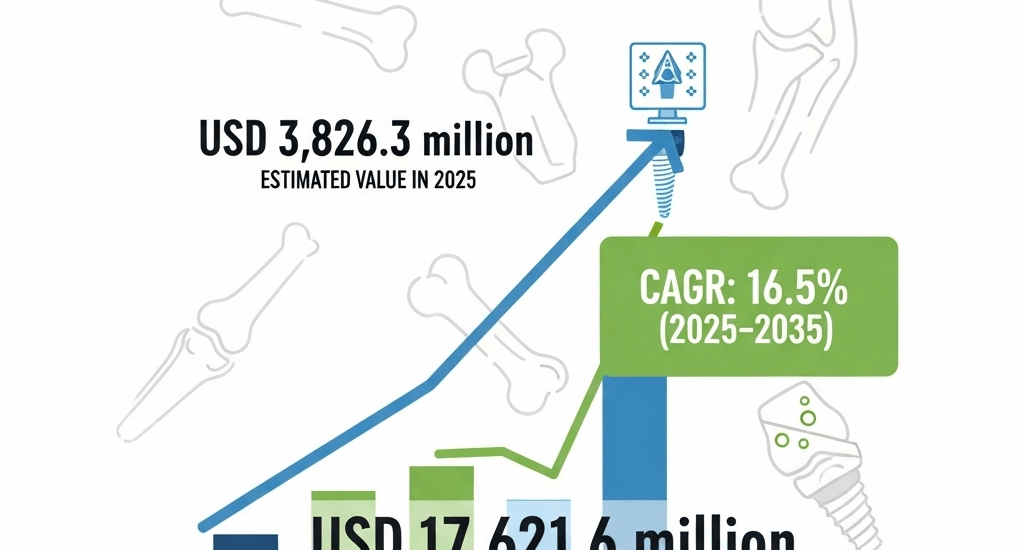
The global Orthopedic Navigation Systems Market is on a high-growth trajectory, projected to grow from USD 3,826.3 million in 2025 to USD 17,621.6 million by 2035, according to a newly published industry report. The market is expected to expand at a compound annual growth rate (CAGR) of 16.5% over the forecast period, fueled by a rising preference for minimally invasive orthopedic procedures, integration of AI and real-time imaging, and increasing global musculoskeletal disorders.
Key Market Insights at a Glance:
- 2025 Market Size: USD 3.83 billion
- 2035 Forecast: USD 17.62 billion
- CAGR: 16.5% (2025–2035)
- Top Technology: Optical Tracking (42.5% market share in 2025)
- Leading Application: Knee Surgery (48.1% market share in 2025)
- Primary End Users: Hospitals (72.8% share in 2025)
- Growth Leaders by Country: USA (16.7%), South Korea (16.5%), EU (16.5%)
Technology Outlook: Optical Tracking Dominates
Optical tracking is projected to lead all technology segments, accounting for 42.5% of market revenue in 2025. This is attributed to its superior real-time imaging, 3D visualization, and enhanced intraoperative precision. The technology has seen expanded use in robotic-assisted surgeries and is gaining traction in both hospital and ambulatory care environments due to its non-invasive approach and reduced radiation exposure.
Click Here for More Information:- https://www.futuremarketinsights.com/reports/dental-consumables-market
Knee Surgery: The Cornerstone of Application Growth
Knee surgeries remain the top application, representing nearly half of the total orthopedic navigation market share in 2025 (48.1%). Driven by the global burden of osteoarthritis and rising total knee arthroplasty procedures, navigation systems help improve prosthetic alignment and reduce implant failure rates. Advances in robotic and AI-assisted systems have made knee procedures safer, faster, and more precise, supporting the adoption curve across surgical centers.
Hospitals: Powerhouses of Adoption
Hospitals dominate the end-user segment with a 72.8% share, thanks to greater capital investment capabilities, integration with advanced imaging and EHR systems, and the availability of multidisciplinary surgical teams. High surgical volumes and reimbursement frameworks are encouraging widespread implementation of navigation technologies in inpatient settings.
Regional Outlook: U.S. and Asia-Pacific at the Forefront
The United States leads growth with a projected CAGR of 16.7%, bolstered by high hip and knee replacement volumes, rapid adoption of robotic platforms, and strong reimbursement models. Meanwhile, Asia-Pacific, especially South Korea and Japan, is emerging as a critical growth region, fueled by increasing healthcare digitization, geriatric populations, and government investment in smart surgical technologies.
In Europe, early adoption of AI-enhanced systems and smart OR infrastructure continues to drive growth across key economies like Germany, France, and the Netherlands. The region benefits from a strong medtech ecosystem, with companies investing in AR-based surgical planning and intraoperative 3D navigation.
Challenges & Growth Opportunities
Despite high growth projections, the market faces hurdles such as high implementation costs, workflow integration issues, and limited interoperability with existing OR infrastructure. These challenges are especially pronounced in mid-sized hospitals and surgical centers.
However, the demand for precision surgery, minimally invasive techniques, and aging populations worldwide presents significant opportunities. Navigation-assisted systems are proving critical in complex orthopedic procedures like spinal surgeries and trauma reconstructions, where surgical accuracy directly impacts outcomes.
Competitive Landscape: Innovation Takes Center Stage
The orthopedic navigation systems market is intensely competitive, with key players like Stryker, Brainlab, Augmedics, Johnson & Johnson, and Globus Medical leading the innovation front. Emerging technologies—such as AR-based surgical navigation, AI-driven imaging, and robot-compatible platforms—are reshaping the surgical landscape.
Recent developments include:
- Globus Medical’s ExcelsiusHub™ (2024): A freehand navigation system for spinal surgeries, enhancing real-time visualization and minimizing radiation exposure.
- Medivis Inc. (2025): Launched an FDA-cleared AR-based Spine Navigation platform with surgical intelligence and seamless OR integration.
Get Sample Report: – https://www.futuremarketinsights.com/reports/sample/rep-gb-16746
About Future Market Insights (FMI)
Future Market Insights, Inc. (ESOMAR certified, recipient of the Stevie Award, and a member of the Greater New York Chamber of Commerce) offers profound insights into the driving factors that are boosting demand in the market. FMI stands as the leading global provider of market intelligence, advisory services, consulting, and events for the Packaging, Food and Beverage, Consumer Technology, Healthcare, Industrial, and Chemicals markets. With a vast team of over 400 analysts worldwide, FMI provides global, regional, and local expertise on diverse domains and industry trends across more than 110 countries.
Contact Us:
Future Market Insights Inc.
Christiana Corporate, 200 Continental Drive,
Suite 401, Newark, Delaware – 19713, USA
T: +1-347-918-3531
For Sales Enquiries: sales@futuremarketinsights.com
Website: https://www.futuremarketinsights.com
LinkedIn| Twitter| Blogs | YouTube