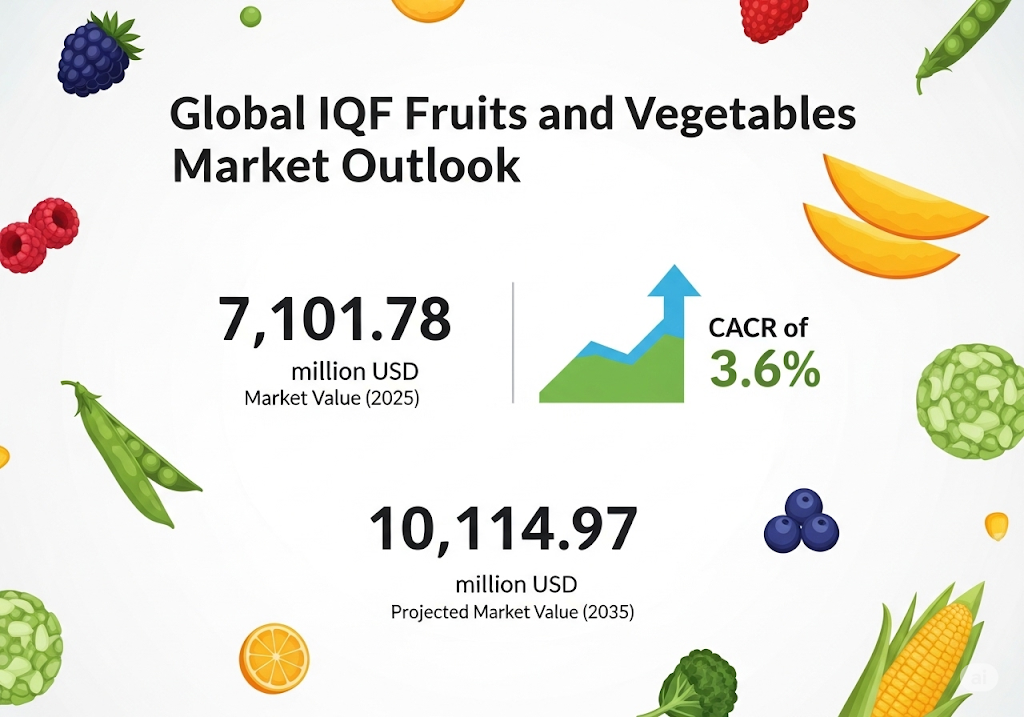
 As of 2025, the global Individual Quick Frozen (IQF) fruits and vegetables market is valued at approximately USD 7.1 billion. According to Future Market Insights, the market is projected to grow at a 3.6% compound annual growth rate (CAGR) to reach more than USD 10.1 billion by 2035. Behind this seemingly modest growth lies a much bigger transformation: how the world processes, preserves, and prioritizes produce.
IQF technology is no longer a novelty. It’s emerging as a global necessity in a food system increasingly defined by unpredictability—from climate change to supply chain disruption. Unlike traditional freezing methods, IQF locks in nutritional value, taste, and texture—making it the most viable way to meet demand for out-of-season, minimally processed fruits and vegetables worldwide.
Surge in Market Demand: Explore Comprehensive Trends and Analysis in Our Full Report: https://www.futuremarketinsights.com/reports/iqf-fruits-and-vegetables-market
Why IQF Deserves More Attention
The IQF process has long been misunderstood as an industrial shortcut. But its role in extending shelf life while preserving quality has become essential to global food security. As urbanization continues and fresh produce becomes more expensive and harder to transport, IQF offers a scalable, consistent alternative that doesn’t compromise on health.
By 2035, as the IQF market edges toward $10.1 billion, this growth will not come from consumer snacking alone—it will be driven by large-scale food processors, institutional kitchens, meal delivery platforms, and an expanding middle class in emerging economies demanding convenient, healthy options year-round.
But the Industry Isn’t There Yet
That said, the IQF sector’s growth potential still faces serious friction. According to Future Market Insights, infrastructure costs, limited access to freezing technology, and fragmented cold supply chains continue to slow expansion—especially in under-resourced regions.
The problem isn’t demand. It’s capacity. Without stronger investment in energy-efficient freezing systems, cold chain logistics, and storage facilities, the sector will struggle to meet its forecasted growth—let alone respond to future shocks in global food availability.
What Needs to Happen Next
- Cold Chain Infrastructure Must Scale Up
This means more than just adding freezers—it requires end-to-end investment in logistics, from rural farms to global ports. - Educate Consumers and Retailers
IQF fruits and vegetables are often fresher, safer, and more nutritious than their “fresh” counterparts on long-haul trucks. That message hasn’t reached most markets yet. - Support Freezing Innovation
Streamlined, modular freezing technology could lower barriers for small- and medium-sized producers, bringing IQF into regional ecosystems that have long lacked access. - Build Domestic Resilience
Countries that currently depend on imports must establish their own IQF capacity if they want to hedge against global supply disruptions and food inflation.
Final Word
According to Future Market Insights, the IQF fruits and vegetables market is growing steadily—from USD 7.1 billion in 2025 to over USD 10.1 billion by 2035. That’s not a headline about explosive growth. It’s a signal—quiet but urgent—that the way we process and distribute fruits and vegetables is changing.
This market doesn’t need hype. It needs action. Because the question isn’t whether IQF will become more important in the future—it’s whether the food industry is willing to build fast enough to meet the moment.
Key Companies
- Ardo
- Greenyard
- Crop’s NV
- Bonduelle
- Wawona Frozen Foods
- Dole Food Co. Inc.
- Uren Food Group Ltd.
- Capricorn Food Products Ltd.
- B&G Foods Inc.
- SunOpta Inc.
- Others

Key Segments of the Report
By Product Type:
- IQF Fruits
- IQF Vegetables
By Application:
- Bakery and Confectionery
- Dairy and Frozen Desserts
- Ready Meals
- Soups and Sauces
- Smoothies and Beverages
- Clinical and Functional Nutrition
By Sales Channel:
- B2B (Foodservice, Institutional Buyers, Manufacturers)
- Retail (Supermarkets/Hypermarkets, Specialty Stores, Online Channels)
By Form:
- Whole
- Diced/Cubed
- Sliced
- Blended Mixes
By Functionality:
- Nutrient Retention
- Shelf-Life Extension
- Ready-to-Use
- Texture Stability
By Product Claim:
- Clean Label
- Additive-Free
- Organic
- Non-GMO
By Region:
- North America
- Latin America
- East Asia
- South Asia & Pacific
- Eastern Europe
- Western Europe
- Middle East & Africa
About Future Market Insights (FMI)
Future Market Insights, Inc. (ESOMAR certified, recipient of the Stevie Award, and a member of the Greater New York Chamber of Commerce) offers profound insights into the driving factors that are boosting demand in the market. FMI stands as the leading global provider of market intelligence, advisory services, consulting, and events for the Packaging, Food and Beverage, Consumer Technology, Healthcare, Industrial, and Chemicals markets. With a vast team of over 400 analysts worldwide, FMI provides global, regional, and local expertise on diverse domains and industry trends across more than 110 countries.
Contact Us:
Future Market Insights Inc.
Christiana Corporate, 200 Continental Drive,
Suite 401, Newark, Delaware – 19713, USA
T: +1-347-918-3531
For Sales Enquiries: sales@futuremarketinsights.com
Website: https://www.futuremarketinsights.com
LinkedIn| Twitter| Blogs | YouTube