

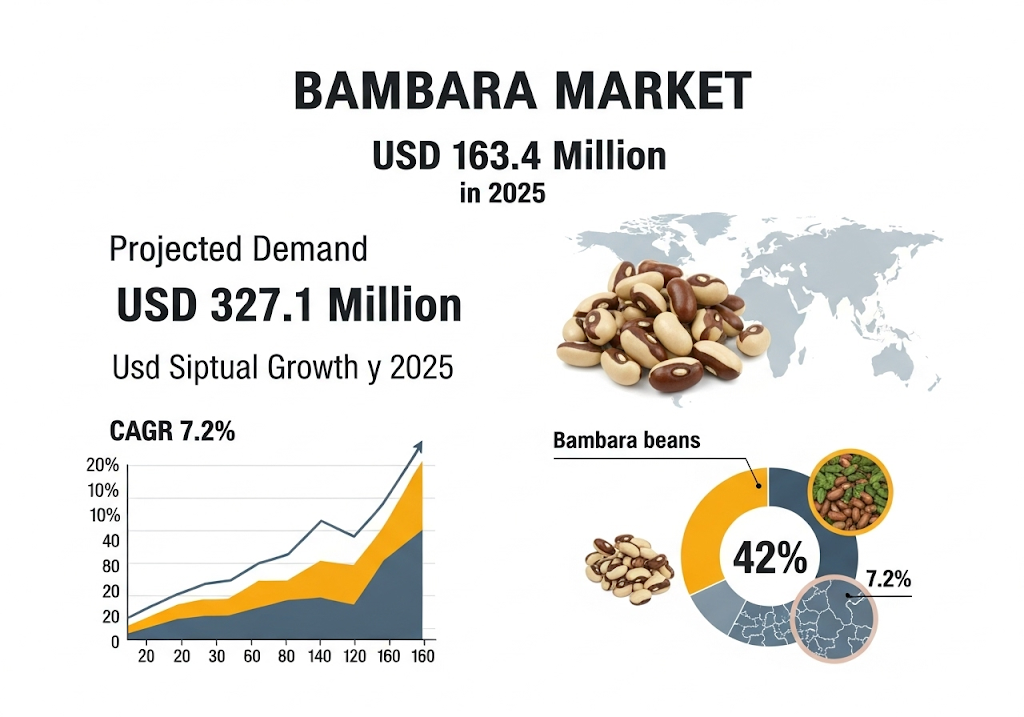
The global bambara beans market is poised for significant expansion, with a projected market value of USD 327.1 million by 2035, growing at an impressive Compound Annual Growth Rate (CAGR) of 7.2% from an estimated USD 163.4 million in 2025. This robust growth is primarily fueled by increasing global demand for sustainable, plant-based protein sources, coupled with strategic agronomic policies and a rising focus on drought-resilient crops.
The market’s upward trajectory is being shaped by several key factors. Region-specific agricultural policies are encouraging cultivation, while the diversification of functional food applications is creating new avenues for consumption. A growing global awareness of climate change and the need for drought-resilient crops in marginal soils further underscore the importance of bambara beans. For instance, in Nigeria, yields are improving due to the adoption of early-maturing seed lines and enhanced access to mobile threshing units. Sub-national procurement contracts are also playing a crucial role in supporting farmer cooperatives across West Africa.
“Bambara beans are emerging as a vital player in the evolving global food landscape,” stated a leading industry analyst. “Their inherent resilience and nutritional density make them an ideal candidate for addressing food security challenges and meeting the escalating demand for sustainable protein. We are witnessing a clear shift towards valuing crops that are both environmentally friendly and nutritionally potent.”
Heightened Market Interest: Our Complete Report Delivers Extensive Analysis and Trends: https://www.futuremarketinsights.com/reports/bambara-beans-market
Key Market Highlights:
- Dominance of Organic Segment: The organic bambara beans segment is set to command a substantial 70% market share in 2025. This is driven by a growing consumer preference for healthy, sustainable, and chemical-free food choices, aligning with the rise of plant-based diets and eco-conscious consumption.
- Cooking Ingredient Leads Applications: The cooking ingredient segment is projected to hold the largest market share at 45% in 2025. Bambara beans’ rich protein content and essential amino acids make them an excellent plant-based alternative in a wide array of dishes, from traditional staples to innovative vegan creations.
- Hypermarkets/Supermarkets Drive Distribution: Hypermarkets and supermarkets are anticipated to be the primary distribution channel, accounting for over 40% of the market share in 2025. Their extensive reach and convenience cater to a broad consumer base increasingly seeking plant-based and sustainable products.
- Asia Pacific to Lead Growth: The Asia Pacific region is identified as a key growth driver, with India emerging as the fastest-growing market at an impressive 10.2% CAGR. This growth is propelled by public-sector initiatives promoting climate-resilient crops and increasing urban consumer interest in plant-based proteins.
Competitive Landscape Overview:
The global bambara beans market, while still holding a niche position within broader categories like pulses and legumes (0.4-0.6% share), plant-based protein ingredients (under 1% share), and functional foods (below 0.2% share), is attracting increasing investment. Key players such as Believe in Bambara, BUSH’S, Earth Expo Company, Henan Changling Food Co. Ltd., African Flavour’s, and Elite Trading Company are actively working to expand product offerings and market reach. These companies are focusing on sustainable farming practices and innovative product formats, including extruded protein-rich flour for plant-based meal solutions and 100% bambara-based snack formulations.
Significant developments in the competitive landscape include:
- Inventory Rationalization & Post-Harvest Handling Efficiency: Driven by the need to optimize working capital and minimize spoilage, retailers and millers are shortening inventory cycles. The deployment of low-cost hermetic bags and moisture sensors has reduced average storage time, while digital batch tracking has improved cross-border acceptance rates.
- Protein-Rich Snack Opportunity: Research and development are validating the nutritional benefits of bambara beans in snack formulations. Clinical studies have demonstrated the high protein content and lower glycemic response of bambara bean crisps, leading to increased adoption in gluten-free bakeries, natural food brands, and sports nutrition segments.
- Traceability Adoption: Across both digital and physical supply chains, there’s a growing emphasis on traceability. Regional aggregators are tagging field-level origin and post-harvest moisture data to meet food safety standards in export markets, with QR-coded tracking being tested in both domestic and cross-border trade.
Despite challenges such as margin pressure from freight costs and input price shocks, the market is demonstrating resilience and adaptability. Suppliers are exploring alternative shipping methods and renegotiating contracts to stabilize profitability.
The rising demand for natural and sustainable ingredients in animal feed is also a significant growth factor. The USDA’s commitment of nearly USD 180 million in January 2025 to support eco-focused product development highlights the increasing shift towards plant-based alternatives in animal nutrition, where bambara beans offer a sustainable solution.
The bambara beans market is segmented by nature (organic, synthetic), application (cooking ingredient, snack foods, dietary supplements, animal feed, flour, dairy alternative), distribution channel (direct sales, indirect sales, hypermarkets/supermarkets, online stores, specialty stores, other retailers), and region (North America, Europe, Asia Pacific, Latin America, and Middle East & Africa).
As global food systems continue to evolve towards more sustainable and nutritious options, bambara beans are well-positioned to become a staple, offering immense potential for growth and innovation in the coming years.
 Stay Informed on Key Market Changes: Get a Sample Report: https://www.futuremarketinsights.com/reports/sample/rep-gb-8406
Key Segments
By Nature:
The industry is segmented into organic and synthetic.
By Application:
The industry finds applications in cooking ingredient, snack foods, dietary supplements, animal feed, flour, dairy alternative.
By Distribution Channel:
The industry is segmented into direct sales, indirect sales, hypermarkets/supermarkets, online stores, specialty stores, other retailers.
By Region:
The industry covers regions including North America, Europe, Asia Pacific, Latin America, and the Middle East & Africa.
About Future Market Insights (FMI)
Future Market Insights, Inc. (ESOMAR certified, recipient of the Stevie Award, and a member of the Greater New York Chamber of Commerce) offers profound insights into the driving factors that are boosting demand in the market. FMI stands as the leading global provider of market intelligence, advisory services, consulting, and events for the Packaging, Food and Beverage, Consumer Technology, Healthcare, Industrial, and Chemicals markets. With a vast team of over 400 analysts worldwide, FMI provides global, regional, and local expertise on diverse domains and industry trends across more than 110 countries.
Contact Us:
Future Market Insights Inc.
Christiana Corporate, 200 Continental Drive,
Suite 401, Newark, Delaware – 19713, USA
T: +1-347-918-3531
For Sales Enquiries: sales@futuremarketinsights.com
Website: https://www.futuremarketinsights.com
LinkedIn| Twitter| Blogs | YouTube




