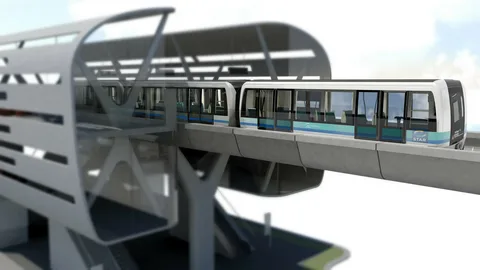
The automated people mover market is set to expand from USD 581.3 million in 2025 to USD 1,050.9 million by 2035, reflecting a CAGR of 6.1%. The surge in industry size is largely attributed to substantial investments in infrastructure development, particularly in international airports and emerging smart cities. Asia and the Middle East are key growth hubs due to the expansion of large-scale airport projects and urban mass transit systems.
The automated people mover (APM) market is growing steadily as cities, airports, and large-scale infrastructure developers seek innovative solutions to meet the demands of seamless, high-frequency passenger transport. Automated people movers are driverless, guided transit systems designed for short-distance travel in high-traffic areas such as airports, urban centers, business parks, and theme parks. By offering reliable, efficient, and safe mobility, APMs are playing a transformative role in reshaping public transit networks and enhancing the overall travel experience.
Delivering Consistent, High-Capacity Passenger Movement
Automated people movers are engineered to transport large volumes of passengers efficiently over short routes with high frequency. These systems are typically fully automated, reducing human error and allowing for uninterrupted operations 24/7. Whether facilitating terminal transfers in airports or serving as feeder systems to metro networks, APMs deliver predictable service with minimal wait times, ensuring passengers reach their destinations quickly and comfortably.
Get Ahead with Our Report: Request Your Sample Now!
https://www.futuremarketinsights.com/reports/sample/rep-gb-7115
Wide Deployment Across Key Infrastructure Hubs
APMs are widely deployed in major international airports to connect terminals, parking areas, rental car centers, and gates. Urban planners are also adopting APMs in downtown districts, hospitals, university campuses, and large commercial complexes to reduce congestion and offer sustainable last-mile connectivity. These systems provide a dependable alternative to buses and shuttles, particularly in environments where consistent flow and accessibility are paramount.
Driving Smart City and Airport Modernization Initiatives
The adoption of APMs is closely linked to smart infrastructure development and airport modernization projects. As urban populations grow and air travel surges, authorities are investing in advanced transit systems to improve passenger throughput, reduce congestion, and enhance traveler convenience. Automated systems align with the vision of smart cities by integrating digital controls, energy-efficient technologies, and real-time monitoring tools for optimized operations and minimal environmental impact.
Advanced Technologies Supporting Safety and Efficiency
Modern APMs are equipped with cutting-edge technologies including automated control systems, obstacle detection sensors, and intelligent braking mechanisms. These features enable safe navigation, collision avoidance, and precise docking at platforms. Real-time system monitoring and diagnostics enhance reliability, while redundancy in critical systems ensures consistent performance even in the event of component failure. Passenger information systems, CCTV integration, and emergency communication further elevate safety standards.
Energy-Efficient Design Promoting Sustainability Goals
Sustainability is a key driver of APM adoption. These systems typically operate on electric power and utilize regenerative braking technologies to conserve energy. Their quiet, emission-free operation makes them ideal for indoor environments and densely populated areas. As cities commit to reducing carbon emissions and promoting green mobility, APMs offer a practical solution for low-impact public transportation.
Customization and Modularity for Varied Applications
APM systems can be customized based on route length, passenger capacity, and architectural constraints. Solutions range from single-car shuttles to multi-car systems serving large airport complexes or urban corridors. Elevated guideways, tunnels, and at-grade tracks can be tailored to specific site requirements, and modular design allows for future scalability. This flexibility makes APMs suitable for both retrofits and new developments.
Reducing Congestion and Improving Accessibility
Automated people movers help alleviate vehicular congestion by reducing dependence on cars and buses for short-distance travel. They also enhance accessibility for individuals with limited mobility, as systems are designed with wide doors, level boarding, and intuitive controls. By offering barrier-free transit, APMs support inclusive mobility and improve connectivity between key destinations.
Public and Private Sector Collaboration Driving Expansion
The growth of the APM market is supported by partnerships between public transit agencies, airport authorities, and private contractors. Governments are allocating resources to enhance transport infrastructure, while engineering firms and system integrators provide expertise in design, implementation, and maintenance. Public-private collaborations are enabling cost-effective deployment and long-term operational support for these complex systems.
Integration with Multimodal Transportation Networks
As cities strive to deliver end-to-end transportation solutions, APMs are being integrated into broader multimodal systems that include metro rail, buses, and bike-sharing services. Real-time scheduling, unified ticketing, and intermodal connectivity ensure that passengers can transition smoothly between different modes of transport. This integration enhances route planning and maximizes the efficiency of urban mobility ecosystems.
Drive Your Business Growth Strategy: Checkout the Report for Key Insights!
https://www.futuremarketinsights.com/checkout/7115
Future Outlook
The automated people mover market is poised for robust expansion as technological advancements, infrastructure upgrades, and sustainability objectives converge. Future systems are expected to incorporate artificial intelligence, digital twin simulations, and autonomous navigation enhancements. With increasing demand for clean, efficient, and connected transit, APMs will continue to play a pivotal role in the evolution of mobility—bridging short-distance gaps and elevating the standard of public transportation in cities and major transit hubs worldwide.
Future Market Insights, Inc. (ESOMAR certified, recipient of the Stevie Award, and a member of the Greater New York Chamber of Commerce) offers profound insights into the driving factors that are boosting demand in the market. FMI stands as the leading global provider of market intelligence, advisory services, consulting, and events for the Packaging, Food and Beverage, Consumer Technology, Healthcare, Industrial, and Chemicals markets. With a vast team of 400 analysts worldwide, FMI provides global, regional, and local expertise on diverse domains and industry trends across more than 110 countries.
Contact Us:
Future Market Insights Inc.
Christiana Corporate, 200 Continental Drive,
Suite 401, Newark, Delaware – 19713, USA
T: +1-845-579-5705
For Sales Enquiries: sales@futuremarketinsights.com
Website: https://www.futuremarketinsights.com
LinkedIn| Twitter| Blogs | YouTube