

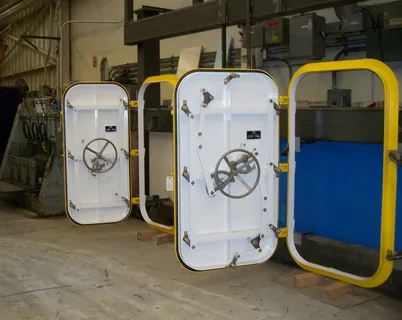
The global watertight door market is set to reach USD 1.6 billion by 2035, up from USD 858.7 million in 2025, at a CAGR of 6.2%. Growth is being driven by global shipyard expansions and stricter compliance norms under SOLAS and class society mandates. Watertight doors are now being specified earlier in the vessel design cycle, with growing demand for automation-compatible, corrosion-proof solutions.
The watertight door market is evolving in response to increasing safety regulations, advanced vessel designs, and growing maritime traffic across commercial, military, and offshore industries. Watertight doors are essential components in shipbuilding, designed to prevent water ingress and ensure compartmentalization in the event of hull breaches or flooding. These systems play a critical role in enhancing onboard safety, protecting cargo, and safeguarding personnel during emergency situations.
Get Ahead with Our Report: Request Your Sample Now!
https://www.futuremarketinsights.com/reports/sample/rep-gb-8629
Enhancing Maritime Safety Through Compartmentalization
Watertight doors are integral to a vessel’s structural integrity, allowing it to maintain buoyancy and stability during emergencies. These doors help isolate flooded sections, limiting water spread and giving crews more time to respond. By creating secure barriers between compartments, watertight doors are a frontline defense against catastrophic flooding, contributing to the overall survivability of marine and offshore platforms.
Diverse Applications Across Marine Sectors
Commercial shipping, naval defense, cruise lines, offshore drilling rigs, and research vessels all rely on watertight doors for compartmental protection. In commercial cargo and container ships, these doors help preserve valuable goods and reduce insurance risks. Military vessels utilize high-performance watertight systems to meet stringent naval standards for survivability. Offshore oil platforms integrate them to maintain operational integrity and personnel safety in harsh ocean conditions.
Alignment with International Maritime Regulations
The adoption of watertight door systems is driven by global maritime safety standards such as those established by the International Maritime Organization (IMO), Safety of Life at Sea (SOLAS) conventions, and classification societies. These regulatory frameworks mandate the installation and periodic inspection of watertight enclosures to reduce flood-related risks. Manufacturers are focusing on compliance-ready designs, offering solutions that meet both traditional and dynamic regulatory requirements.
Integration with Automation and Monitoring Systems
Modern watertight doors are increasingly integrated with automation systems, allowing for remote monitoring and control from ship bridges or centralized stations. Integration with ship management systems ensures that doors can be opened, closed, or locked automatically during critical situations. Sensors and status indicators offer real-time feedback, enhancing situational awareness and ensuring doors remain fully operational when needed most.
Design Innovations and Material Advancements
Technological advancements have led to the development of watertight doors with improved materials such as high-strength steel, aluminum alloys, and composite materials. These innovations reduce weight without compromising strength or resistance to corrosion. Fire-rated, pressure-resistant, and explosion-proof variants have also emerged, offering specialized protection in vessels with unique operational demands. Flush-mounted and sliding designs cater to spatial efficiency and aesthetic requirements in cruise ships and yachts.
Focus on Ease of Operation and Ergonomics
User-friendly operation is a key trend in the watertight door market. Manufacturers are focusing on creating doors that are easy to operate manually or automatically, even under high pressure or emergency conditions. Ergonomic handles, low-maintenance mechanisms, and safety interlocks enhance usability and minimize the risk of operator error. Doors designed for crew comfort and operational convenience are increasingly sought after in the cruise and commercial marine sectors.
Customization and Modular Deployment
The need for vessel-specific configurations is fueling demand for customizable watertight doors. Shipbuilders and operators require solutions that align with ship layouts, usage scenarios, and design standards. Modular systems allow for flexible deployment across new builds and retrofits, reducing downtime and installation costs. Tailored dimensions, finishes, and control systems enable optimal integration into a wide range of maritime assets.
Durability, Maintenance, and Lifecycle Management
Durability is critical in the marine environment, where exposure to saltwater, pressure fluctuations, and mechanical stress is constant. Manufacturers are engineering doors with corrosion-resistant coatings, long-life seals, and reinforced frames. Lifecycle management is further supported by remote diagnostics, maintenance scheduling features, and replacement part availability, ensuring that watertight integrity is sustained over years of operation.
Reinforcing Safety Culture and Risk Mitigation
The presence of watertight doors on a vessel is more than a technical requirement—it’s a reflection of a safety-first mindset. Effective training, clear signage, and routine drills involving watertight enclosures help crews understand their importance and functionality. Organizations that invest in quality watertight solutions signal their commitment to operational safety and environmental stewardship.
Drive Your Business Growth Strategy: Checkout the Report for Key Insights!
https://www.futuremarketinsights.com/checkout/8629
Future Outlook
The watertight door market is set to expand alongside global maritime trade, naval investments, and offshore energy development. Emerging trends such as smart ship technology, hybrid propulsion systems, and autonomous vessels will influence future door designs and integration needs. As vessel designs grow more complex and safety standards more rigorous, watertight doors will remain a cornerstone of marine safety infrastructure, ensuring resilience, reliability, and regulatory compliance across the seas.
About Future Market Insights (FMI)
Future Market Insights, Inc. (ESOMAR certified, recipient of the Stevie Award, and a member of the Greater New York Chamber of Commerce) offers profound insights into the driving factors that are boosting demand in the market. FMI stands as the leading global provider of market intelligence, advisory services, consulting, and events for the Packaging, Food and Beverage, Consumer Technology, Healthcare, Industrial, and Chemicals markets. With a vast team of 400 analysts worldwide, FMI provides global, regional, and local expertise on diverse domains and industry trends across more than 110 countries.
Contact Us:
Future Market Insights Inc.
Christiana Corporate, 200 Continental Drive,
Suite 401, Newark, Delaware – 19713, USA
T: +1-845-579-5705
For Sales Enquiries: sales@futuremarketinsights.com
Website: https://www.futuremarketinsights.com
LinkedIn| Twitter| Blogs | YouTube




