

Chocolate isn’t just a treat—it’s a global commodity. And behind every glazed donut, frosted cereal, and coated energy bar lies the real driver of the modern chocolate economy: industrial chocolate. It’s the unsung ingredient fueling a multibillion-dollar ecosystem of processed foods. But even as the demand rises, so do the warning signs.
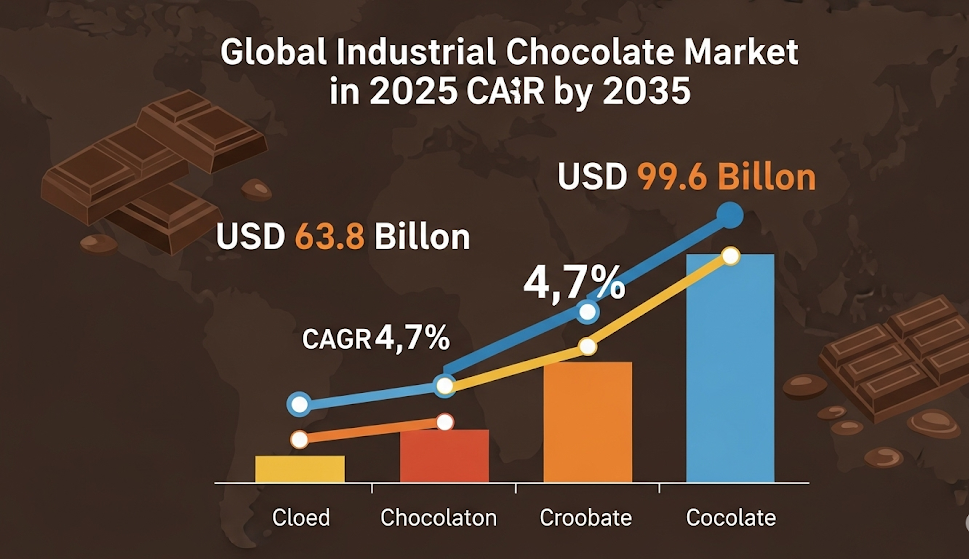
According to Future Market Insights (FMI), the global industrial chocolate market is projected to grow from USD 63.8 billion in 2025 to USD 99.6 billion by 2035, with a compound annual growth rate (CAGR) of 4.7% over the forecast period. This isn’t a boutique trend—it’s a macro-level surge. And it comes at a cost that goes far beyond the price per metric ton.
Uncover Market Opportunities: Access a Sample Report Now: https://www.futuremarketinsights.com/reports/sample/rep-gb-16643
The Engine Behind Everyday Indulgence
Unlike premium or craft chocolate, industrial chocolate is produced at scale and primarily used in manufacturing. Think of what goes into candy bars, spreads, baked goods, dairy mixes, and even cosmetics. It’s everywhere—but rarely seen on its own.
What’s pushing this growth? A rising global appetite for chocolate-infused foods—especially in Asia-Pacific and the Middle East—combined with the expansion of processed snack and dessert categories. Whether it’s mass-market cookies or budget-brand ice cream, industrial chocolate is the flavor workhorse.
But the sector’s rapid acceleration reveals a deeper tension: Can global supply chains keep up with demand? And more importantly—should they?
Growth Meets a Grinding Reality
Industrial chocolate’s projected growth is a textbook example of globalized food economics: high volume, low margin, steady output. Yet the complexity of the supply chain—from cocoa bean to chocolate liquor to compound coating—is precisely what makes it vulnerable.
The market thrives on assumptions: that raw materials will remain available, that production will remain cheap, and that demand will remain steady. But with rising costs across logistics, ingredients, and energy—not to mention unpredictable weather patterns—those assumptions are now at risk.
Even with impressive market projections, this is a system under pressure.
Scale Without Sustainability?
The challenge is not that industrial chocolate is growing—it’s that it’s growing without a clear strategy for long-term resilience. Most of the product is used in ways where cost trumps quality, and where origin, ethics, and environmental impact are largely invisible to the end consumer.
This model works—until it doesn’t.
Without coordinated shifts in sourcing, pricing, and transparency, the growth path outlined by FMI may accelerate systemic strain. Industrial chocolate may be a $99 billion business by 2035, but that figure masks the deeper question: Is the foundation of this market built to last?
The Road Ahead
The next decade will define whether industrial chocolate remains an efficient, scalable input—or becomes a high-risk commodity tethered to global volatility. Growth alone isn’t the story. The real narrative is whether the industry can sustain that growth without burning through its resources—natural, economic, and human.
The numbers are bullish. The fundamentals are brittle. And the clock is ticking.
Key Players
- Barry Callebaut
- Cargill
- Nestlé
- Blommer Chocolate Company
- Mars Inc.
- Puratos Group
- Mondelez International
- The Hershey Company
- Fuji Oil Holdings Inc.
- Olam Food Ingredients
Segmentation
By Product:
This segment is further categorized into Cocoa Butter, Cocoa Liquor, and Cocoa Powder.
By Application:
This segment is further categorized into Bakery, Ice Cream and Frozen Dessert, Dairy, Cereals, and Others.
By Type:
This segment is further categorized into Confectionery, Cocoa, and Other Products.
By Region:
The industry is analyzed across North America, Latin America, Western Europe, Eastern Europe, South Asia & Pacific, East Asia, Central Asia, Balkan and Baltic Countries, Russia and Belarus, and The Middle East & Africa.

About Future Market Insights (FMI)
Future Market Insights, Inc. (ESOMAR certified, recipient of the Stevie Award, and a member of the Greater New York Chamber of Commerce) offers profound insights into the driving factors that are boosting demand in the market. FMI stands as the leading global provider of market intelligence, advisory services, consulting, and events for the Packaging, Food and Beverage, Consumer Technology, Healthcare, Industrial, and Chemicals markets. With a vast team of over 400 analysts worldwide, FMI provides global, regional, and local expertise on diverse domains and industry trends across more than 110 countries.
Contact Us:
Future Market Insights Inc.
Christiana Corporate, 200 Continental Drive,
Suite 401, Newark, Delaware – 19713, USA
T: +1-347-918-3531
For Sales Enquiries: sales@futuremarketinsights.com
Website: https://www.futuremarketinsights.com
LinkedIn| Twitter| Blogs | YouTube




