

Grocery shopping used to be simple. Today, it’s anything but. From AI-powered supply chains to the race for faster delivery, the food and grocery retail market has morphed into a high-stakes global battleground—one that’s expanding in value, but not necessarily in equity.
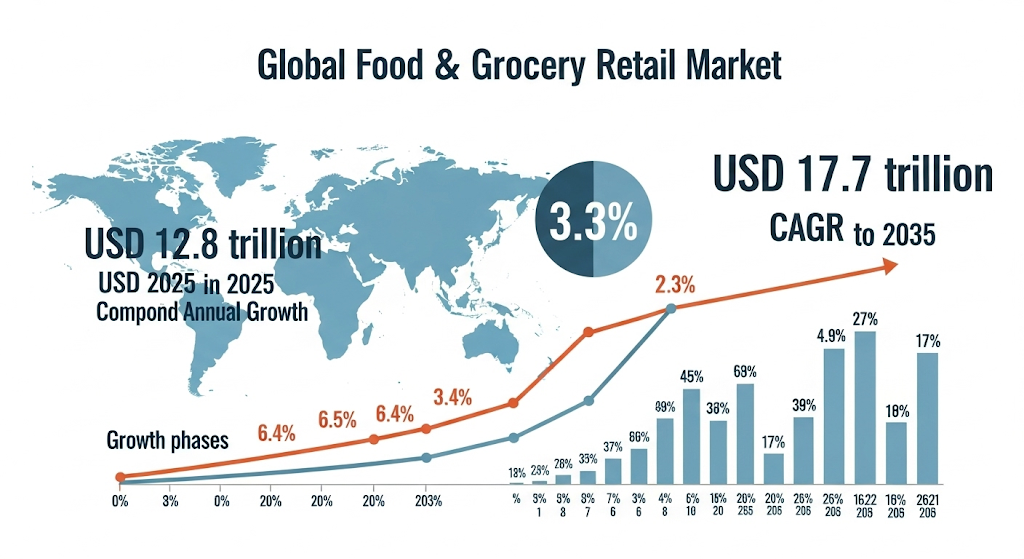
According to Future Market Insights, the global food and grocery retail market is set to grow from USD 12.8 trillion in 2025 to USD 17.7 trillion by 2035, reflecting a compound annual growth rate (CAGR) of 3.3% over the next decade. While that growth sounds reassuring, it obscures a far more complicated reality: power is consolidating, small players are disappearing, and the very nature of food access is being rewritten.
Track the Latest Market Developments: Request a Sample Report: https://www.futuremarketinsights.com/reports/sample/rep-gb-19531
Growth Isn’t the Whole Story
On paper, a $17.7 trillion market should signal robust health. But behind the numbers is a market being reshaped by automation, data dominance, and consolidation. In urban centers, speed and convenience dominate. In rural or underserved regions, however, physical access to fresh, affordable food continues to shrink. The gap between what’s growing and who’s benefitting is getting harder to ignore.
Retail giants are transforming grocery from a community staple into a high-margin tech operation. Warehouses are replacing storefronts. Algorithms are deciding what ends up in digital carts. And increasingly, customer “choice” is being shaped by backend logistics, not local demand.
The Illusion of Abundance
Yes, global demand is rising. Yes, technology is improving efficiency. But in many regions, the rise of private-label dominance and centralized fulfillment means less diversity on the shelf, fewer local suppliers, and diminishing control for consumers.
Traditional neighborhood grocers—once the backbone of food accessibility—are struggling to compete. As grocery platforms optimize for scale and data capture, they often sacrifice community-specific offerings and push out smaller vendors. The food may be cheaper and delivered faster, but it’s becoming less personal, less nutritious, and in some cases, less available.
A Market in Transition—But Toward What?
The growth predicted by Future Market Insights may be inevitable, but what’s not guaranteed is the shape it takes. Will grocery retail become even more centralized, optimized for shareholder value over food quality or worker conditions? Or will it evolve toward a more balanced model—where technology and tradition can coexist, and access doesn’t depend on a ZIP code or broadband connection?
Final Shelf Check
The global grocery retail market is expanding. That much is clear. But who controls that growth—and who it ultimately serves—is still very much in flux.
A $17.7 trillion industry should feed people better, not just faster. It should elevate producers, not just platforms. And it should reflect the values of the communities it claims to serve—not just the efficiency of the systems that deliver to them.
Until then, growth is just a number. The real story is what’s being lost in the name of convenience.
Leading Manufacturers
- Walmart;
- Costco Wholesale Corp.
- 7-ELEVEN, Inc.
- Amazon.com Inc.
- The Kroger Co.
- Target Brands, Inc.
- ALDIAEON Co Ltd
- Carrefour CA
- Schwarz Gruppe
Key Segmentation
By Product Type:
By Product type the industry has been categorised into Fresh Food, Frozen Food, Food Cupboard, Beverages, Cleaning & Household, Others
By Distribution Channel:
By Distribution Channel the industry has been categorised into Supermarkets & Hypermarkets, Convenience Stores, Departmental Stores, Online
By Region:
Industry analysis has been carried out in key countries of North America, Latin America, Europe, East Asia, South Asia and Middle East & Africa
 Maximize Your ROI: Access the Full Market Report: https://www.futuremarketinsights.com/checkout/19531
About Future Market Insights (FMI)
Future Market Insights, Inc. (ESOMAR certified, recipient of the Stevie Award, and a member of the Greater New York Chamber of Commerce) offers profound insights into the driving factors that are boosting demand in the market. FMI stands as the leading global provider of market intelligence, advisory services, consulting, and events for the Packaging, Food and Beverage, Consumer Technology, Healthcare, Industrial, and Chemicals markets. With a vast team of over 400 analysts worldwide, FMI provides global, regional, and local expertise on diverse domains and industry trends across more than 110 countries.
Contact Us:
Future Market Insights Inc.
Christiana Corporate, 200 Continental Drive,
Suite 401, Newark, Delaware – 19713, USA
T: +1-347-918-3531
For Sales Enquiries: sales@futuremarketinsights.com
Website: https://www.futuremarketinsights.com
LinkedIn| Twitter| Blogs | YouTube




