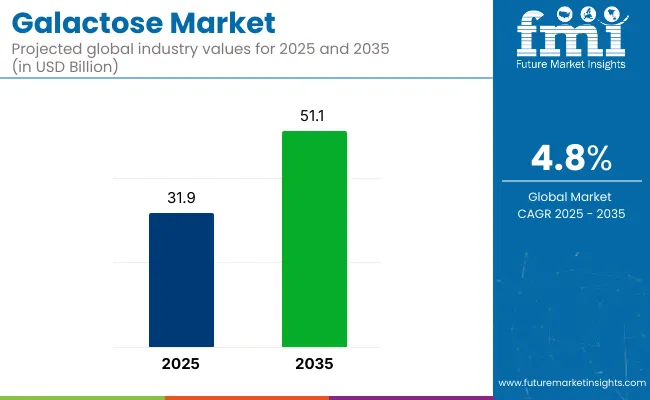
 The global galactose market is projected to grow from USD 31.9 billion in 2025 to USD 51.1 billion by 2035, expanding at a robust CAGR of 4.8%. This growth is underpinned by increasing interest in functional food ingredients, the surge in lactose-free product formulations, and expanding applications in biotechnology and pharmaceuticals. The market is being driven by both consumer health preferences and industry-level innovations.
Explore Market Dynamics: Request Your Sample Report Now: https://www.futuremarketinsights.com/reports/sample/rep-gb-13980
Market Trends Highlighted
Lactose-Free Revolution: Rising prevalence of lactose intolerance is accelerating demand for galactose as an alternative sweetener in food and beverage applications.
Pharma Innovations: Extensive clinical research into galactose’s role in cognitive function and metabolic health is strengthening its value in pharmaceutical formulations.
Enzyme-Based Production: Enzymatic synthesis is gaining momentum as a sustainable and scalable production method, especially in developed markets like the USA and Germany.
Plant-Based Sourcing: Consumer inclination toward clean-label and vegan products is promoting the adoption of plant-derived galactose, now holding 68.0% of the market share.
Accelerated Market Demand: Find Comprehensive Insights and Trends in Our Full Report: https://www.futuremarketinsights.com/reports/galactose-market
Developments
- Formulation Focus: Powdered galactose is forecasted to dominate with 49.0% of the product segment in 2025 due to better shelf stability and ease of use in various formulations.
- Pharmaceutical Growth: Among end-use categories, the pharmaceutical sector is poised for the fastest growth, while food applications will lead by value, capturing a 34.0% share in 2025.
- R&D Expansions: Countries like Germany and Japan are investing in galactose-based synbiotics and cosmetic innovations, respectively, positioning themselves as leaders in applied research.
Key Takeaways of the Report
- Market Value (2025): USD 31.9 billion
- Market Forecast (2035): USD 51.1 billion
- CAGR (2025–2035): 4.8%
- Leading Product: D-Galactose with 72.0% share
- Top Source: Plant-derived sugar with 68.0% share
- Leading End Use: Food segment (34.0%), fastest growth in pharmaceuticals
- Top Market by Growth Rate: USA (CAGR of 4.9%)
Market Drivers
- Rising Health Consciousness: Growing consumer awareness around digestive health and functional nutrition is boosting galactose demand in food and supplements.
- Lactose Intolerance Trends: As global lactose intolerance rates rise, galactose is emerging as a critical component in dairy alternatives.
- Pharmaceutical Demand: Increasing use of galactose in metabolic and cognitive health treatments is fueling pharmaceutical sector growth.
- Technology Advancements: Enzyme-based biotechnological processes are streamlining galactose production, making it more cost-effective and scalable.
Regional Insights
North America leads in innovation and adoption, while Europe is rapidly embracing plant-based galactose amid regulatory support. Asia Pacific remains a promising region, driven by food innovation and high lactose-intolerance rates.
- North America: Dominated by the USA, where R&D in galactose applications for health supplements and medical nutrition is particularly strong.
- Europe: Countries like Germany and France are investing in pharmaceutical-grade and cosmetic applications of galactose.
- Asia Pacific: Japan is leading functional food integration, with a focus on clean-label, plant-derived sugars.
Country-wise CAGR Analysis
- USA: Fastest-growing market with a CAGR of 4.9%, driven by enzyme-based technology and clinical interest in galactose’s health benefits.
- Germany: CAGR of 4.8%, bolstered by advanced biotech applications and demand for industrial-grade D-galactose.
- Japan: CAGR of 4.8%, backed by high lactose intolerance rates and the country’s leadership in functional food.
- UK: CAGR of 4.7%, supported by policy-driven demand for plant-based and allergen-free food alternatives.
- France: CAGR of 4.6%, with rising use in personal care, pharma, and clean-label food products.
Competition Outlook
The galactose market is moderately consolidated, with leading players focusing on innovation, plant-based sourcing, and pharmaceutical-grade product development. Key manufacturers are actively investing in enzyme technology and exploring cross-industry applications, from nutraceuticals to cosmetics. Market leaders in 2025 are expected to retain dominance by enhancing purity levels and formulation adaptability of D-galactose, which currently holds the largest market share at 72.0%.
Key players
- Thermo Fisher Scientific Inc.
- Merck KGaA
- Kyowa Hakko Kirin Co., Ltd.
- Suven Life Sciences Ltd.
- Nacalai Tesque Inc
- Cayman Chemical Company, Inc.
- Anhui HeGeng Biotech Engineering Co., LTD.
- Zhejiang Yixin Pharmaceutical Co., Ltd
Key Segmentation
By Source:
- Plant Derived Sugar
- Synthetic Sugar
By Product Type:
- D-Galactose
- L-Galactose
By Form:
- Powder
- Liquid
- Crystal
By End Use:
- Food
- Bakery Goods
- Sweet Spreads
- Confectionary
- Dairy Products
- Canned Food
- Beverage
- Carbonated Drinks
- Fruit Drink and Juice
- Powdered Drinks and Mixers
- Alcoholic Beverages
- Pharmaceuticals
- Personal Care
- Biofuel Industry
- Animal Feed Industry
By Region:
- North America
- Latin America
- Western Europe
- Eastern Europe
- East Asia
- South Asia Pacific
- Middle East and Africa