

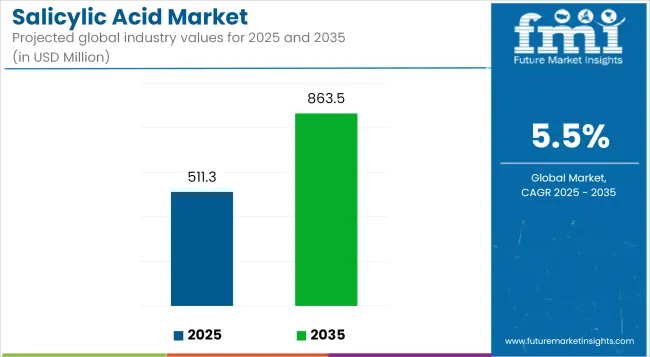
The global salicylic acid market, valued at USD 511.34 million in 2025, is projected to reach USD 863.45 million by 2035, growing at a CAGR of 5.5%. Widely used in skincare, personal care, and pharmaceuticals, the compound’s demand remains strong, especially in acne and anti-inflammatory treatments. North America, Europe, and Asia-Pacific lead consumption, with trends favoring eco-friendly formulations and low-irritant derivatives.
Stay Informed on Key Market Changes: Get a Sample Report: https://www.futuremarketinsights.com/reports/sample/rep-gb-15115
Key Industry Highlights
The salicylic acid market is undergoing steady transformation, fueled by consumer awareness, dermatological needs, and sustainable innovation. Major contributors include increased acne prevalence, personal grooming habits, and the incorporation of salicylic acid in OTC formulations and pain relievers. Market players are also adapting to changing regulatory environments, focusing on safer concentrations and natural or green-sourced derivatives. The industry is witnessing a shift towards plant-based synthesis, biodegradable formats, and clean label initiatives to align with environmental and health-conscious consumer demand.
Heightened Market Interest: Our Complete Report Delivers Extensive Analysis and Trends: https://www.futuremarketinsights.com/reports/salicylic-acid-market
Collaboration Between Small Market Players to Strengthen Product Portfolio
Strategic collaborations and partnerships, particularly among small to mid-sized enterprises, have become critical to enhancing product diversity and technological capabilities. These companies are pooling resources to develop sustained-release formulations and natural salicylic acid derivatives to cater to sensitive-skin demographics. This collaborative ecosystem is fostering innovation in non-irritant formulations, enabling brands to penetrate both mature and emerging markets more effectively. Through joint ventures, players are also better equipped to address formulation challenges posed by increasingly stringent cosmetic regulations.
Market Concentration
While several multinational corporations dominate the top tier, the market maintains a moderately fragmented landscape. Key global players benefit from strong R&D infrastructure and expansive distribution networks, whereas smaller players maintain agility through niche product innovation and regional market penetration. The competitive concentration is especially notable in the pharmaceutical and skincare segments, where companies with a diversified topical treatment portfolio, robust clinical pipelines, and regulatory compliance capabilities have a clear edge. However, price competition and capacity expansion from Asian manufacturers, particularly China and India, continue to reshape global supply dynamics.
Country-wise Insights
United States
The U.S. market is witnessing rapid expansion due to the increasing prevalence of dermatological conditions such as acne, eczema, and psoriasis. Salicylic acid is widely recognized for its keratolytic and anti-inflammatory properties, leading to its integration into OTC drugs, cleansers, medicated pads, and analgesics. The country’s pharmaceutical sector is not only adopting advanced formulation techniques but also embracing sustainable manufacturing practices. The U.S. CAGR of 5.7% reflects strong domestic consumption and continuous clinical innovation in dermatology and pain relief products.
China
China remains a powerhouse due to its cost-effective manufacturing capabilities and raw material dominance, particularly in phenol production, a key precursor in salicylic acid synthesis. With a robust industrial base and government support, Chinese producers can offer globally competitive pricing while meeting high-quality standards. These strengths have enabled China to maintain a pivotal role in the global supply chain. The market in China is growing at a CAGR of 5.2%, driven by large-scale production and advanced technology adoption that aligns with international safety norms.
India
India is emerging as a high-growth market, projected to record a CAGR of 7.6% through 2035. The rise in disposable incomes, urbanization, and increased focus on skincare and wellness has led to higher consumption of salicylic acid-based products. The country also benefits from a vibrant pharmaceutical manufacturing sector and a growing preference for natural ingredients in cosmetics. Domestic producers are investing in R&D and export infrastructure to meet both local and global demand.
Japan and Brazil
Japan (CAGR 6.2%) is leveraging its technological edge to develop advanced skincare formulations, particularly in anti-aging and sensitive-skin solutions. Meanwhile, Brazil (CAGR 6.1%) is tapping into its expanding middle-class population and high demand for personal care products, especially in urban centers. Both countries are expected to play increasingly strategic roles in shaping the salicylic acid consumption landscape in their respective regions.
Competition Outlook
The salicylic acid market is highly competitive, with key players focusing on product innovation, supply chain optimization, and eco-certification to gain a market edge. Leading companies are investing in green chemistry, biotechnology-based production, and sustained-release mechanisms to differentiate their offerings.
Leading Salicylic Acid Brands by Market Share
- Thermo Fisher Scientific Inc.
- BASF SE
- Seqens International
- Alta Laboratories
- Merck KgaA
- Alfa Aesar
- Midas Pharma GmbH
- Novocap
- Simco Chemicals
- Shanghai Sunwise Chemical Co., Ltd.
- Cayman Chemical
- Others
Top Segments Studied in the Salicylic Acid Market Research Report
By Form:
As per Form, the industry has been categorized into Powder and Liquid.
By End-Use Application:
As per End-Use Application, the industry has been categorized into Pharmaceutical, Skin Care, Hair Care, Food Preservatives, and Others.
By Region:
Industry analysis has been carried out in key countries of North America, Latin America, Western Europe, Eastern Europe, East Asia, South Asia & Pacific, Central Asia, Russia and Belarus, Balkan & Baltics, and the Middle East & Africa.




