

While thionyl chloride is widely recognized for its industrial role as a chlorinating and dehydrating agent in pharmaceuticals, agrochemicals, and dyes, one of its most strategically significant yet underreported applications lies in the realm of lithium battery technology, especially in high-energy, low-temperature primary batteries used in defense and aerospace sectors. This niche but growing application is driving a unique demand curve that differentiates itself from the conventional thionyl chloride market narrative.
With increasing geopolitical tension, space exploration initiatives, and demand for long-life power sources in extreme environments, the spotlight is subtly shifting toward military-grade lithium-thionyl chloride (Li-SOCl₂) batteries. These batteries rely on thionyl chloride as both a solvent and catholyte, making the chemical an integral—yet often overlooked—component in advanced energy systems.
Request the Report Sample: https://www.futuremarketinsights.com/reports/sample/rep-gb-4601
Revisiting Thionyl Chloride: A Versatile yet Volatile Chemical
Thionyl chloride (SOCl₂) is an inorganic compound composed of sulfur, oxygen, and chlorine. It is a reactive, colorless to pale yellow liquid with a sharp, suffocating odor. While its hazardous nature mandates strict handling protocols, its chemical properties make it indispensable in synthesis processes where substitution of hydroxyl groups with chlorine is required.
In bulk industrial applications, thionyl chloride is predominantly used in the production of acyl chlorides and in converting carboxylic acids and alcohols to more reactive derivatives. Yet these applications, although significant in volume, are now being paralleled by emerging demand from energy storage and defense sectors that require ultrapure, high-performance thionyl chloride for battery-grade applications.
Li-SOCl₂ Batteries: Powering the Extreme
Unlike rechargeable lithium-ion batteries, Li-SOCl₂ batteries are primary cells, meaning they are not designed for recharging but offer exceptional energy density, long shelf life, and reliable performance under extreme temperature conditions. Thionyl chloride functions in these batteries as both the electrolyte solvent and active cathode material, participating directly in the redox reaction that releases energy.
These batteries are particularly valuable in applications that demand long-lasting, maintenance-free power—such as remote sensing systems, deep-sea monitoring devices, aerospace instruments, missile guidance systems, and critical military communications. With operating temperature ranges from -55°C to +85°C and energy densities exceeding 500 Wh/kg, Li-SOCl₂ batteries outclass many conventional chemistries in niche, high-stakes environments.
The growing deployment of unmanned systems—drones, UAVs, and autonomous underwater vehicles (AUVs)—has further intensified the need for compact power sources that remain reliable over years, not months. Thionyl chloride’s electrochemical behavior makes it uniquely suited to this role, placing it at the core of a highly specialized, mission-critical supply chain.
To Gain More Insights about this Research, Visit! https://www.futuremarketinsights.com/reports/thionyl-chloride-market
Strategic Supply and Geopolitical Significance
Although global thionyl chloride production is concentrated in countries like China and India, the rising demand from defense-oriented applications is pushing governments and corporations in the U.S. and Europe to secure more domestic or allied supply chains. Purity is paramount in battery applications, and only a fraction of total thionyl chloride production meets the stringent specifications required for lithium battery synthesis.
This supply-demand mismatch is giving rise to a tiered market, where ultrapure, battery-grade thionyl chloride commands a premium price, separate from its industrial-grade counterpart. This is also prompting investments in process refinement and purification technologies that can increase the yield of high-grade product from existing manufacturing setups.
For instance, in 2023, a leading American specialty chemical manufacturer began pilot production of high-purity thionyl chloride in response to Department of Defense contracts emphasizing energy independence for critical military systems. These developments underscore the geostrategic importance of thionyl chloride beyond its traditional role in chemical synthesis.
Environmental and Regulatory Challenges
Despite its utility, thionyl chloride poses substantial handling and environmental risks. It reacts violently with water, releasing toxic gases such as hydrogen chloride and sulfur dioxide. As such, its storage, transport, and disposal are heavily regulated under frameworks such as the U.S. EPA’s Toxic Substances Control Act and the European Union’s REACH regulation.
Battery-grade applications add another layer of complexity, requiring not only purity but traceability and compliance with military-grade material specifications. There is a growing call for greener alternatives or safer analogs, but so far, thionyl chloride remains irreplaceable in certain energy chemistries due to its unmatched electrochemical characteristics.
Some research efforts are underway to recycle spent Li-SOCl₂ cells and recover thionyl chloride or its derivatives for reuse, though technical and economic feasibility is still a work in progress. Until such systems become scalable, the environmental footprint of thionyl chloride will remain a point of contention in sustainability assessments of defense and aerospace battery technologies.
Inorganic Chemicals Industry Analysis: https://www.futuremarketinsights.com/industry-analysis/inorganic-chemicals
Market Outlook and Competitive Dynamics
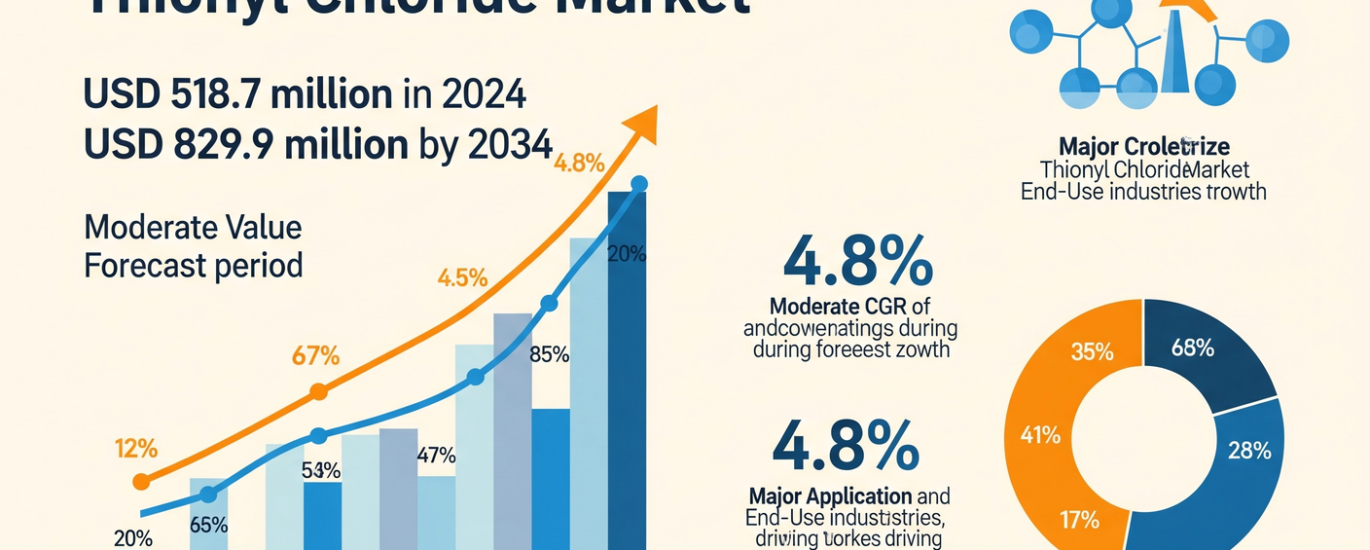
According to Future Market Insights, the thionyl chloride market size is projected to be worth USD 518.7 million in 2024 and USD 829.9 million by 2034. The industry is expected to experience revenue growth at a moderate CAGR of 4.8% during the forecast period. This growth is being driven not just by technological needs, but also by national security policies, space programs, and the increasing importance of electronic warfare and autonomous systems.
Key players such as Lanxess, Transpek Industry Ltd., and Shandong Kaisheng New Materials are quietly expanding their portfolios to include high-purity thionyl chloride variants. Startups and specialty chemical firms are entering the scene with proprietary purification technologies, eyeing a piece of this specialized market.
More than Just a Chlorinating Agent
While thionyl chloride may not have the glamour of rare earth elements or the visibility of lithium and cobalt in energy debates, it is proving to be a linchpin in critical defense and energy infrastructure. Its role in powering next-generation, ultra-reliable lithium batteries—particularly for aerospace and military use—is elevating its status from an industrial workhorse to a strategic asset.
As demand for long-life, high-performance batteries expands, especially in sectors where failure is not an option, the relevance of thionyl chloride will only deepen. In this context, the thionyl chloride market is no longer just a chemical supply chain—it’s becoming an enabler of technological sovereignty and national security.




