

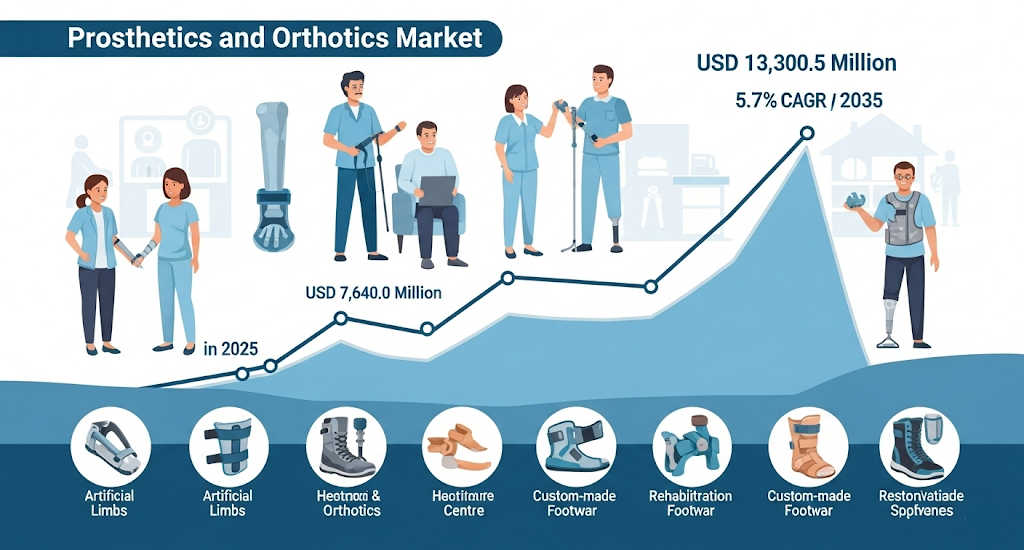
The global prosthetics and orthotics market is estimated to be valued at USD 7,640.0 million in 2025 and is projected to reach USD 13,300.5 million by 2035, registering a compound annual growth rate (CAGR) of 5.7% over the forecast period.
After 15 years reporting for The New York Times, I’ve learned this: progress on paper doesn’t always mean progress in people’s lives. But in the U.S., this booming market masks a harsh reality — most patients still can’t get the care they desperately need.
The numbers don’t lie. North America dominates with about 40% of the market. We have the technology. The infrastructure. The money. Yet countless Americans live without prosthetic limbs or settle for outdated, inadequate devices. Why? Because the system is broken. Insurance companies routinely deny coverage for advanced prosthetics, labeling lifesaving devices as “experimental.” The result? Innovation benefits the wealthy few, while many are left behind.
Get Sample Report: – https://www.futuremarketinsights.com/reports/sample/rep-gb-16484
Innovation—But Not for Everyone
Yes, the tech is incredible. AI-driven fittings, 3D-printed sockets, microprocessor knees — the future is here. But what good is cutting-edge technology if the people who need it most can’t afford it? Prosthetic limbs can cost upwards of $90,000. Most Americans can’t pay that out-of-pocket. Insurance coverage is a patchwork at best and a roadblock at worst.
This isn’t just about dollars. It’s about dignity. It’s about mobility. It’s about the simple right to live without limits. But our healthcare system is content to let people suffer in silence while profits soar.
The Ugly Truth About Access
- Insurers deny coverage for advanced prosthetics on technicalities.
- Patients face crushing costs that can destroy their financial stability.
- Access is a lottery—dictated by race, income, and geography.
- Veterans may receive cutting-edge devices, but civilians? They get left behind.
What Must Change—Now
The system requires a complete overhaul. “Medical necessity” must include modern prosthetics, not just cheap substitutes. Private insurers must be held accountable for denying claims. Costs must be transparent — no more hidden fees or surprise bills. And equity can’t be an afterthought; it has to be the foundation.
Bottom Line
The prosthetics and orthotics market is booming—financially. But for millions of Americans, this growth means nothing. The technology exists, the money is flowing, but access remains painfully out of reach.
If we don’t demand change, we’re complicit in a system that prioritizes profits over people. Innovation should not be a luxury. It should be a right. Anything less is a betrayal of what healthcare is supposed to be.
Explore In-Depth Analysis-Click Here to Access the Report:- https://www.futuremarketinsights.com/reports/prosthetics-and-orthotics-market
Key Segments
By Type:
- Prosthetics
- Orthotics
By Region:
- North America
- Latin America
- Western Europe
- Eastern Europe
- East Asia
- South Asia Pacific
- Middle East and Africa




