The global hemp seed oil market is gearing up for an explosive decade. As plant-based products gain popularity across health, wellness, and cosmetic sectors, hemp seed oil is being positioned as the next big thing. But while the numbers tell a story of undeniable growth, the industry faces a deeper problem: public confusion and a lack of transparency.
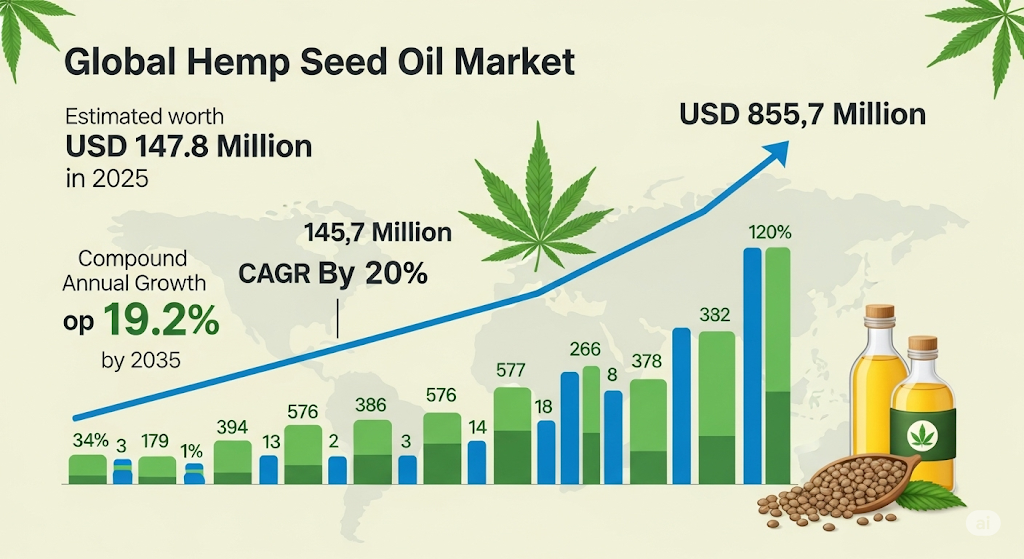
According to Future Market Insights, the hemp seed oil market is projected to grow from USD 147.8 million in 2025 to an astonishing USD 855.7 million by 2035, reflecting a staggering compound annual growth rate (CAGR) of 19.2% (Future Market Insights).
That forecast reflects strong global momentum. But momentum alone doesn’t equal maturity.
Access Key Market Insights: Request a Sample Report Now: https://www.futuremarketinsights.com/reports/sample/rep-gb-11630
Misunderstood from the Start
One of the biggest obstacles facing hemp seed oil is consumer misunderstanding. Despite being made from Cannabis sativa, hemp seed oil is not the same as CBD oil or THC products. It has no psychoactive compounds, no intoxicating effect, and no legal gray area when it comes to federal classification.
What it does offer is a nutrient-dense oil rich in essential fatty acids, used in everything from salad dressings to skin creams. But without clearer labeling and stronger regulation, many consumers still confuse it with cannabidiol or assume exaggerated benefits. That disconnect threatens to undermine trust just as the market is starting to mature.
Growing Need for Market Insights: Access Our Full Report for Thorough Analysis and Trends: https://www.futuremarketinsights.com/reports/hemp-seed-oil-market
From Grocery Shelf to Medicine Cabinet
The uses of hemp seed oil are expanding rapidly. It’s now found in personal care products, nutraceuticals, food products, and even pet supplements. That kind of cross-category versatility is rare—and powerful. But it also magnifies the need for consistent standards.
At present, there’s no uniform benchmark for potency, purity, or efficacy in hemp seed oil products. As manufacturers scramble to cash in on demand, the lack of oversight could lead to inconsistent quality and misleading health claims—something that could stall growth just as the market hits its stride.
Global Growth, Local Complications
The market’s expansion is being felt far beyond the United States. Hemp seed oil is gaining ground in Europe, Asia-Pacific, and Latin America as a plant-based, sustainable alternative in multiple industries. Still, regulation lags behind demand. Without unified international standards for production and labeling, the risk of overselling and underdelivering is very real.
For the market to hit the USD 855.7 million mark in a decade, stakeholders need to get serious about product integrity, traceability, and consumer education.
Final Take
The hemp seed oil market is moving fast. The projected 19.2% CAGR through 2035 is impressive, but it will mean little if the foundation isn’t built on transparency and trust.
This isn’t about overregulation—it’s about making sure the product lives up to its potential. Hemp seed oil could play a legitimate role in the future of wellness and sustainable living. But to earn that future, the industry must stop selling hype and start delivering honesty.
Company Profile
- Nutiva Inc.
- Canopy Growth Corporation
- Connolis LLC
- Maverik Oils
- NP Nutra
- Hemp Oil
- Agropro
- Canah International SRL
- Z-Company
- Ecofiber Limited
 Explore Convenience Food Industry Analysis: https://www.futuremarketinsights.com/industry-analysis/convinience-food
Key Segmentation
By Product Type:
- Conventional
- Organic
By Grade:
- Food grade
- Pharmaceutical grade
By Extraction Process:
- Cold pressed hemp seed oil
- Refined hemp seed oil
By End User:
- Food & beverages
- Nutraceuticals
- Cosmetics & personal care
- Pharmaceuticals
- Industrial products
By Price Range:
- Mass
- Premium
By Region:
- North America
- Latin America
- Western Europe
- Eastern Europe
- East Asia
- South Asia Pacific
- Middle East and Africa