Introduction: A Growing Focus on Agricultural Emissions
While the Emission Control Catalyst for Small Engines Market is typically analyzed through the lens of recreational vehicles, generators, and handheld landscaping tools, one crucial segment often receives limited attention—small agricultural engines. These engines, widely used in irrigation pumps, two-wheel tractors, and tillers, are prevalent in developing economies and contribute significantly to local air pollution.
As the global sustainability agenda accelerates, these non-road small engines are drawing scrutiny from regulators and environmental groups. This growing concern is opening new doors for catalyst manufacturers who are adapting their technologies to meet the rugged demands of agricultural machinery. In this context, emission control catalysts are no longer just compliance components; they are fast becoming enablers of sustainable and economically viable farming practices.
𝐌𝐚𝐤𝐞 𝐈𝐧𝐟𝐨𝐫𝐦𝐞𝐝 𝐃𝐞𝐜𝐢𝐬𝐢𝐨𝐧𝐬 – 𝐀𝐜𝐜𝐞𝐬𝐬 𝐘𝐨𝐮𝐫 𝐒𝐚𝐦𝐩𝐥𝐞 𝐑𝐞𝐩𝐨𝐫𝐭 𝐈𝐧𝐬𝐭𝐚𝐧𝐭𝐥𝐲! https://www.futuremarketinsights.com/reports/sample/rep-gb-14245
Small Engines, Big Emissions: Why Agriculture Matters
Within the Emission Control Catalyst for Small Engines Market, the agricultural segment has remained largely underrepresented. Yet studies show that in countries like India, Indonesia, and Kenya, small engines used in farming can account for up to 15% of localized particulate and black carbon emissions. These emissions stem largely from two-stroke and outdated four-stroke engines, which are still in widespread use due to their affordability and simplicity.
These engines emit a disproportionately high level of pollutants relative to their size, largely because they lack proper combustion control and emission treatment systems. While the automotive sector has seen extensive integration of catalytic converters and particulate filters, small agricultural engines have yet to benefit from similar advancements. The result is a persistent gap between emission reduction goals and actual on-ground impact, particularly in rural and peri-urban farming zones.
Catalyst Technology Tailored for Rugged Terrain
Advances in catalyst technology are beginning to reshape the Emission Control Catalyst for Small Engines Market, especially in response to agricultural needs. Unlike catalysts for automotive or industrial use, those designed for farming equipment must operate under extreme environmental conditions: dusty fields, irregular maintenance, and long operational hours.
Innovations such as miniaturized Diesel Oxidation Catalysts (DOCs), Lean NOx Traps (LNT), and simplified Selective Catalytic Reduction (SCR) systems are being tailored to small diesel engines used in water pumps and sprayers. One standout example is a ceramic-based catalytic converter developed by the Indian Institute of Technology (IIT) specifically for irrigation pump sets. Field trials in Punjab demonstrated a 60% reduction in carbon monoxide emissions and a 50% cut in unburned hydrocarbons—all without compromising engine performance.
These examples reflect how technology developers are localizing solutions for emerging markets and farming-specific applications. The ability of catalysts to withstand fluctuating engine loads and inconsistent fuel quality makes them a highly adaptable emission control tool in diverse agricultural settings.
𝐔𝐧𝐥𝐨𝐜𝐤 𝐂𝐨𝐦𝐩𝐫𝐞𝐡𝐞𝐧𝐬𝐢𝐯𝐞 𝐌𝐚𝐫𝐤𝐞𝐭 𝐈𝐧𝐬𝐢𝐠𝐡𝐭𝐬 – 𝐄𝐱𝐩𝐥𝐨𝐫𝐞 𝐭𝐡𝐞 𝐅𝐮𝐥𝐥 𝐑𝐞𝐩𝐨𝐫𝐭 𝐍𝐨𝐰: https://www.futuremarketinsights.com/reports/emission-control-catalyst-for-small-engines-market
Regulatory Undercurrents and Global Market Disparities
Despite the progress, the Emission Control Catalyst for Small Engines Market remains shaped by significant regional disparities. The U.S. and European Union have established clear and stringent regulations, such as the EPA’s Tier 4 Final standards and EU Stage V norms. These rules apply to non-road mobile machinery and mandate the use of emission control devices for engines as small as 19 kW (25 horsepower).
In contrast, regulatory frameworks in Africa, Southeast Asia, and parts of South America are either in early stages or inconsistently enforced. However, change is underway. Pilot projects in Vietnam and Uganda are demonstrating the benefits of low-emission agricultural equipment, and NGOs are working alongside governments to distribute retrofitting kits that include compact catalytic converters.
This fragmented regulatory landscape presents both challenges and growth opportunities for companies operating in the Emission Control Catalyst for Small Engines Market. Manufacturers that can design cost-effective, durable, and easy-to-install catalyst solutions for low-regulation regions may unlock entirely new customer bases in the coming decade.
The Economics of Compliance and Catalyst Adoption
One of the strongest arguments for expanding catalyst adoption in small agricultural engines is economic. Farmers in low- and middle-income countries are typically cost-sensitive and risk-averse. However, when emission control catalysts are introduced with clear financial incentives or as part of a bundled engine upgrade, adoption rates improve significantly.
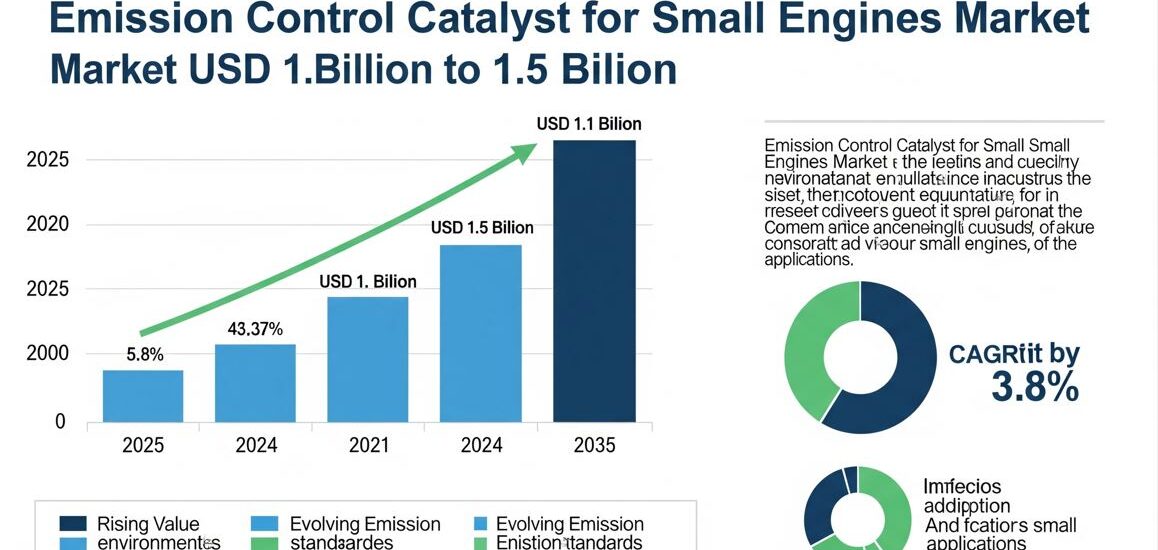
For example, in Kenya’s Clean Agriculture Initiative, a pilot program equipped farmers with diesel irrigation pumps retrofitted with DOC systems. Not only did emissions drop sharply, but fuel consumption improved by 8–10%, resulting in tangible cost savings over the season. Additionally, some programs have begun to leverage voluntary carbon credits as a means to subsidize the cost of catalyst systems, making them financially accessible for smallholders. According to Future Market Insights, the market shall by 2035 account for a market value of USD 1,580 Million, with a compound annual growth rate (CAGR) of 3.8% through the forecast period.
As awareness grows, so too does the realization that emission control catalysts are not just about environmental compliance—they are about operational efficiency and long-term resilience. This shift in perception could redefine the value proposition within the Emission Control Catalyst for Small Engines Market, especially as rural electrification and carbon pricing mechanisms evolve.
Functional Agents & Additives: https://www.futuremarketinsights.com/industry-analysis/functional-agents-and-additives
A Catalyst for Sustainable Farming Futures
The Emission Control Catalyst for Small Engines Market is at a pivotal point, with emerging segments like agricultural engines poised for transformative growth. While historically underdeveloped, this niche is gaining attention due to rising environmental awareness, regulatory evolution, and technological innovation tailored for rugged, non-road applications.
Catalyst solutions for agricultural engines represent more than a compliance measure—they are an investment in sustainability, public health, and economic security for millions of farmers globally. If properly supported by research funding, government incentives, and international cooperation, emission control technologies could become a cornerstone of clean, climate-resilient farming in the 21st century.