

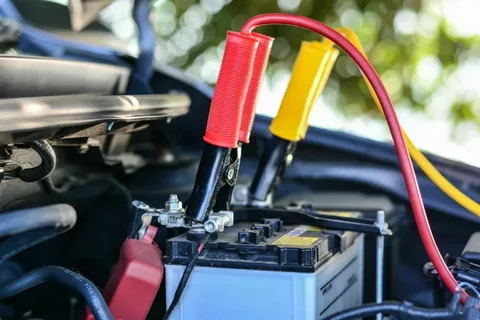
The global car battery chargers market is expected to grow from USD 24.9 billion in 2025 to USD 44.9 billion by 2035. The market is poised to expand at a 6.1% CAGR during the forecast period. The market is witnessing strong growth as increasing vehicle ownership and the rising adoption of electric vehicles (EVs) drive demand for efficient battery charging solutions.
In an age where electrification is reshaping the automotive landscape, energy isn’t just a resource—it’s the backbone of mobility. At the heart of this shift lies a growing dependence on reliable, intelligent, and portable energy replenishment. Enter the car battery charger: a quiet but critical player in keeping vehicles powered, connected, and on the move.
From jump-starting conventional vehicles to maintaining EV battery health and enabling off-grid charging solutions, car battery chargers are no longer simple accessories—they’re evolving into indispensable tools that support the energy ecosystem of modern transportation.
Get Ahead with Our Report: Request Your Sample Now!
https://www.futuremarketinsights.com/reports/sample/rep-gb-1844
More Than a Jump-Start: Enabling Intelligent Energy Management
At a glance, a car battery charger appears to be a utility device. But today’s chargers do more than transfer power—they monitor, regulate, and optimize charging cycles to preserve battery life and ensure maximum efficiency. With features like automatic shutoff, multi-stage charging, and compatibility with lead-acid, AGM, and lithium-ion chemistries, they’ve become smart energy companions.
Advanced models now integrate diagnostics, real-time monitoring, and thermal protection. This allows them not only to restore power but also to identify potential battery issues before they become breakdowns. In a connected car environment, this kind of intelligent support is becoming essential.
Overshadowed by EV Infrastructure, Yet Essential Across the Spectrum
While large-scale EV charging stations and fast-charging networks capture most of the attention, car battery chargers play an equally important role behind the scenes. They serve everyday drivers, fleet operators, service centers, and roadside assistance providers—offering convenient and immediate solutions when power is low or maintenance is due.
For internal combustion engine (ICE) vehicles, they ensure reliability during cold seasons, long storage periods, or irregular use. For electric vehicles, portable chargers and battery maintainers provide flexibility and peace of mind—especially in areas where public infrastructure remains limited.
Built for Versatility, Designed for Reliability
Modern chargers are engineered for diverse environments and demanding use cases. Whether mounted on garage walls, tucked in glove compartments, or used in commercial maintenance facilities, they must perform reliably across a wide range of voltages, temperatures, and battery types.
Manufacturers are responding with rugged enclosures, waterproof ratings, and advanced circuitry that protects against overcharging, reverse polarity, and short circuits. Some models even offer solar compatibility or smart app control—extending their utility far beyond traditional use.
Challenges in Compatibility and Integration
As battery technologies evolve—especially in the transition from 12V systems to high-voltage EV batteries—compatibility and safety have become top concerns. Chargers must now accommodate a broader range of battery specifications, charging rates, and communication protocols.
Additionally, integration with vehicle diagnostics and battery management systems (BMS) is becoming more important. The shift toward smart maintenance and remote diagnostics means that chargers are no longer standalone—they’re part of the connected vehicle support system.
Exhaustive Market Report: A Complete Study
https://www.futuremarketinsights.com/reports/car-battery-chargers-market
An Enabler of Sustainable Mobility
Car battery chargers also contribute to the sustainability movement by extending battery life, reducing waste, and enabling energy-efficient vehicle operation. Proper charging practices minimize premature battery replacements and optimize performance—supporting both environmental goals and economic efficiency.
In the EV space, smart chargers that sync with off-peak grid hours, renewable energy sources, or solar systems further amplify the sustainability impact. In this way, chargers become not just power devices, but strategic tools for responsible energy usage.
Unseen, Yet Unstoppable
They may not dominate dashboards or drive media buzz, but car battery chargers are the unseen force that keeps mobility alive and uninterrupted. Whether preserving stored vehicles, supporting electric fleets, or offering roadside rescue, they quietly deliver the energy modern drivers depend on.
As automotive technologies continue to electrify, digitize, and decentralize, car battery chargers will play a growing role in enabling flexible, efficient, and reliable mobility. Behind every reliable start, every charged journey, and every connected car is a charger—silent, steady, and ready to power what’s next.




