

A Global Boom in Your Freezer
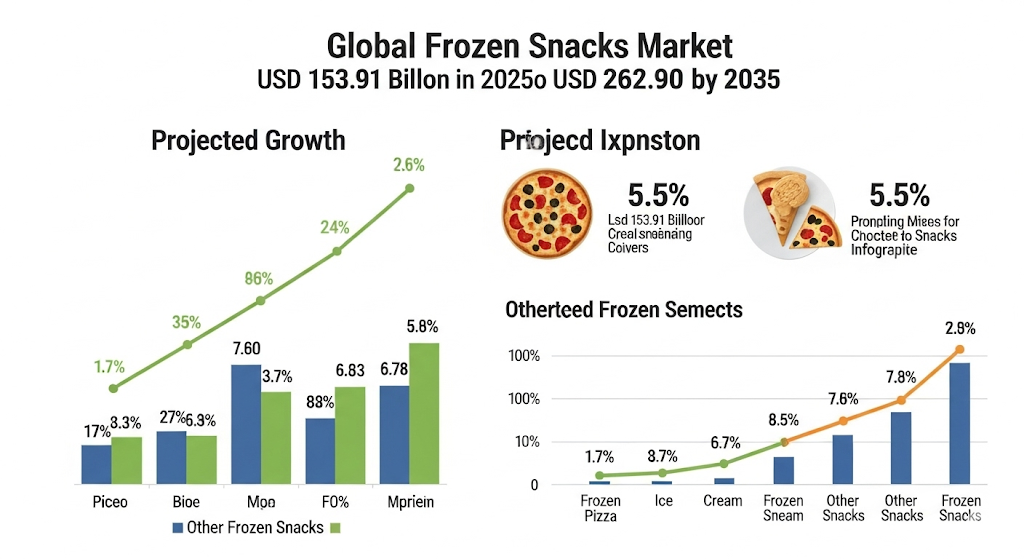
The frozen snacks market is no longer a fallback for busy weeknights—it’s a global industry quietly surging toward a major milestone. According to Future Market Insights (FMI), the market is projected to grow from USD 153.91 billion in 2025 to USD 262.90 billion by 2035, expanding at a robust CAGR of 6.7%. As urban lifestyles accelerate and consumer habits shift, frozen snacks are evolving from mere convenience to a near-daily staple in millions of households.
FMI attributes this growth to several factors: changing consumer schedules, increased demand for ready-to-eat products, and the wider availability of frozen foods in emerging economies. The pandemic-era spike in frozen food purchases has solidified a trend that now shows little sign of reversing.
Unveil Market Trends: Get Your Sample Report Now: https://www.futuremarketinsights.com/reports/sample/rep-gb-14491
Convenience vs. Nutrition: A Growing Tension
While frozen snacks have become symbols of convenience, they often bring with them a nutritional cost. Many of the best-selling items—potato bites, breaded proteins, and stuffed pastries—are highly processed and rich in sodium, saturated fats, and preservatives.
FMI acknowledges this tension, noting that “health consciousness among consumers is rising,” which is pushing manufacturers to innovate. Plant-based alternatives, gluten-free options, and products with reduced sodium or no artificial additives are increasingly being introduced. But the bulk of the global market growth is still driven by indulgent, calorie-dense offerings—especially in North America and Europe.
Heightened Market Interest: Our Complete Report Delivers Extensive Analysis and Trends: https://www.futuremarketinsights.com/reports/frozen-snacks-market
Safety: More Than Just Cold Storage
The frozen snacks market also brings questions around food safety and packaging. Although FMI does not highlight regulatory gaps directly, the report’s emphasis on “advanced freezing technology” and “shelf-life preservation” underscores the industry’s reliance on chemical additives and specialized packaging to maintain product integrity.
This invites scrutiny. Are these practices keeping up with the demands of modern food safety? And are consumers fully informed about how their snacks are processed and preserved? For a sector growing this quickly, these questions deserve urgent answers.
The Rise of Emerging Markets
Another key insight from FMI: growth isn’t just concentrated in the West. Asia-Pacific, Latin America, and parts of the Middle East are experiencing sharp increases in demand for frozen snacks. As incomes rise and Western-style snacking culture spreads, manufacturers are rapidly localizing offerings to meet regional tastes—think samosas, bao, empanadas—frozen, boxed, and ready to reheat.
However, as these markets expand, they risk replicating the same nutritional pitfalls seen elsewhere. Without forward-looking reformulation strategies, the same ultra-processed snack patterns could soon take hold globally.
What Needs to Change—Before the Freezer Backfires
- Clearer Nutritional Labeling
Manufacturers must lead with transparency—clearly displaying sodium, fat, and additive content. - Health-Focused Product Development
Investing in truly healthier alternatives, not just “low-fat” marketing gimmicks, is critical. - Modernized Safety Standards
As frozen snacks travel farther and last longer, preservation methods must meet the highest global safety thresholds. - Consumer Education
Convenience doesn’t have to mean compromise—but consumers need the tools and knowledge to choose wisely.
The Bottom Line: Freeze with Foresight
The frozen snacks market is expected to nearly double over the next decade. That statistic alone should make regulators, nutritionists, and consumers sit up. This is no longer just about quick meals—it’s about long-term food systems, health outcomes, and how convenience shapes global diets.
FMI’s data makes one thing clear: frozen snacks are here to stay. But if we don’t insist on better standards, clearer labeling, and truly nutritious innovation, we risk sleepwalking into a public health freezer full of empty calories and missed opportunities.
Company Profile
-
- Nestle
- ConAgra Foods Inc.
- Ajinomoto Co. Inc.
- McCain Foods
- The Kraft Heinz Co.
- Cargill Incorporated
- Tyson Foods Inc.
- NewForrest Fingerfood BV
- Rich Products Corp.
- Nomad Foods Ltd.
 Explore Snacks Industry Analysis: https://www.futuremarketinsights.com/industry-analysis/snacks
Frozen Snacks Market Segmentation
By Product Type:
- Desserts
- Confectionery
- Vegetable & Fruit Snacks
- Bakery Products
- Meat Based Snacks
- Meat Substitute Snacks
- Seafood Snacks
- Other Products
By Category:
- Ready to Eat
- Ready to Cook
- Others
By Sales Channel:
- Offline Sales Channel
- Online Sales Channel
By Region:
- North America
- Latin America
- Western Europe
- Eastern Europe
- East Asia
- South Asia Pacific
- Middle East and Africa




