In the rapidly evolving landscape of sustainable packaging, Expanded Polypropylene (EPP) foam is gaining attention for its resilience, versatility, and growing role in advanced logistics applications. Most commonly recognized for its use in automotive components and protective packaging, EPP foam is now emerging as a game-changer in a niche yet critical industry—cold chain logistics. Often overshadowed by materials like expanded polystyrene (EPS) and polyurethane in temperature-controlled packaging, EPP foam is quietly disrupting the thermal packaging market with its superior thermal insulation, reusability, and eco-friendliness. This article delves into an uncommon yet increasingly relevant angle of the Expanded Polypropylene (EPP) Foam Market: its expanding role in sustainable cold chain packaging.
𝐌𝐚𝐤𝐞 𝐈𝐧𝐟𝐨𝐫𝐦𝐞𝐝 𝐃𝐞𝐜𝐢𝐬𝐢𝐨𝐧𝐬 – 𝐀𝐜𝐜𝐞𝐬𝐬 𝐘𝐨𝐮𝐫 𝐒𝐚𝐦𝐩𝐥𝐞 𝐑𝐞𝐩𝐨𝐫𝐭 𝐈𝐧𝐬𝐭𝐚𝐧𝐭𝐥𝐲! https://www.futuremarketinsights.com/reports/sample/rep-gb-2600
Unveiling the Hidden Utility of EPP Foam in Temperature-Controlled Packaging
While EPP foam has long been utilized in automotive interiors and sports gear due to its high impact resistance and lightweight nature, its characteristics also make it uniquely suited for thermal packaging applications. EPP foam has a closed-cell structure that provides excellent insulation against temperature changes, helping to maintain required conditions during the transportation of temperature-sensitive products such as vaccines, biologics, and perishable foods.
In pharmaceutical logistics, maintaining precise temperature ranges during transit can be the difference between efficacy and spoilage. Companies like Va-Q-tec and Pelican BioThermal have started incorporating EPP foam into reusable cold chain containers, citing its high thermal resistance and ability to withstand repeated use. Unlike EPS boxes, which are often single-use and environmentally burdensome, EPP containers can be used hundreds of times without significant degradation in performance. This is particularly important as the global demand for temperature-sensitive pharmaceuticals and biologics grows in tandem with healthcare advancements and the expansion of mRNA-based vaccine distribution channels.
Environmental Advantages Over Traditional Thermal Packaging Materials
One of the strongest value propositions of EPP foam lies in its environmental impact—or rather, its minimization of it. Traditional cold chain packaging materials such as EPS and PU foams are petroleum-derived, non-recyclable, and often end up in landfills after just one use. In contrast, EPP foam is 100% recyclable and can be repurposed without significant material loss. Its reusability not only makes it economically advantageous in the long run but also significantly reduces the carbon footprint of logistics operations.
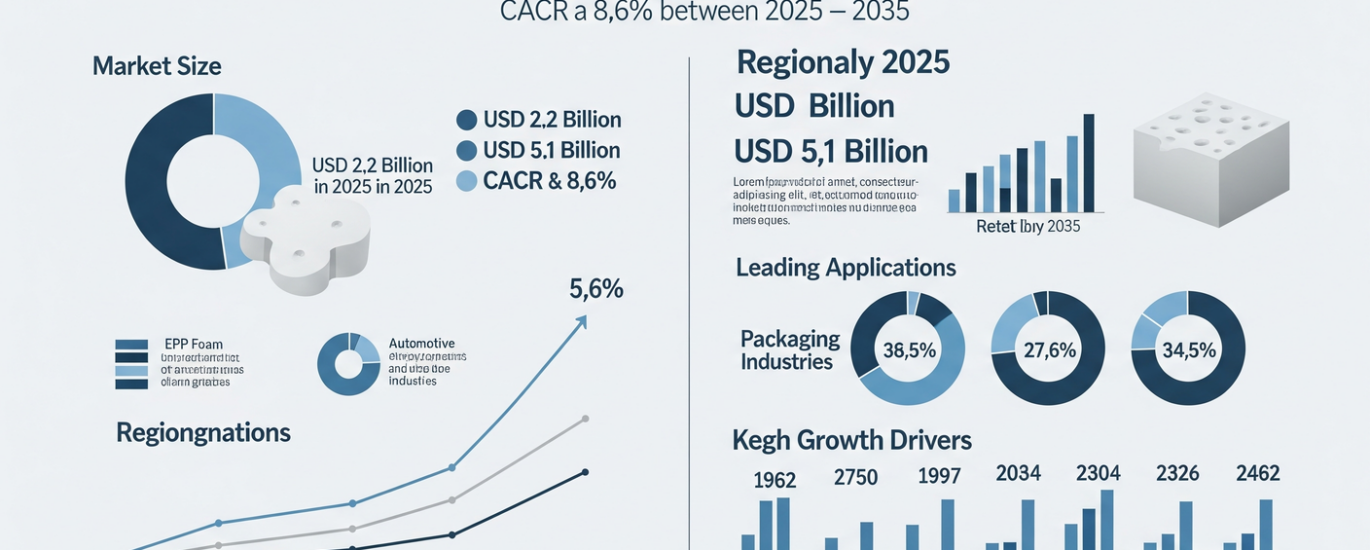
According to Future Market Insights, the global Polypropylene (EPP) Foam Market is estimated at USD 2.2 billion in 2025. The market is projected to expand to USD 5.1 billion by 2035, translating to a CAGR of 8.6% between 2025 and 2035. Additionally, EPP foam requires less energy to mold and form during manufacturing, further enhancing its sustainability credentials. With extended product life, lightweight design reducing transportation emissions, and superior durability, EPP-based solutions offer a compelling alternative to traditional cold chain packaging.
𝐔𝐧𝐥𝐨𝐜𝐤 𝐂𝐨𝐦𝐩𝐫𝐞𝐡𝐞𝐧𝐬𝐢𝐯𝐞 𝐌𝐚𝐫𝐤𝐞𝐭 𝐈𝐧𝐬𝐢𝐠𝐡𝐭𝐬 – 𝐄𝐱𝐩𝐥𝐨𝐫𝐞 𝐭𝐡𝐞 𝐅𝐮𝐥𝐥 𝐑𝐞𝐩𝐨𝐫𝐭 𝐍𝐨𝐰: https://www.futuremarketinsights.com/reports/expanded-polypropylene-epp-foam-market
Market Trends Driving Adoption in the Cold Chain Sector
Several macroeconomic and regulatory trends are converging to support the adoption of EPP foam in the cold chain market. The rise of global e-commerce and direct-to-consumer pharmaceutical shipments is pushing for more durable, reusable, and efficient packaging solutions. Simultaneously, evolving regulations by agencies such as the U.S. FDA and EMA are requiring tighter controls on temperature-sensitive goods, indirectly boosting demand for higher-performing thermal packaging.
Moreover, sustainability commitments from multinational corporations are accelerating the shift toward recyclable and reusable packaging materials. Cold chain-dependent industries such as food delivery, dairy exports, and specialty chemical logistics are exploring EPP foam solutions as a means to meet both performance and environmental targets. In regions like Europe and Southeast Asia, government-backed green packaging initiatives are subsidizing the adoption of EPP-based containers, providing further momentum to this emerging application.
Challenges and Future Outlook for EPP in Cold Chain Applications
Despite its numerous advantages, the widespread adoption of EPP foam in cold chain logistics is not without challenges. The initial cost of EPP containers remains higher than disposable alternatives, which can be a deterrent for companies with tight budgets or minimal infrastructure for reverse logistics. Additionally, awareness about the material’s properties and benefits is still limited among packaging engineers and procurement managers, particularly in emerging economies.
Polymers & Plastics Industry Analysis: https://www.futuremarketinsights.com/industry-analysis/polymers-and-plastics
However, innovations in material science and production processes are gradually lowering the cost barrier. Modular designs and smart tracking technologies are being integrated into EPP containers, enhancing their value proposition. As sustainability continues to be a dominant theme in corporate supply chain strategies, the long-term cost-efficiency and environmental benefits of EPP foam are expected to outweigh short-term financial constraints.
Looking ahead, the Expanded Polypropylene (EPP) Foam Market is poised for diversification beyond its traditional sectors. With growing investment in sustainable cold chain infrastructure and increasing consumer demand for environmentally responsible packaging, EPP foam is set to become a material of choice for companies aiming to future-proof their supply chains.