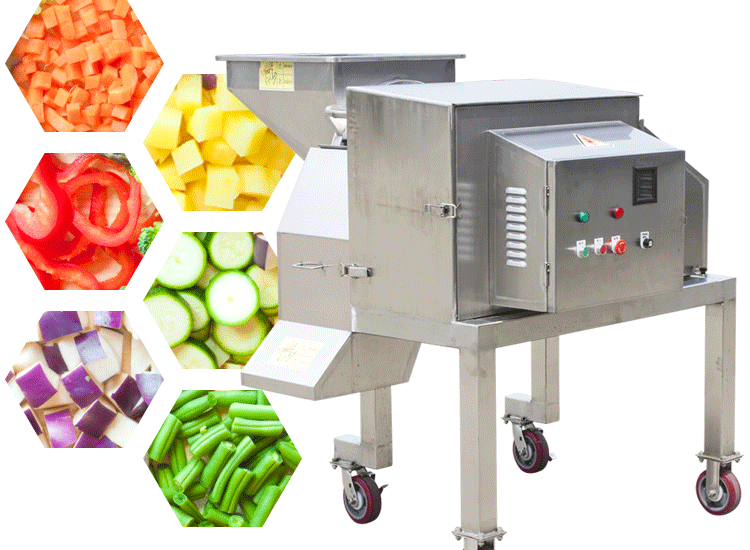
In a world obsessed with speed, hygiene, and consistency, food prep is no longer just about sharp knives and skilled hands. It’s about precision, output, and machine-grade reliability. Vegetable dicing machines, once considered niche equipment in industrial kitchens, are now front and center in the global movement to modernize food processing — and frankly, they’ve earned their spotlight.
According to recent data from Future Market Insights, the vegetable dicing machines market is poised for steady expansion, with current valuations at USD 1,798.4 million and projected revenue expected to climb to USD 2,488.3 million by 2035. This growth, reflecting a CAGR of 3.3% from 2025 to 2035, underscores the rising demand for industrial automation in food processing sectors worldwide.
Fueling this momentum is the surging appetite for processed and convenience food. As urbanization accelerates and lifestyles become increasingly fast-paced, ready-to-eat meals have become staples in households globally. This shift is compelling food processors to invest in advanced dicing technologies that streamline operations, cut labor costs, and meet stringent safety standards. Manufacturers are leaning on high-capacity, precision-engineered machines that deliver uniform cuts essential for mass production. Importantly, the sector is also moving toward eco-friendly innovations — energy-efficient models and designs that minimize food waste are gaining traction among environmentally conscious buyers.
Preview the Latest Trends – Request a Sample Copy: https://www.futuremarketinsights.com/reports/sample/rep-gb-15133
Automation Isn’t a Luxury. It’s a Lifeline.
Let’s not sugarcoat it: labor shortages in the food sector have reached critical levels. In almost every region — from North America to Asia — food producers and commercial kitchens are struggling to hire and retain prep staff. The old model of relying on a fleet of line cooks to dice vegetables by hand? It’s outdated, inefficient, and in today’s climate, unsustainable.
That’s where dicing machines come in — not as replacements for humans, but as reinforcements. They’re fast. Reliable. Consistent. And unlike the shrinking workforce, they show up every day. For food businesses facing the pressure of rising demand and shrinking margins, these machines aren’t optional anymore. They’re essential infrastructure.
Waste Is No Longer Tolerable
Let’s talk about the elephant in the room — food waste. The industry has quietly tolerated sloppy prep, uneven cuts, and product loss for decades. But that era is ending. With raw material prices surging and global supply chains tightening, every gram of produce counts.
Vegetable dicing machines reduce human error, streamline prep lines, and dramatically cut down on trim waste. They don’t just save time — they save tons of food. Literally. This isn’t some futuristic sustainability goal — it’s a real, tangible solution being implemented today, from packaging plants to dark kitchens serving delivery-only menus.
The result? Cleaner cuts, longer shelf life, and more efficient packaging. That’s not just good for business — it’s better for the planet.
Scaling Up Without Compromise
From cloud kitchens in Mumbai to meal kit facilities in California, one thing is clear: food businesses want to scale, but not at the cost of quality. Dicing machines allow operators to serve up consistency across hundreds of locations. A tomato diced in Bangkok looks identical to one sliced in Brooklyn. That matters — for branding, for food safety, and for consumer trust.
The evolution of these machines is equally impressive. Today’s models are smarter, safer, and easier to clean. Stainless steel builds, adjustable grid sizes, and modular maintenance systems are becoming the norm — not the exception. For fast-growing operations, that level of standardization is game-changing.
The Road Ahead: Less Hands, More Smarts
Let’s be honest — this isn’t just about slicing cucumbers. It’s about rethinking how food is made, how it’s delivered, and how to do it better. As we barrel toward a future of smart kitchens and AI-powered supply chains, vegetable dicing machines are playing a surprisingly pivotal role. They reduce contamination risks, lower utility bills, and elevate the professionalism of even the scrappiest startup kitchen.
There are still barriers, of course. High initial costs can spook small operators. Lack of technical know-how in remote regions also remains a hurdle. But the momentum is clear — the food industry is moving toward intelligent automation, and vegetable dicing machines are leading the charge.
Access the Complete Report – Drive Your Strategy Forward: https://www.futuremarketinsights.com/reports/vegetable-dicing-machines-market
Market Share Analysis by Key Players
- FAM STUMABO (Duravant)
- Urschel Laboratories, Inc.
- GEA Group AG
- KRONEN GmbH
- Jaymech Food Machines