

The produce aisle, once the undisputed champion of “natural” goodness, is facing a formidable challenger: the humble fruit powder. What began as a niche ingredient for supplements and baby food has exploded into a global phenomenon, infiltrating everything from smoothies and baked goods to savory dishes, promising concentrated flavor and a potent dose of nutrients.
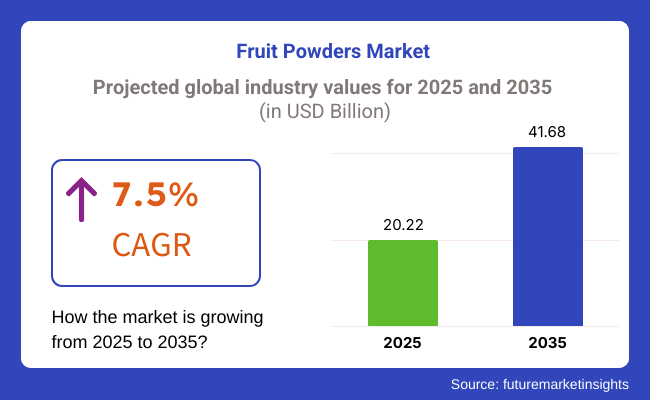
Future Market Insights projects fruit powders market to surge from USD 20.22 billion in 2025 to a colossal USD 41.68 billion by 2035, exhibiting a robust compound annual growth rate (CAGR) of 7.5%. This isn’t just about convenience; it’s a testament to our insatiable demand for “natural” alternatives to synthetic additives. But as a journalist who has meticulously tracked the wellness industry’s every pivot, I have to ask: are we truly embracing a cleaner, healthier future, or are we simply swapping one form of industrial processing for another, all while turning a blind eye to the inconvenient truths embedded in this booming business?
Unveil Market Trends: Get Your Sample Report Now: https://www.futuremarketinsights.com/reports/sample/rep-gb-2505
The Powdered Promise: Convenience Meets “Natural” Appeal
The allure of fruit powders is undeniable. They offer a prolonged shelf life, eliminate spoilage, and provide a convenient way to incorporate fruit goodness into myriad products without the bulk or perishability of fresh produce. This versatility is driving widespread adoption across the food and beverage industry. Future Market Insights explicitly states that increasing consumer demand for “natural, minimally processed ingredients” is a major impact driver, and fruit powders are explicitly “preferred as a natural substitute for synthetic flavoring agents and preservatives in the food and beverage industry.” This is a powerful narrative, tapping directly into the “clean label” ethos that dominates modern consumer preferences.
The market intelligence firm highlights the expansive applications of fruit powders, from functional foods and beverages to dairy products and confectionery. This breadth of use is a clear indicator of their perceived value and adaptability. Whether it’s enriching a breakfast cereal with berry powder or fortifying a snack bar with a tropical fruit blend, the industry sees fruit powders as a crucial component for meeting evolving consumer demands for healthier, more transparent ingredients. It’s a compelling vision, almost too perfect.
Surge in Market Demand: Explore Comprehensive Trends and Analysis in Our Full Report: https://www.futuremarketinsights.com/reports/fruit-powders-market
The Hidden Costs of “Minimally Processed”
Yet, the term “minimally processed” can be a dangerously deceptive one. While fruit powders start with whole fruit, the journey from fresh produce to fine powder is far from a simple, rustic affair. It involves significant industrial processes: washing, slicing, drying, and then grinding. Each step requires energy, specialized equipment, and careful control to maintain nutrient profiles and flavor.
Future Market Insights itself notes that “technological advancements” are crucial for the market’s growth, acknowledging the complex science involved in producing high-quality fruit powders. They discuss the importance of methods like spray-drying, freeze-drying, and vacuum drying techniques to preserve nutritional integrity. This is not inherently bad, but it means that the “natural” fruit in your powder has undergone significant transformation. Are consumers fully aware of the energy consumption and specialized machinery behind that vibrant, seemingly pure powder? Are they asking about the potential for nutrient degradation during these processes, even if some methods are designed to minimize it? I doubt it. The narrative of “natural” often glosses over these industrial realities.
The Sustainability Smokescreen: A Global Footprint
Furthermore, the environmental claims associated with fruit powders, while often valid in principle, demand a deeper, more critical look. The idea of reducing food waste by processing “ugly” or surplus fruit is commendable. The reduced weight and volume for transportation, compared to fresh fruit, can certainly lower carbon emissions. Future Market Insights points to the “rising demand for sustainable products” as a market driver, creating a powerful environmental halo around fruit powders.
However, the sheer scale of a USD 41 billion market by 2035 means colossal volumes of raw fruit are needed. Where are these fruits sourced from? What are the agricultural practices involved in their cultivation? Intensive monoculture farming, even for “natural” ingredients, can lead to soil degradation, extensive water usage, and reliance on agrochemicals. The “green” appeal of a powder can quickly fade if its source material is tied to unsustainable farming practices in distant lands.
Moreover, the processing itself demands resources. While powdering can reduce transportation emissions, the energy required for drying processes can be substantial. Are manufacturers utilizing renewable energy sources? Are they implementing efficient water management in their processing facilities? These are the crucial questions that market reports, focused on growth metrics, often leave unanswered. The “sustainability” argument often feels like a blanket statement, rather than a detailed accounting of environmental impact across the entire value chain.
Beyond the Buzzwords: A Call for Genuine Accountability
The global fruit powders market is a powerful economic force, undeniably reshaping how we consume fruits. Its growth, as meticulously detailed by Future Market Insights, is a testament to clever innovation and keen market responsiveness. But as profits soar and the powders become ubiquitous, the industry has an ethical imperative to move beyond the superficial appeal of “natural” and “minimally processed.”
Consumers, now more than ever, deserve genuine transparency. We need to understand not just the benefits in the shaker, but the entire journey of the fruit, from farm to powder. Is the supply chain truly ethical, ensuring fair labor practices for those who harvest the fruit? Is the processing truly sustainable, minimizing its environmental footprint at every stage? If the fruit powders market is to genuinely embody the values of health, purity, and environmental responsibility that it so readily claims, it must offer more than just impressive growth figures. It must offer the full, unvarnished truth. Demand it.
Key Market Players
- Kanegrade Ltd
- Döhler Group
- Paradise Fruits
- Chaucer Foods Ltd
- Saipro Biotech Pvt Ltd
- Baobab Foods Inc.
- NutraDry
- FutureCeuticals
- Van Drunen Farms
- Milne MicroDried
 Explore Fruits and Vegetables Industry Analysis: https://www.futuremarketinsights.com/industry-analysis/fruits-and-vegetables
Key Segments
By Product Type:
The market is segmented into strawberry, blackberry, black currant, raspberry, blueberry, peach, apple, pear, apricot, and plum, with demand driven by nutritional benefits and flavor preferences.
By Nature:
The market is divided into organic and conventional fruit powders, with organic variants gaining traction due to rising consumer preference for chemical-free and sustainable products.
By End Use:
The fruit powders market is categorized into fruit processing, beverage processing, dietary supplements, pharmaceuticals, and cosmetics and personal care, with increasing applications in functional foods and wellness products.
By Technology:
The market includes freeze-dried, spray-dried, vacuum-dried, and drum-dried fruit powders, with freeze-drying leading due to its superior nutrient retention and premium product applications.
By Region:
The market is segmented into North America, Latin America, Western Europe, Eastern Europe, South




