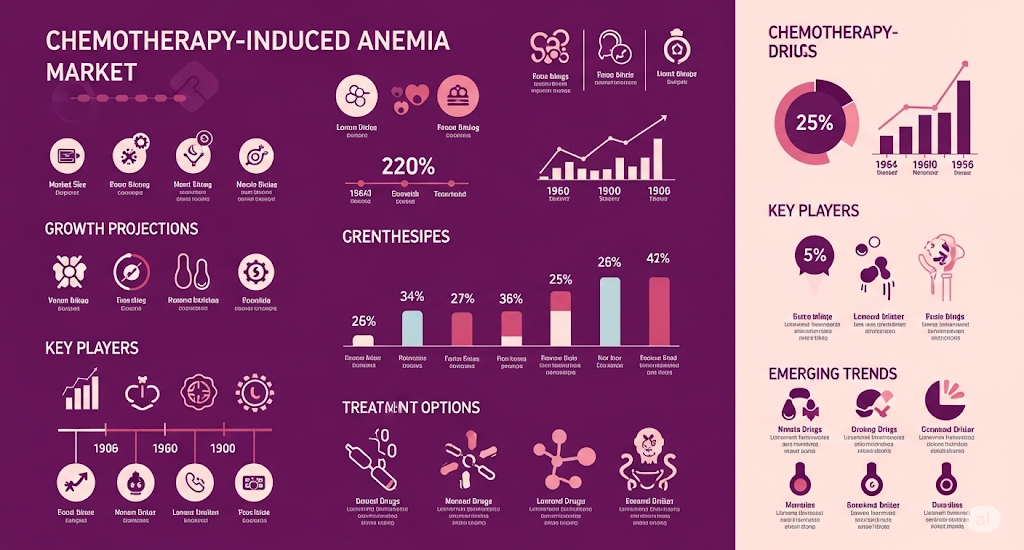
According to Future Market Insights, the Chemotherapy Induced Anemia Market was worth USD 2,771.8 million in 2025. It’s now projected to skyrocket to USD 5,503.7 million by 2035. That’s not just growth—it’s an indictment of modern cancer care.
Anemia isn’t some mild inconvenience. For chemotherapy patients, it’s debilitating. It crushes energy, impairs recovery, and often forces treatment delays. So when the market for “managing” this condition is booming, one has to ask—why are we tolerating this?
Get Sample Report: – https://www.futuremarketinsights.com/reports/sample/rep-gb-1757
The Profitable Side Effect No One Talks About
Let’s be honest: chemotherapy-induced anemia is a direct result of how aggressive and toxic many cancer treatments still are. And instead of working harder to reduce this toxicity, the healthcare industry has learned to monetize the damage.
An entire economy now thrives on a condition that should be shrinking. That should say everything.
From intravenous iron therapies to erythropoiesis-stimulating agents, these interventions don’t come cheap. They also don’t solve the root problem. They manage it. Temporarily. Expensively. And often with risk.

A Market That Reflects Failure, Not Progress
Future Market Insights highlights a 7.1%annual growth rate through 2035, with North America leading the charge.¹ In plain terms: the most advanced healthcare systems are also the most dependent on anemia treatments. That’s not leadership. That’s complacency.
This growth isn’t a sign of innovation. It’s a sign we’re stuck. And patients—fatigued, breathless, and drained—are the ones paying the price.
The fact that there’s even a multibillion-dollar market for something caused by standard care should force serious reflection. But it doesn’t. Instead, we keep scaling it. Marketing it. Normalizing it.
When Healthcare Becomes a Loop
This is the quiet tragedy of modern oncology: patients go in for treatment, get sicker from the treatment, and then need another set of treatments to cope. It’s a closed loop. Profitable, yes—but profoundly broken.
Instead, the conversation is focused on dosage adjustments, supportive therapies, and “managing” fatigue—as if anemia is inevitable. It isn’t. At least not always. But the current model doesn’t incentivize prevention. It monetizes exhaustion.
Enough Excuses. Fix the Problem.
The chemotherapy-induced anemia market should be shrinking. It’s not. And that’s unacceptable.
Until we begin measuring success by how few patients need these interventions—not how many—we’re failing. Until hospitals and drugmakers prioritize prevention over prescription, we’re lying to ourselves.
Explore In-Depth Analysis-Click Here to Access the Report:- https://www.futuremarketinsights.com/reports/chemotherapy-induced-anemia-market
Key Segmentation
By Range of Anemia:
- Mild Anemia
- Moderate Anemia
- Severe Anemia
- Life-Threatening Anemia
By Treatment Type:
- RBC Transfusion
- Erythropoiesis-stimulating agents (ESAs)
- Iron Supplementation
By Drug Type:
- Epogen Injection
- Procrit Injection
- Androxy Oral
- Aranesp Injection
- Epoetin Alfa Injection
- Others
By End User:
- Hospitals
- Specialty Clinics
- Ambulatory Surgical Centers
- others
By Region:
- North America
- Latin America
- Europe
- East Asia
- South Asia
- Oceania
- The Middle East and Africa (MEA)