

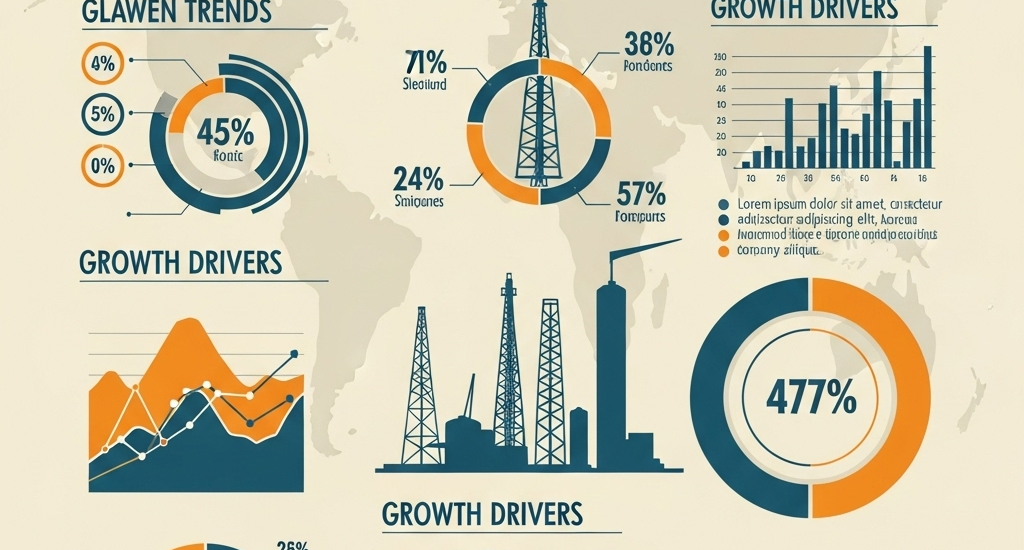
The North and Central America Proppant Market is estimated to reach USD 1.6 billion by 2025. From 2025 to 2035, the market is expected to grow at a CAGR of 13.6%, surpassing USD 5.7 billion in sales by 2035.
In the complex world of energy production, it’s not the rigs, pipelines, or refineries that define success at the source—it’s what happens deep underground. At the heart of hydraulic fracturing, a process that has revolutionized oil and gas extraction, lies a granular yet critical material: proppant. And in North and Central America, where shale reserves stretch across vast terrains, the proppant market plays a foundational role in sustaining energy output.
Often overlooked in broader energy debates, proppants—mainly sand, resin-coated grains, or ceramic materials—are essential to unlocking hydrocarbons from deep within the earth. They keep fractures open under extreme pressure, enabling the steady flow of oil and gas to the surface. Quietly but powerfully, the proppant market continues to underpin regional energy resilience and output.
Get Ahead with Our Report: Request Your Sample Now!
https://www.futuremarketinsights.com/reports/sample/rep-sa-455
Beyond Fracturing: The Enabler of Subsurface Efficiency
Hydraulic fracturing wouldn’t work without proppants. Once high-pressure fluid creates cracks in the shale rock, proppants are injected to hold those fractures open. Their role is deceptively simple but technically vital: maintain permeability under intense pressure and temperature, allowing resources to flow freely.
In North and Central America, where unconventional oil and gas plays like the Permian Basin, Eagle Ford, and Vaca Muerta are critical to energy supply, proppants directly influence well productivity. The type, size, and strength of the proppant used can significantly affect both output and operational cost.
Overshadowed by Infrastructure, Essential to Production
While drilling rigs and extraction technology get most of the industry spotlight, the success of each well often depends on what’s beneath the surface. Proppants don’t make headlines, yet they are one of the highest-volume materials used in the hydraulic fracturing process.
They’re also logistically complex—requiring careful transport, storage, and handling in remote or rugged terrains. From local sourcing of natural sand to specialized coatings that resist crushing, every innovation in proppant technology is an incremental gain in yield and sustainability.

Real-Time Optimization in a Cost-Driven Industry
Operators across North and Central America are constantly seeking ways to optimize output while lowering environmental and financial costs. Proppants are at the center of this balance. Data-driven approaches now allow companies to model proppant placement, monitor fracture behavior, and adjust material use in real time.
Advanced analytics help determine whether to use high-strength ceramics in deeper wells or blend local sand for more cost-efficient operations. This level of precision drives smarter resource utilization and enhances long-term well integrity.
A New Era of Materials Innovation and Sustainability
Environmental scrutiny is reshaping the future of the proppant market. Companies are exploring biodegradable coatings, dust-suppression technologies, and logistics optimizations to reduce the environmental footprint of fracking operations.
In addition, innovation in manufacturing and refining processes is producing lighter, stronger, and more chemically resistant proppants—tailored to perform under increasingly challenging subsurface conditions. As demand shifts toward more sustainable energy practices, proppants are adapting to meet both performance and regulatory expectations.
Exhaustive Market Report: A Complete Study
https://www.futuremarketinsights.com/reports/proppant-market
Tied to Energy Security, Regional Supply Chains, and Operational Strategy
The strategic importance of proppants extends beyond the wellhead. Regional sourcing reduces transportation costs, supports local economies, and enhances supply chain resilience. In an industry where margins are tight and operations are sprawling, proximity to proppant reserves becomes a competitive advantage.
Moreover, with geopolitical shifts and energy independence goals shaping national policies, the ability to maintain steady and efficient domestic production hinges in part on the availability and quality of proppant materials.
The Unsung Foundation of Unconventional Energy
The North and Central America proppant market may not command public attention, but it quietly supports a critical segment of the region’s energy portfolio. From shale gas to tight oil, every barrel and cubic foot extracted owes its journey to a grain of engineered sand lodged deep underground.
Ignore its importance, and the energy supply chain becomes brittle and less efficient. Embrace it, and proppants become a lever for maximizing output, minimizing waste, and advancing toward a smarter, more sustainable form of resource extraction.
In the race to meet energy demand while managing costs and environmental impact, the proppant remains a humble but high-impact player—holding open the fractures through which opportunity flows.




