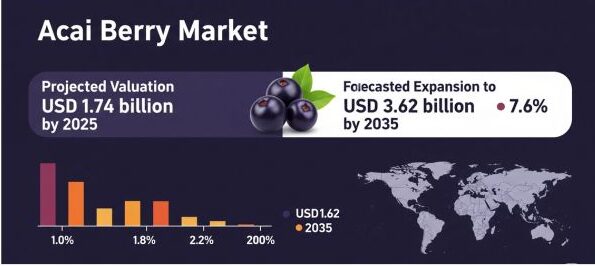
The world can’t seem to get enough of acai. Once a forager’s fruit deep in the Amazon, it’s now the darling of smoothie bowls, diet supplements, and anti-aging serums across five continents. The global obsession is driving unprecedented market growth—and a brewing ethical crisis.
According to Future Market Insights, the acai berry market is projected to skyrocket from $1.4 billion in 2023 to over $3 billion by 2033. That’s more than double in just ten years. The demand isn’t slowing, and brands are racing to cash in. But behind the purple sheen of this so-called “superfruit,” the facts are messier—and far more uncomfortable.
Gain Valuable Market Knowledge: Request a Sample Report: https://www.futuremarketinsights.com/reports/sample/rep-gb-1207
A Superfood With Superficial Science
Let’s call it what it is: acai’s reputation is mostly marketing. Touted as an antioxidant powerhouse and immune booster, it’s been folded into everything from skincare creams to high-performance nutrition bars. But for all the hype, real, clinical evidence is still thin. Consumers are buying into a health halo—often without understanding how little scientific consensus actually supports the claims.
Still, the branding works. And why wouldn’t it? Acai sells a lifestyle: natural, clean, pure, exotic. It hits every buzzword. And in a wellness industry that thrives on perception, that’s more than enough to drive billions.
Growing Need for Market Insights: Access Our Full Report for Thorough Analysis and Trends: https://www.futuremarketinsights.com/reports/acai-berry-market
The Invisible Supply Chain
As global demand rises, so does the strain on sourcing. The fruit grows deep in the Amazon rainforest, often harvested by hand. It spoils quickly. Transporting it from remote riverside communities to global processing facilities is a logistical feat—and a delicate one at that.
Future Market Insights highlights the rise of frozen pulp, powders, and extracts as key formats driving global expansion. But what’s not said nearly enough is this: every layer of processing distances the consumer further from the source. With that distance comes opacity. How was it harvested? Who grew it? What ecosystems were disrupted? Nobody’s asking—and nobody’s telling.
From Forest to Formula: At What Cost?
The growth sounds good on paper. But in practice, that growth puts pressure on fragile ecosystems. The rising demand for acai could tip the balance in already vulnerable regions of the Amazon. Palm monocultures threaten biodiversity. Short-term profits can incentivize long-term ecological damage.
And we’re not just talking about trees. People live there. Local communities, often Indigenous, depend on those lands. When an ingredient gets hot enough to go global, it often pushes out the very people who sustained it for generations.
The Ethical Mirage of “Natural”
“Natural” is not the same as “ethical.” “Plant-based” is not a stand-in for “sustainable.” And “clean” doesn’t guarantee safety, fairness, or ecological responsibility.
The acai boom is a case study in how quickly wellness trends can morph into commercial gold—and how little scrutiny follows. What’s labeled “natural” in a grocery store might be the product of overharvested lands, underpaid labor, and long, untraceable supply chains.
The Future: Transparent or Tumultuous?
According to FMI, the market is expanding fast in North America, Europe, and parts of Asia. Acai is no longer niche—it’s mainstream. And yet, the infrastructure around its production remains thin, inconsistent, and largely unregulated.
If the industry continues on its current trajectory—volume over values, growth over guardrails—the acai market may grow in size, but shrink in credibility.
The Bottom Line
Acai is big business. But with that growth comes responsibility. The industry—and the consumers who fuel it—must ask tougher questions. Where is this fruit coming from? Who’s benefiting? Who’s losing?
The acai berry might be good for your smoothie. But is it good for the world that produces it?
If the answer isn’t clear, maybe it’s time we stop calling it “clean.”
Leading Manufacturers
- The Berry Company Limited
- Amafruits
- NacttiveGlobalA
- Terrasoul Superfoods
- Acai of America Inc.
- Ecuadorian Rainforest, LLC
- Navitas Organics
- KOS BareOrganics®
- PITAYA FOODS
- Mountain Rose Herbs
- Acai Roots, Inc
- Acai Frooty
- Acai Exotic LLC
- Açaí Express
- Sunfood Superfoods
- Naked Juice Company
- New Acai Amazonas
- Nativo Aca
- The Açaí Lab
- Organique Acai
 Explore Fruits and Vegetables Industry Analysis: https://www.futuremarketinsights.com/industry-analysis/fruits-and-vegetables
Key Segments of the Report
By Form:
As per Form, the industry has been categorized Raw and Processed (Frozen, Powder, Juice and Pulp and Purees)
By Application:
As per the Application, the industry is Food & Beverages (Bakery, Confectionery, Infant formula, Snacks, Desserts, Juices and Nectars, Squash and Smoothies) Dietary Supplements, Cosmetics & Personal Care and Pharmaceuticals
By Claims:
Organic, Non-GMO, Gluten-Free, Dairy free Nut free are key claims selling the products
By Region:
Industry analysis has been carried out in key countries of the regions such as North America, Latin America, Europe, East Asia, South Asia, Oceania, and the Middle East & Africa.