

While the world obsesses over solar panels and flashy green tech, Europe is quietly building something even more essential: the skeleton that holds the solar revolution together. Photovoltaic (PV) mounting systems—those unglamorous steel and aluminum frames—are now at the center of Europe’s push to decarbonize. Ignore them, and the entire solar dream collapses.
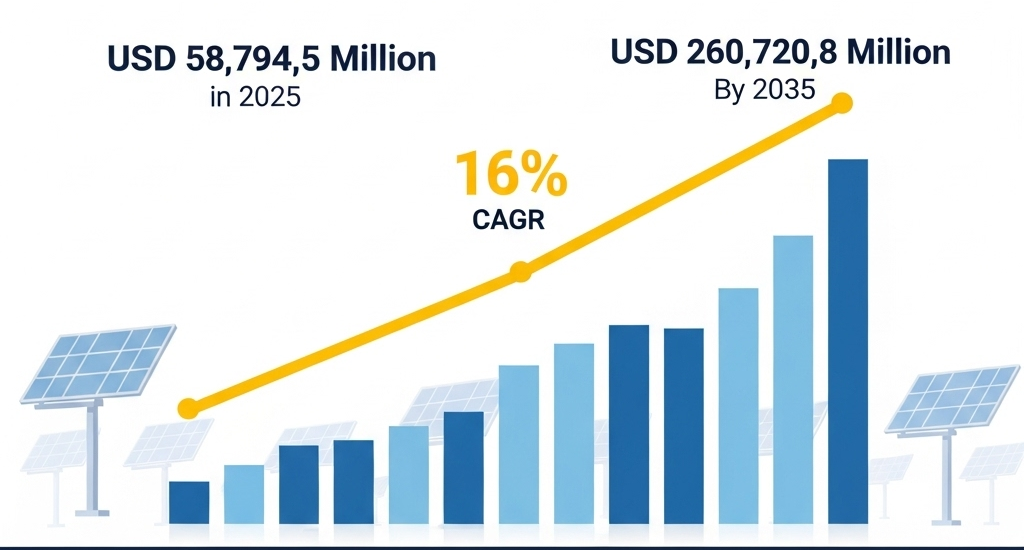
The market for photovoltaic mounting systems in Europe is expanding quickly because to encouraging government regulations and the quick uptake of renewable energy. Mounting systems are becoming more and more important as the structural foundation of solar installations, enhancing energy production, installation effectiveness, and system longevity. The market is anticipated to grow at a compound annual growth rate (CAGR) of 16% from USD 58,794.5 million in 2025 to USD 260,720.8 million by 2035.
The demand isn’t slowing down. Cities are blanketing rooftops in panels. Rural landscapes are turning into energy farms. Warehouse owners are scrambling to turn idle space into electricity. And every single one of these projects depends on one thing: a mounting system strong enough to hold the line against wind, rain, and time.
Drive Business Expansion: Gain Valuable Insights into Market Potential with Our In-Depth Market Analysis – Request a Sample Now: https://www.futuremarketinsights.com/reports/sample/rep-gb-17286
But here’s the thing no one wants to talk about: the backbone is under stress.
First, the bureaucracy is maddening. Europe’s clean energy future is being strangled by red tape. Permitting processes vary from country to country, region to region—slowing installations and sending costs soaring. For a continent that claims to lead the green transition, its inability to streamline regulation is frankly embarrassing.
Second, the supply chain is fragile. Most of the materials used—like precision-grade aluminum and galvanized steel—are sourced from outside Europe. That’s a risk. One disruption, one geopolitical hiccup, and the whole operation can grind to a halt.
Third, there simply aren’t enough trained professionals to meet demand. We’re staring down a shortage of engineers, certified installers, and structural experts. It’s a skills crisis—one that could stall projects and inflate prices just as momentum builds.
Still, there’s reason for optimism. Future Market Insights points to an industry pivoting fast. Lightweight, pre-fabricated mounting systems are gaining ground—faster to install, cheaper to transport, and easier to deploy on aging buildings. These aren’t pipe dreams; they’re already shaping project decisions in dense cities and coastal zones.
Another bright spot? Agrivoltaics. Mounting systems designed to share land with crops and livestock are emerging as a win-win. They maximize land use and generate clean power. That’s the kind of innovation Europe desperately needs more of.
Latest Automation Auxiliary Reports: https://www.futuremarketinsights.com/industry-analysis/automation-auxiliary
But let’s not sugarcoat this: ambition alone won’t get Europe to net-zero. Without serious investments in workforce training, manufacturing capacity, and regulatory reform, the solar surge could stall at the worst possible moment.
Photovoltaic mounting systems may not make headlines—but they should. They are the unsung heroes of the energy transition. And unless Europe fixes its weak spots, that backbone could break under its own success.




